Ordinary Language Philosophy
🗂️ Interactive Notebook: Open Study Companion (Video Summary, Flashcards, Mind Map) ↗
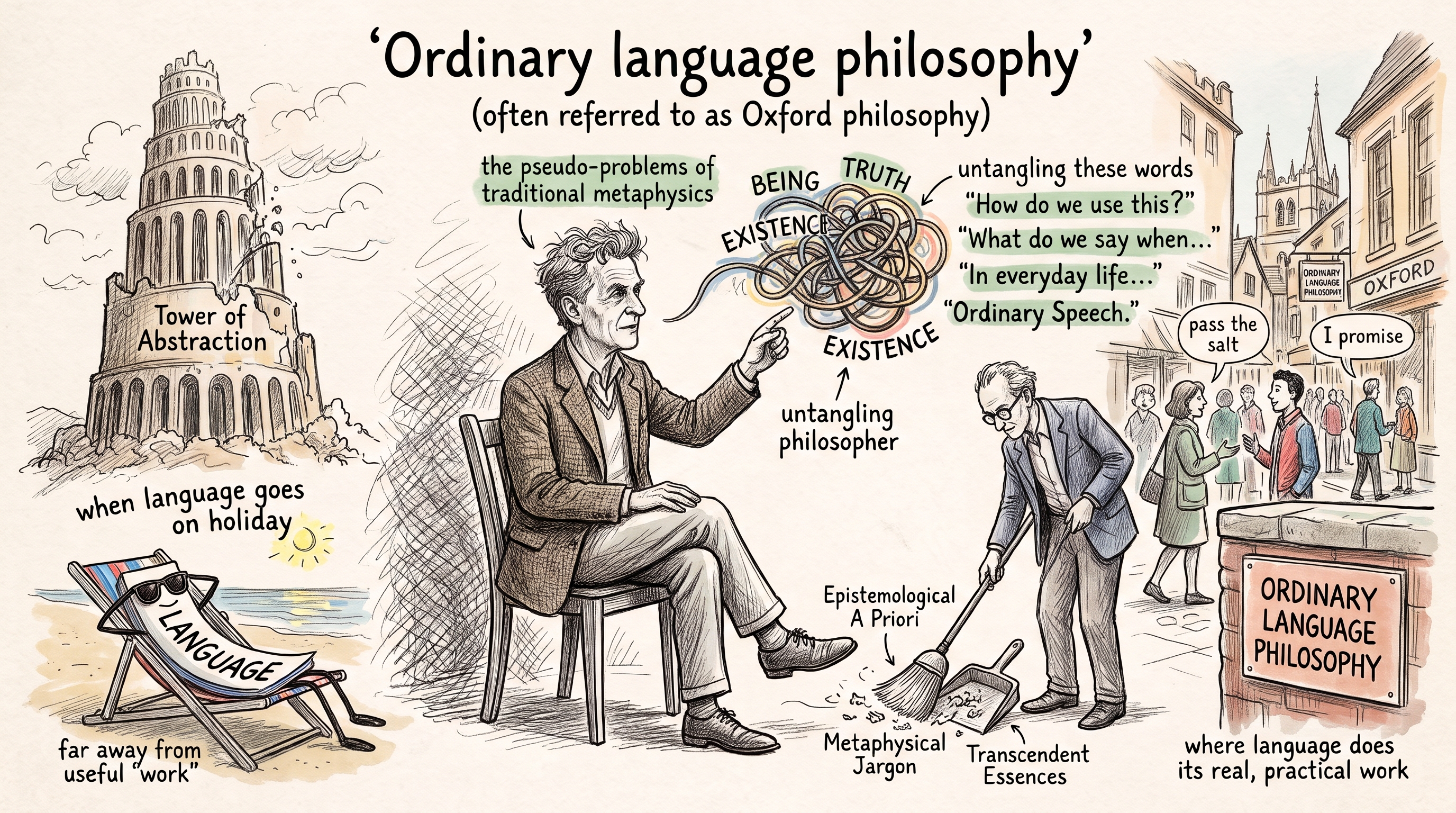
Ordinary language philosophy (often referred to as Oxford philosophy or linguistic philosophy) is a prominent mid-twentieth-century movement within analytic philosophy. It contends that traditional metaphysical and epistemological dilemmas are largely pseudo-problems rooted in the distortion and abstracted misapplication of everyday words ("when language goes on holiday"). Rather than constructing formal, symbolic languages to resolve philosophical puzzles, ordinary language philosophers argue that philosophy should function therapeutically—carefully mapping the ordinary uses, practical nuances, and pragmatic rules of natural language to dissolve conceptual knots.[1][2]
Historical Development and Context
Ordinary language philosophy flourished between the 1930s and 1960s, centered primarily at the University of Oxford and the University of Cambridge, as a direct corrective against Idealism, Logical Positivism, and Ideal Language Philosophy.[1:1]
The Break from Ideal Language Philosophy
Early figures of the analytic tradition—most notably Gottlob Frege, Bertrand Russell, the early Ludwig Wittgenstein, and the logical positivists of the Vienna Circle—viewed natural language as vague, logically flawed, and inherently treacherous.[3] Early ideal language philosophy harbored an epistemological blind spot regarding the rich communicative functionality of everyday speech, assuming that because natural discourse lacks the formal rigidity of mathematical logic, surface grammar must conceal and distort true logical structure.[3:1]
By the 1930s, however, Ludwig Wittgenstein radically rejected his earlier logical atomism formulated in the Tractatus Logico-Philosophicus, concluding that everyday language is not a defective formal calculus, but an organic human institution that is already in complete order as practiced.[4] Wittgenstein recognized that the operational rules and grammar of human forms of life are not occult essences buried beneath phenomenal appearances; rather, they operate continuously in plain sight.[4:1] Simultaneously at Oxford, thinkers including Gilbert Ryle and J. L. Austin pioneered a method of forensic linguistic analysis, treating natural English as an intricate repository of distinctions refined across centuries of shared human experience.[5]
| Dimension | Ideal Language Philosophy (Frege, Russell, Early Wittgenstein, Positivism) | Ordinary Language Philosophy (Later Wittgenstein, Ryle, Austin, Strawson) |
|---|---|---|
| View of Natural Language | Vague, misleading, ambiguous, and logically defective | Functionally rich, complete, and refined through collective social practice |
| Philosophical Method | Formalization into symbolic logic; exposing hidden "logical form" | Conceptual analysis, speech-act classification, and linguistic phenomenology |
| Primary Goal | Solving problems via formal theory construction and scientific precision | Dissolving pseudo-problems through therapeutic description of linguistic use |
| Theory of Meaning | Referential / Truth-conditional (propositions mirror states of affairs) | Pragmatic / Use-based (meaning is determined by practical rule-governed use) |
| Status of Metaphysics | Demolished as meaningless nonsense via empirical verification criteria | Dissolved as category mistakes, boundary errors, and grammatical bewitchment |
| Institutional Centers | Cambridge, Vienna, Berlin | Oxford (Ryle, Austin, Strawson) and Cambridge (Later Wittgenstein) |
Core Methodological Principles
- Meaning as Use: Rejecting the referential dogma that words function solely as passive labels for physical objects or private mental representations, ordinary language philosophy maintains that the meaning of an expression is constituted by its rule-governed function within a concrete community.[4:2] Meaningful communication does not require transcendental metaphysics or symbolic formalization; it is anchored in the shared biological attunements and socio-cultural practices that Wittgenstein termed "forms of life," establishing the normative common ground necessary for mutual intelligibility.[4:3]
- Philosophical Therapy and Dissolution: The purpose of philosophy is not to erect speculative metaphysical systems, but to practice conceptual therapy—unraveling the artificial knots that arise when thinkers rip vocabulary away from its native communicative context.[4:4] Divorced from the friction of concrete everyday life, baroque metaphysical theories become an intellectual house of cards, collapsing the instant standard communicative criteria and real-world contrasts are reapplied.[2:1]
- Rejection of Revisionism & Grammatical Snares: Standard conversational usage provides the baseline criterion for sense. Wittgenstein warned that philosophers perpetually fall into the trap of surface grammar, reflexively presuming that every substantive noun (such as time, mind, or truth) must denote an occult physical or mental substance.[4:5] When speculative thinkers re-engineer terms like know, see, cause, free, or real to demand impossible certainties, they produce linguistic illusions rather than profound insights.[2:2]
- Linguistic Phenomenology: Formulated by J. L. Austin, this technique examines the micro-distinctions between closely allied expressions (such as doing an act "by accident" versus "by mistake") to calibrate human awareness against the real-world situations those words delineate.[5:1]
"For a large class of cases—though not for all—in which we employ the word 'meaning' it can be defined thus: the meaning of a word is its use in the language."[4:6]
Key Figures and Contributions
Ludwig Wittgenstein (Later Period)
Working at Cambridge, Wittgenstein established the movement's foundational epistemology in his posthumously published Philosophical Investigations (1953).[4:7]
- Language-Games (Sprachspiele): Wittgenstein argued that language is not a uniform mechanism for asserting propositions, but a dynamic assemblage of human activities woven into a "form of life" (Lebensform).[4:8] Words take on entirely different functions depending on the context—whether giving orders, cracking jokes, praying, or reporting facts.[4:9]
- Family Resemblance (Familienähnlichkeit): Challenging essentialist assumptions that every category must possess an invariant core definition, Wittgenstein demonstrated that concepts like game, number, or art are united by overlapping networks of traits, analogous to shared familial features.[4:10]
- Private Language Argument: Proved that an exclusively private language referring solely to inner sensations without public criteria is impossible, establishing that meaning and rule-following are inherently social activities.
Gilbert Ryle
As Waynflete Professor of Metaphysical Philosophy at Oxford and editor of Mind, Ryle dismantled Cartesian internalism using rigorous conceptual mapping.[6]
- Category Mistakes & The Ghost in the Machine: In The Concept of Mind (1949), Ryle demonstrated that traditional mind-body dualism rests on a fundamental category mistake—treating the mind as an occult, non-physical organ functioning parallel to the mechanical body.[6:1] Theorists searching for an immaterial mind piloting the physical organism are fundamentally barking up the wrong tree; mental attributes describe behavioral dispositions, capacities, and overt skills rather than ghostly transactions inside a private mental theater (see Ghost in the Machine, The Mind-Body Dichotomy, Deconstruction of the Central Controller, and Philosophy of Mind).[6:2]
- Knowing-How vs. Knowing-That: Distinguished between propositional knowledge (knowing-that) and practical competence (knowing-how), refuting the "Intellectualist Legend" that skillful execution requires prior internal contemplation of theoretical rules.
J. L. Austin
Austin instituted the famous Saturday Morning Meetings at Oxford, transforming natural language examination into a rigorous linguistic science.[5:2]
- Speech Act Theory: In How to Do Things with Words (1962), Austin challenged the philosophical dogma that all declarative sentences merely assert facts (constatives).[7] Austin precisely draws the line between constatives and performative utterances—expressions that execute an action by the very act of speaking under established social conventions (e.g., "I apologize", "I bet", "I name this ship").[7:1]
- Threefold Division of Speech Acts: Austin categorized verbal utterances into three simultaneous dimensions:[7:2]
- Locutionary act: The literal acoustic and semantic emission of words with definite sense and reference.
- Illocutionary act: The social force enacted by the utterance (warning, commanding, promising, welcoming).
- Perlocutionary act: The actual psychological or behavioral consequence produced in the listener (persuading, alarming, convincing).
- Critique of Sense-Data (Sense and Sensibilia): Austin dismantled empiricist theories of perception, demonstrating that sense-datum epistemologists have painted themselves into a corner; by artificially manipulating terms like illusion, delusion, and appears, they construct an insurmountable skeptical wall that isolates consciousness from the external world.[5:3]
P. F. Strawson
Strawson synthesized ordinary language analysis with systematic metaphysical description, re-anchoring formal logic within human linguistic practice.[8]
- Refutation of Russell's Theory of Descriptions: In "On Referring" (1950), Strawson criticized Bertrand Russell's formal analysis of non-referring definite descriptions (e.g., "The present King of France is bald"). Strawson distinguished between a sentence, its use, and its utterance, demonstrating that when a statement's existential presupposition fails, the sentence is not false; rather, the assertion fails to arise, producing a truth-value gap.[8:1]
- Descriptive Metaphysics: In Individuals (1959), Strawson demarcated revisionary metaphysics (which attempts to construct an alternative conceptual reality) from descriptive metaphysics, which maps the invariant conceptual structures through which human beings make sense of space, time, material bodies, and persons.[8:2]
- G. E. Moore: Precursor who defended common sense against philosophical skepticism, asserting that ordinary perceptual certainties (e.g., "Here is one hand") are far more certain than abstract philosophical premises.[1:2]
- Norman Malcolm & Alice Ambrose: Influential students of Wittgenstein who propagated ordinary language methodology throughout North American universities.[1:3]
- H. P. Grice: Oxford philosopher whose formulation of the Cooperative Principle and conversational implicature bridged ordinary language analysis with modern formal pragmatics.[9]
Major Philosophical Applications
Dissolving Epistemological Skepticism
Radical epistemological skeptics argue that because sensory illusion or dreaming is theoretically conceivable, human beings can never legitimately claim to know anything about the external world. Ordinary language philosophers counter that the epistemic verb to know derives its communicative validity strictly from practical contrasts with recognizable instances of doubt, conjecture, or error.[5:4]
When a skeptic demands infallible, absolute proof before conceding that someone "knows" there is a tree outside the window, they have not unearthed a tragic human limitation. Rather, they have performed an epistemic sleight of hand, stripping the verb of its grammatical rules and contrastive communicative utility to invent a pseudo-problem through linguistic inflation.[2:3]
Deconstructing the Problem of Other Minds
Traditional epistemology asks how an isolated subject can ever logically infer the existence of another person's inner consciousness from external physical movements alone. Drawing on Wittgenstein and Ryle, ordinary language philosophy demonstrates that criteria for emotional and mental states are fundamentally tied to public contexts and visible human interactions (a principle closely analyzed in Theory of Mind - The Cognitive Architecture of Social Intelligence and Constructs of the Mind-Unmasking Consciousness in East and West).[4:11]
We do not observe a physical spasm and calculate a probability hypothesis about an invisible inner theater; in ordinary language and life, an individual wincing, crying out, and clutching an injury is the criteria for pain, dissolving the skeptical chasm between outer bodily behavior and inner experience.[6:3]
Criticisms and Decline
By the late 1960s and 1970s, ordinary language philosophy receded from its preeminent standing across Anglo-American faculties under pressure from several decisive critiques:
- Gricean Pragmatics and the Semantics/Pragmatics Boundary: In his William James Lectures (1967), H. P. Grice proved that many conversational oddities identified by Oxford philosophers were not semantic violations of meaning, but breaches of communicative maxims (conversational implicature).[9:1] Declaring "I know that I have hands" while looking at them sounds bizarre not because it violates the meaning of know, but because stating the obvious breaches the pragmatic maxim of quantity (being adequately informative).[9:2]
- Ernest Gellner's Sociological Indictment: In Words and Things (1959), sociologist and philosopher Ernest Gellner attacked Oxford philosophy as an insular, conservative academic subculture, alleging that sanctifying the conversational idioms of mid-century British academics effectively insulated inherited prejudices and institutions from critical philosophical critique.[1:4]
- The Rise of Generative Linguistics and Formal Semantics: Noam Chomsky's revolution in generative grammar, W. V. O. Quine's naturalist epistemology, and Saul Kripke's modal semantics demonstrated that rigorous formal modeling and empirical cognitive science could illuminate deep structures of language and reference that informal descriptive reflections could not access.[3:2]
While ordinary language philosophy no longer dominates academic departments as a self-contained school, its insights remain permanently embedded across contemporary philosophy and linguistics. It gave birth to speech act theory, pragmatics, and modern philosophy of action; inspired naturalistic models of language in applied linguistics (such as The Lexical Approach by Michael Lewis, Collocations, and Michael Hoey's Lexical Priming - A New Theory of Words and Language); and instilled an enduring methodological requirement that philosophical theories must answer to how concepts actually operate within human communicative life.[7:3]
Resonant Notes
The following notes in the vault share direct thematic, linguistic, and philosophical connections with Ordinary Language Philosophy:
🟣 Core Lexical Syllabus & Applied Metaphoric Expressions
- unravel (Weaving, Textiles & The Loom) — Metaphoric cognitive picture capturing ordinary language philosophy's therapeutic mission: unraveling the artificial conceptual knots, category mistakes, and speculative dilemmas woven by metaphysical language when divorced from everyday use.
- in-plain-sight (Light & Vision) — Captures Wittgenstein's fundamental insight that the most important aspects of language are hidden because of their simplicity and familiarity, operating in plain sight across everyday communicative forms of life.
- blind-spot (Light & Vision) — Diagnoses the pervasive epistemic blind spot of traditional metaphysics and logical atomism, which obsessively constructed idealized formal calculi while remaining oblivious to the nuanced pragmatic grammar of natural language.
- sleight-of-hand (Magic & The Supernatural) — Illustrates how speculative metaphysicians and epistemological skeptics execute an intellectual sleight of hand by covertly shifting ordinary epistemic words (know, certain, real) into impossible, absolute standards.
- fall-into-a-trap (Hunting, Tracking & Trapping) — Embodies Wittgenstein's famous struggle against the bewitchment of intelligence by language, showing how philosophers fall into the trap of surface grammar by assuming that every substantive noun must denote an occult physical or mental entity.
- barking-up-the-wrong-tree (Hunting, Tracking & Trapping) — Epitomizes Gilbert Ryle's diagnosis of the Cartesian category mistake: theorists hunting for a spectral "ghost in the machine" operating parallel to the mechanical body are barking up the wrong tree, seeking an invisible substance where there are observable behavioral dispositions and skills.
- paint-oneself-into-a-corner (Color & Art) — Represents radical epistemological skepticism and sense-datum theory, wherein philosophers paint themselves into a corner by demanding impossible criteria for knowledge, severing the mind from the external world.
- draw-the-line (Color & Art) — Articulates J. L. Austin's forensic linguistic phenomenology, drawing the line between constative descriptions and performative deeds, as well as discerning fine boundaries between acting by accident versus by mistake.
- common-ground (Geography & Landscapes) — Grounds language-games in shared forms of life (Lebensformen) and public communicative conventions, establishing the normative common ground of natural language that enables mutual intelligibility without metaphysical guarantees.
- a-house-of-cards (Buildings & Structures) — Illustrates how towering philosophical systems, Cartesian foundationalism, and skeptical paradoxes represent an intellectual house of cards: resting on unexamined linguistic distortions, they collapse the instant ordinary communicative criteria are restored.
🔴 Linguistic Turn, Analytic Philosophy & Category Mistakes
- Analytic Philosophy — Situates ordinary language philosophy within the broader twentieth-century linguistic turn, detailing its emergence alongside logical positivism, formal logic, and the philosophy of science.
- Gilbert Ryle's-The Concept of Mind — The central Oxford manifesto of ordinary language methodology, dismantling the Cartesian "ghost in the machine" through the forensic diagnosis of category mistakes.
- Ghost in the Machine — Focuses specifically on Ryle's critique of Cartesian mind-body dualism and its evolution into cognitive systems theory, artificial intelligence, and contemporary philosophy of mind.
- Ludwig Wittgenstein — Traces Wittgenstein's philosophical transition from the formal logical atomism of the Tractatus to the pragmatic, use-based framework of language-games and family resemblance in Philosophical Investigations.
- The Mind-Body Dichotomy — Comprehensive architectural survey contrasting Cartesian substance dualism with ordinary language dissolution and embodied cognitive models.
- Deconstruction of the Central Controller — Cognitive neuroscience's empirical vindication of Ryle's category mistake, demonstrating how brain modularity and active inference dismantle the homunculus and Cartesian theater.
- David Hume's Bundle Theory (1739) — 18th-century empirical precursor to ordinary language philosophy, showing that introspection uncovers no unitary subject behind fleeting perceptions, dissolving the metaphysical ego.
- Philosophy of Mind — Modern cognitive and philosophical critiques of the Cartesian theater and internal spectator, utilizing Rylean and functionalist models of cognitive architecture.
🟡 Pragmatics, Sociolinguistics & Phenomenological Inquiries
- Theory of Mind - The Cognitive Architecture of Social Intelligence — Examines the evolutionary cognitive architecture behind mentalizing and intentionality, aligning with Austin's and Ryle's emphasis on public behavioral criteria over telepathic introspection.
- Perception vs. Apperception — Traces how sensory data is converted into conscious awareness, directly engaging Austin's forensic linguistic critique of sense-datum epistemologies.
- Alfred Schütz (1899–1959) — Phenomenological sociology of the lifeworld (Lebenswelt) and typified social interaction, providing a continental sociological parallel to Wittgensteinian "forms of life" and everyday communicative routines.
- The Social Construction of Reality - A Treatise in the Sociology of Knowledge — Berger and Luckmann's landmark sociological treatise showing how institutional order and shared typifications are constructed through everyday conversational interaction.
- The Freeze-Drying of Language — The Dictionary (1755), Prescriptive Grammar, and the Social Stratification of Speech — Historical analysis of linguistic codification, contrasting prescriptive lexicographical ossification with ordinary language philosophy's defense of living, evolving vernacular usage.
- Jürgen Habermas's The Structural Transformation of the Public Sphere — Connects ordinary language communication and speech act theory with Habermas's later theory of communicative action and rational public discourse.
- Continental Philosophy — Highlights the contrasting methodology of 20th-century European thought (existentialism, phenomenology, critical theory) with Oxford conceptual analysis and linguistic deflation.
- Jacques Derrida — Explores deconstruction's celebrated critique of J. L. Austin's speech act theory regarding performativity, iterability, and communicative context.
🟢 Applied Linguistics, Lexical Priming & Natural Grammar
- The Lexical Approach by Michael Lewis — Direct application of linguistic analysis to pedagogy, treating language as grammaticalized lexis and multi-word chunks rather than abstract generative rule sets.
- Collocations — The primary operational unit of the Lexical Approach; demonstrates how everyday fluency relies on prefabricated lexical chunks and customary usage patterns rather than formalistic grammar algorithms.
- Lexical Priming - A New Theory of Words and Language — Corpus linguistics framework showing that words are primed through authentic social usage, mirroring Wittgenstein's dictum that meaning is determined by practical contextual use.
- Scott Thornbury's Teaching Unplugged (Dogme ELT) — Conversation-driven ELT pedagogy that liberates language learning from textbook formalisms, prioritizing emergent natural grammar directly grounded in learners' communicative lifeworlds.
- Portmanteau (also known as a lexical blend or blend word) — Linguistic analysis of how morphological blending and lexical innovation operate through evolving language-games and colloquial adaptation.
References
Avrum Stroll / Twentieth-Century Analytic Philosophy / cup.columbia.edu ↩︎ ↩︎ ↩︎ ↩︎ ↩︎
Oswald Hanfling / Philosophy and Ordinary Language: The Bent and Genius of Our Tongue / routledge.com ↩︎ ↩︎ ↩︎ ↩︎
Scott Soames / Philosophical Analysis in the Twentieth Century, Volume 2: The Age of Meaning / press.princeton.edu ↩︎ ↩︎ ↩︎
Anat Biletzki and Anat Matar / Ludwig Wittgenstein (Stanford Encyclopedia of Philosophy) / plato.stanford.edu ↩︎ ↩︎ ↩︎ ↩︎ ↩︎ ↩︎ ↩︎ ↩︎ ↩︎ ↩︎ ↩︎ ↩︎
Guy Longworth / John Langshaw Austin (Stanford Encyclopedia of Philosophy) / plato.stanford.edu ↩︎ ↩︎ ↩︎ ↩︎ ↩︎
Julia Tanney / Gilbert Ryle (Stanford Encyclopedia of Philosophy) / plato.stanford.edu ↩︎ ↩︎ ↩︎ ↩︎
Mitchell Green / Speech Acts (Stanford Encyclopedia of Philosophy) / plato.stanford.edu ↩︎ ↩︎ ↩︎ ↩︎
Paul Snowdon / Peter Frederick Strawson (Stanford Encyclopedia of Philosophy) / plato.stanford.edu ↩︎ ↩︎ ↩︎
Wayne Davis / Implicature (Stanford Encyclopedia of Philosophy) / plato.stanford.edu ↩︎ ↩︎ ↩︎