Georg Simmel's concept of The Stranger
🗂️ Interactive Notebook: Open Study Companion (Video Summary, Flashcards, Mind Map) ↗
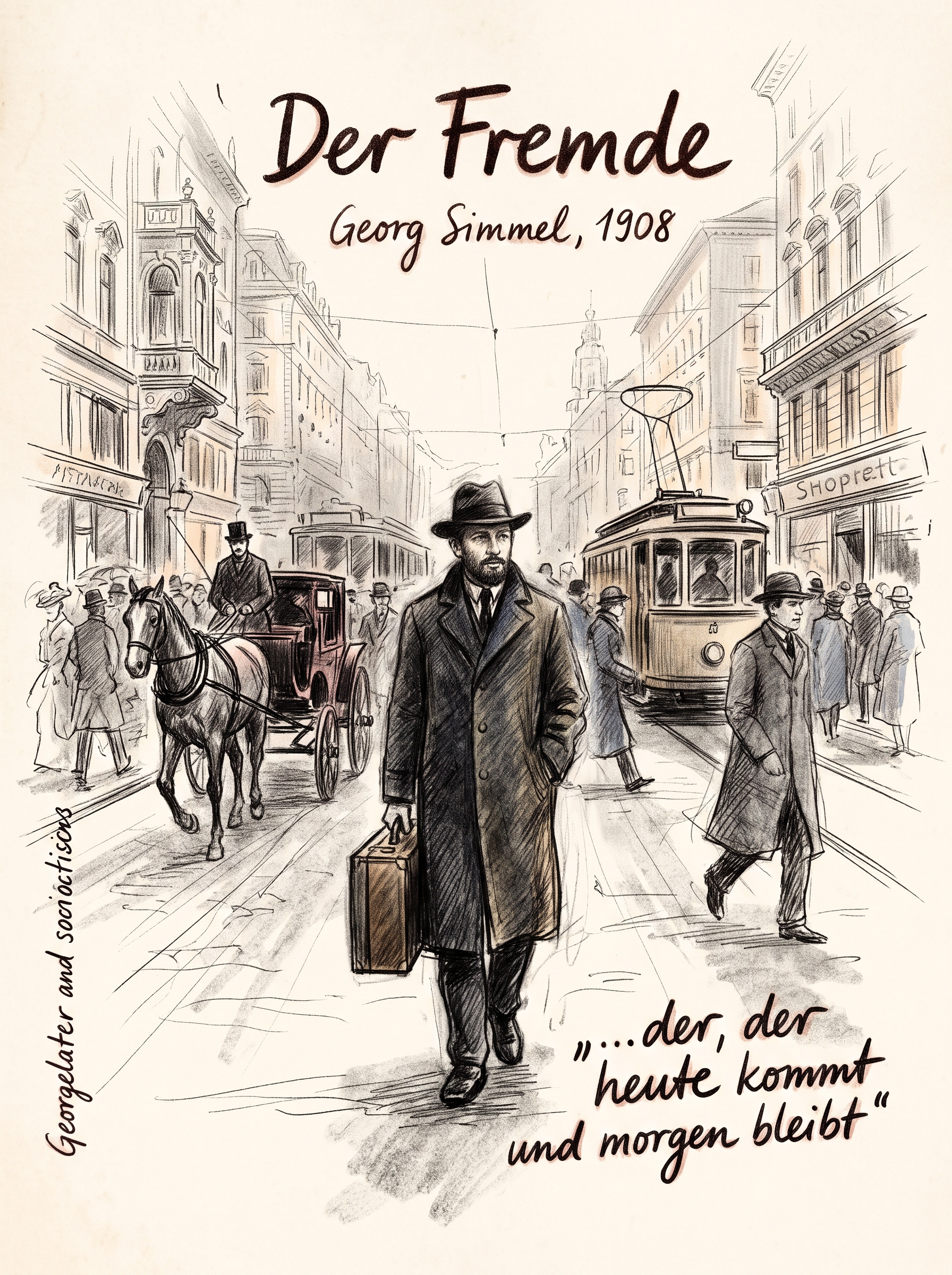
Georg Simmel's seminal 1908 essay "The Stranger" (Der Fremde) constitutes one of the foundational conceptual archetypes of classical sociology. Rejecting static, biological, or geographic definitions of social exclusion, Simmel formulates the Stranger as an elemental form of sociation (Vergesellschaftung): an individual whose structural position is defined by the paradoxical synthesis of nearness and remoteness, spatial proximity and social detachment. The Stranger is not the transient wanderer who arrives today and leaves tomorrow, but rather "the person who comes today and stays tomorrow." By participating in the group's practical, institutional, and economic life while remaining unbound by its ancestral ties, sacred traditions, and kinship loyalties, the Stranger achieves a distinct sociological objectivity, serves as an impartial confidant and economic trader, and yet remains perpetually vulnerable to abstract categorizations, collective suspicion, and xenophobic scapegoating.
1. Epistemological Foundations: Formal Sociology and Spatial Relations
In his monumental 1908 treatise Soziologie: Untersuchungen über die Formen der Vergesellschaftung (Sociology: Inquiries into the Construction of Social Forms), Simmel established formal sociology (Formale Soziologie) by distinguishing the variable psychological or material content (Inhalt) of human interaction from its invariant geometric forms (Formen).[1] For Simmel, "society" does not exist as a static, substantial monolith; rather, it is an ongoing, dynamic process of reciprocal interaction termed sociation (Vergesellschaftung).
In Chapter 9 of Soziologie, entitled "The Space and the Spatial Orders of Society" (Der Raum und die räumlichen Ordnungen der Gesellschaft), Simmel establishes that space is not merely a passive physical container in which actions happen; rather, spatial boundaries are externalized projections of social boundaries.[1:1] Physical distance and social distance are reciprocally constitutive.
Within this spatial-relational framework, Simmel introduces the Stranger not as an idiosyncratic psychological personality or an absolute external alien, but as a specific, highly functional social type (Soziologischer Typus) whose identity is generated entirely by their geometric position within a relational network.
| Sociological Dimension | Physical Boundary | Sociological Boundary | The Stranger's Position |
|---|---|---|---|
| Spatial Inscription | Geographic coordinates, physical walls, territorial frontiers. | Norms of belonging, kinship lineages, shared sacred traditions. | Physically inside the territorial group, yet socially outside its ancestral core. |
| Relational Genesis | Determined by topographic borders and spatial proximity. | Determined by patterns of reciprocal interaction (Wechselwirkung). | Constituted by an ongoing relation of mutual distance within shared physical space. |
| Systemic Function | Delineates jurisdictional authority and defense lines. | Regulates inclusion, collective identity, and social closure. | Embodies the living frontier where the group's inside meets the outside world. |
2. The Spatial-Relational Paradox: The Dialectic of Nearness (Nähe) and Remoteness (Ferne)
The foundational paradox of the Stranger lies in the simultaneous, dialectical co-presence of two mutually contradictory spatial-affective categories: nearness (Nähe) and remoteness (Ferne).[2]
Simmel carefully delineates the Stranger from two related social positions: the in-group native and the transient wanderer:
- The In-Group Native: Possesses both physical nearness and social nearness; their identity is organically rooted in shared soil, lineage, and collective memory.
- The Transient Wanderer (Der Wandernde): Arrives today and departs tomorrow; represents physical presence without temporal duration or systemic social integration.
- The Stranger (Der Fremde): The synthesis of wandering and spatial fixing. The Stranger "comes today and stays tomorrow." They import the detached, cosmopolitan perspective of the outside world directly into the intimate interior of the settled group.[2:1]
| Relational Quality | The In-Group Native | The Transient Wanderer | The Stranger (Der Fremde) |
|---|---|---|---|
| Spatial Status | Physically present, permanently fixed. | Physically transient, mobile. | Physically present, permanently settled. |
| Temporal Horizon | Rooted in ancestral past and shared future. | Confined to the fleeting present moment. | Originates from elsewhere, projected into group's future. |
| Affective Tie | Particularistic: blood, clan, custom, sacred duty. | Non-existent: pure anonymity. | Universalistic: shares only general human qualities. |
| Group Boundary | Embedded within the boundary. | Completely outside the boundary. | Border figure: simultaneously inside and outside. |
The Universal vs. The Particular
Simmel observes that relations between organic group members are governed by particularistic ties: specific genealogies, shared folklore, local dialects, and hereditary roles.
In contrast, the relationship between the group and the Stranger is governed entirely by universal qualities. The group recognizes that the Stranger shares certain broad human traits—gender, professional skill, basic humanity, or general trade utility—but shares no unique, specific biographical roots with the local community. Because what is shared with the Stranger is also shared with millions of other human beings across the globe, the bond is inherently abstract. This tension between intimate physical co-presence and radical abstract remoteness constitutes the existential and structural core of the stranger experience.
3. The Epistemological Advantage: Sociological Objectivity (Objektivität)
Because the Stranger is structurally detached from the group's ancestral lineage, party factions, and inherited loyalties, they occupy an unprecedented epistemological vantage point: sociological objectivity (Objektivität).[2:2]
Simmel emphasizes that objectivity does not signify cold indifference, passive apathy, or moral neutrality. Rather, it represents an active, lucid freedom from the subjective distortions, blind spots, and sectarian passions that cloud the judgment of in-group insiders:
"Because he is not bound by roots to the particular constituents and partisan tendencies of the group, he confronts all of these with a distinctly 'objective' attitude, an attitude which does not signify mere detachment and absence of interest, but is a particular structure of distance and interest, indifference and involvement."[2:3]
| Epistemological Dynamic | In-Group Insider | The Objective Stranger |
|---|---|---|
| Cognitive Framework | Immersed in tradition; unreflective common sense (natural attitude). | Critical detachment; sees local customs as contingent and historical. |
| Factional Entanglement | Deeply committed to hereditary feuds, clan alliances, and family status. | Free from partisan loyalties; evaluates situations on their formal merits. |
| Interpretive Blindness | Normalized assumptions; inability to perceive the arbitrary nature of local norms. | Heightened clarity; easily identifies systemic contradictions and structural patterns. |
| Freedom of Judgment | Constrained by fear of peer sanction and familial retribution. | Autonomous deliberation unburdened by customary taboos. |
This structural objectivity enables the Stranger to evaluate disputes without prejudice. They are not beholden to any faction's past grievances, nor are their future prospects tied to the patronage of a particular local family. Consequently, the Stranger possesses a rare freedom of thought and action that settled insiders can never achieve.
4. Functional Archetypes of the Stranger: Confidant, Arbitrator, and Mobile Trader
Simmel demonstrates that rather than acting merely as an awkward anomaly or social nuisance, the Stranger fulfills three indispensable, specialized functions that the host society cannot generate from within its own ranks:
| Archetypal Role | Relational Mechanism | Historical & Structural Manifestation | Sociological Rationale |
|---|---|---|---|
| The Confidant | Radical social distance ensures non-retaliatory discretion. | The travelling confessor, therapist, visiting doctor, outside advisor. | Insiders confess intimate crimes and forbidden desires because the Stranger cannot weaponize them in local politics. |
| The Impartial Arbitrator / Judge | Absence of kinship ties guarantees judicial autonomy. | Italian Renaissance city-states hiring the podestà (foreign magistrate). | Internal judges are compromised by family rivalries; only a non-native magistrate can deliver unbiased justice. |
| The Mobile Trader / Merchant | Disconnection from fixed agrarian land enables pure monetary exchange. | Jewish merchants in medieval Europe, Levantine traders in the Mediterranean. | Agrarian feudalism treated land as sacred; movable financial capital and commerce fell to mobile outsiders. |
1. The Confidant: The Safe Haven of the Distant Ear
One of Simmel's most striking psychological observations is that human beings routinely reveal their deepest, most dangerous secrets—confessions of illicit love, hidden financial betrayals, crisis of faith, and private pathologies—to strangers rather than to their closest intimates:
- Confiding in a spouse, sibling, or lifelong neighbor carries enormous social risk: the information may permanently destabilize intimate hierarchies, invite judgment, or be weaponized in future family disputes.
- The Stranger, by contrast, operates outside the local reputational economy. Confiding in the Stranger provides the catharsis of verbalization without the terror of ongoing surveillance or social consequences. Once the interaction concludes, the Stranger's structural distance absorbs the secret into silence.
2. The Arbitrator: The Neutrality of the Outsider
When deep ideological, economic, or blood conflicts erupt within a tightly knit community, internal resolution is frequently impossible because every native judge belongs to a specific family, caste, or political faction.
Simmel notes that historical societies frequently imported outside authorities to settle disputes. In the Italian Renaissance, rival city-states routinely appointed their chief magistrate and military commander—the podestà—from a completely different city, binding them to an explicit legal contract that forbade them from marrying local citizens, purchasing local real estate, or socializing privately with local patricians. The city required a Stranger to administer absolute, uncorrupted justice.
3. The Mobile Trader: Money, Liquidity, and Commerce
In pre-modern, traditional, and feudal societies, the economy was anchored in immobile, qualitative assets: ancestral land, hereditary serfdom, and rigid guild privileges. Within this closed ecosystem, mobile commerce and cross-border trade were viewed with deep moral suspicion.
Because the Stranger owned no ancestral land and held no guild pedigree, their economic existence was forced into the realm of movable property and monetary exchange.[3] As Simmel elaborates in The Philosophy of Money (Philosophie des Geldes), money is the pure instrument of relational abstraction—it possesses no religious loyalty, respects no aristocratic bloodlines, and flows indifferently across all physical and cultural borders:
- The Stranger became the quintessential trader, merchant, and banker.
- Operating between distinct closed communities, the Stranger connected isolated markets, introduced exotic commodities, and provided liquid credit.
- The Stranger’s social mobility matched the mobility of currency itself: unattached, adaptable, calculative, and free from the sentimental inertia of local soil.
5. Structural Vulnerability: Abstraction, Generalization, and the Scapegoat Mechanism
The very attributes that grant the Stranger objectivity, commercial utility, and social indispensability also expose them to intense structural vulnerability. Simmel identifies a sinister psychological dialectic governing how host communities perceive the Stranger during times of peace versus times of crisis:
| Phase of Perception | Systemic Condition | Cognitive & Affective Posture | Social & Political Consequence |
|---|---|---|---|
| Organic Peace & Functional Utility | Stable social order, economic equilibrium, routine trade. | Universalistic recognition; valued for objectivity, credit, and commercial connections. | Institutional toleration; protection under commercial charters or customary hospitality. |
| Systemic Crisis & Cognitive Regression | Plague, economic collapse, famine, military defeat, ideological upheaval. | Collapse of individuation; Stranger reduced to an abstract, threatening signifier. | Rise of xenophobic conspiracy theories; moral panic targeting internal outsiders. |
| The Scapegoat Projection | Unresolved collective guilt, systemic breakdown, internal factional friction. | Demonization; objectivity reframed as treachery, liquidity reframed as parasitism. | Pogroms, legal disenfranchisement, property expropriation, or violent expulsion. |
The Shift from the Unique Individual to the Abstract Category
When dealing with a fellow insider, community members perceive individual distinctions: John may be lazy, Peter honest, and Mary eccentric. Their faults are judged as personal moral failings, not as systemic indictments of their lineage.
With the Stranger, however, this individuation collapses into abstract generalization:[2:4]
- The Stranger is never judged purely on their unique merits or specific ethical choices.
- Instead, the Stranger is experienced as the embodied representative of an abstract, alien category: "the foreigner," "the outsider," "the Jew," "the immigrant."
- If one stranger commits an error or generates economic friction, the entire group of strangers is collectively condemned.
The Scapegoat Dynamic
Because the Stranger is physically inside the gates yet emotionally and genealogically unanchored, they constitute the ultimate lightning rod for collective anxieties. During periods of plague, military defeat, or financial depression:
- The organic community seeks an explanation for its internal decay.
- Because the insider community cannot bear to confront its own structural failings, it projects collective guilt onto the mobile, unrooted element within its midst.
- The Stranger's objectivity is reinterpreted as cold, calculating treachery; their commercial liquidity is demonized as parasitical exploitation; and their lack of ancestral loyalty is condemned as active subversion.
- Consequently, the Stranger easily becomes the target of xenophobic violence, legal disenfranchisement, and violent expulsion.
6. Conceptual Evolution: The Stranger Across Modern Social Theory
Simmel's foundational archetype inspired and evolved across multiple sociological traditions throughout the twentieth and twenty-first centuries.
| Theoretical Framework | Primary Thinker | Foundational Work | Conceptual Transformation of the Stranger |
|---|---|---|---|
| Formal Sociology | Georg Simmel (1858-1918) | "The Stranger" (1908) | A relational geometric form synthesizing physical nearness and social remoteness; source of objectivity and trade. |
| Phenomenological Sociology | Alfred Schütz (1899–1959) | "The Stranger: An Essay in Social Psychology" (1944) | The newcomer who lacks the host group's "stock of knowledge" and unquestioned cultural recipes; exposes the arbitrariness of the lifeworld. |
| Urban Interactionism & Ecology | Robert E. Park & Everett Stonequist | "Human Migration and the Marginal Man" (1928) / The Marginal Man (1937) | The "Marginal Man": an individual caught between two incompatible cultural worlds; experiences permanent psychological crisis and intellectual hybridity. |
| Postmodern Critical Theory | Zygmunt Bauman | Modernity and Ambivalence (1991) | The embodiment of cognitive ambivalence; disrupts the binary classification of "friend vs. enemy," provoking modern state-building efforts of social purification. |
Alfred Schütz: The Stranger as Phenomenological Crisis
In his 1944 essay "The Stranger: An Essay in Social Psychology," Alfred Schütz (1899–1959) reformulated Simmel's spatial concept using phenomenological sociology.[4] Schütz examines the exact psychological experience of an immigrant entering an unfamiliar culture:
- The Breakdown of Cultural Recipes: The native population navigates daily life using a taken-for-granted stock of knowledge—cultural "recipes" and habits that allow them to act without deep reflection (the "natural attitude").
- The Stranger's Dilemma: For the stranger, this cultural map is utterly useless. The stranger cannot take anything for granted; they must translate every gesture, idiom, and social expectation into a conscious, reflective puzzle.
- The Accusation of Disloyalty: Because the stranger must consciously examine and question what the native accepts as absolute common sense, the host community often views the stranger's critical inquiry as an act of bad faith, skepticism, or disloyalty.
Robert E. Park: The "Marginal Man"
The Chicago School of Sociology, pioneered by Robert E. Park and elaborated by Everett Stonequist, transposed Simmel's stranger into the concept of the Marginal Man (homo marginalis):[5]
- The Marginal Man is a cultural hybrid who lives simultaneously on the boundary of two distinct societies that refuse to fully merge (e.g., the second-generation immigrant, the racial minority, or the emancipated urbanite).
- Rather than viewing this condition solely as a deficit, Park argued that the marginal position produces an acute, enlightened self-consciousness: the marginal man becomes the most cosmopolitan, reflective, and creative agent of modern urban transformation.
Zygmunt Bauman: Modernity, Ambivalence, and the Unclassifiable
In Modernity and Ambivalence (1991), Zygmunt Bauman argues that the primary ambition of modern political rationality is to impose absolute order, order that relies on clear binary classifications: inside vs. outside, citizen vs. foreigner, friend vs. enemy.[6]
- The Stranger represents the terrifying third term—the embodiment of ambivalence that undermines all binary categories.
- The Stranger is physically inside, yet socially outside; friend-like in proximity, yet enemy-like in foreignness.
- Because the Stranger defies the state's taxonomic grids, modernity treats the stranger with deep anxiety, seeking either to violently assimilate them (erasing their otherness) or violently exclude/exterminate them (the logic of the concentration camp and ethnic cleansing).
7. Comparative Theoretical Matrix: Simmel, Schütz, Park, and Bauman
| Analytical Dimension | Georg Simmel (1908) | Alfred Schütz (1944) | Robert E. Park (1928) | Zygmunt Bauman (1991) |
|---|---|---|---|---|
| Primary Theoretical Lens | Formal sociology & spatial geometry. | Phenomenological sociology & the lifeworld. | Urban human ecology & cultural anthropology. | Postmodern critical theory & state sociology. |
| Core Definition | The person who comes today and stays tomorrow. | The actor attempting to interpret an unfamiliar cultural pattern. | The cultural hybrid caught between two distinct cultural worlds. | The cognitive anomaly defying the binary of friend vs. enemy. |
| Nature of Social Distance | Dynamic balance of spatial nearness and cultural remoteness. | Epistemological gap between two divergent stocks of knowledge. | Psychological and racial marginality on cultural fault lines. | Boundary crisis that threatens the modern project of absolute order. |
| Primary Cognitive Posture | Sociological Objectivity: bird's-eye perspective free from prejudice. | Reflective Analysis: questioning taken-for-granted recipes. | Heightened Self-Consciousness: critical, cosmopolitan reflexivity. | Ambivalence: provoking cognitive panic in the categorizing observer. |
| Primary Economic / Social Function | Trader, merchant, banker, impartial arbitrator, secret confidant. | Newcomer, foreign scholar, immigrant assimilating into a new group. | Entrepreneur, intellectual, cosmopolitan innovator, cultural mediator. | The lightning rod for state classification, assimilation, or purge. |
| Societal Response in Crisis | Abstract hostility, collective projection, and scapegoating. | Accusations of bad faith, ingratitude, and cultural disloyalty. | Segregation, racial alienation, identity fragmentation. | Bio-political cleansing, forced ghettoization, or legislative eradication. |
🎴 Interactive Web Practice (Comprehension Check)
Question 1 (Spatial Paradox & The Synthesis of Distance): Why does Georg Simmel define the Stranger as "the person who comes today and stays tomorrow," and how does this spatial-relational position differ fundamentally from both the organic group native and the transient wanderer?
Answer: Simmel distinguishes the Stranger from both the settled native and the nomadic wanderer by establishing a paradoxical synthesis of nearness (Nähe) and remoteness (Ferne):
- The In-Group Native: Possesses both physical proximity and deep social-genealogical nearness. Their identity is rooted in the shared ancestral history, organic kinship ties, and hereditary traditions of the community.
- The Transient Wanderer (Der Wandernde): Arrives today and leaves tomorrow. While they physically enter the geographic space of the group, they establish no lasting social relations, institutional commitments, or structural permanence. Their presence is fleeting, leaving the group's boundary undisturbed.
- The Stranger (Der Fremde): "Comes today and stays tomorrow." The Stranger imports the spatial and cultural freedom of the outside world directly into the interior of the settled group, establishing a durable, permanent presence. The Stranger is physically inside the group, interacting with its members daily, yet socially outside its ancestral core. This synthesis transforms the border from a distant geographic line into an active, living personal presence within everyday community life.
Question 2 (Objectivity, The Confidant & The Money Economy): How does the Stranger's structural detachment generate sociological objectivity, and why are strangers historically associated with both the role of the intimate confidant and the mobile trader?
Answer: The Stranger's lack of organic entanglement with the host society creates three powerful functional dynamics:
- Sociological Objectivity: Because the Stranger is not bound by local kinship ties, ancestral alliances, family feuds, or traditional taboos, they evaluate internal social disputes with clear, uncommitted detachment. Objectivity is not passive indifference; it is an active capacity to perceive systemic configurations and human actions on their formal merits, free from partisan blinders. For this reason, historical societies (such as Renaissance Italian city-states) frequently hired outside judges (the podestà) to administer impartial justice that native magistrates could never deliver.
- The Intimate Confidant: Individuals routinely confess forbidden secrets, moral transgressions, and emotional vulnerabilities to strangers that they would never reveal to close friends or family. Because the Stranger exists outside the local status hierarchy, the confession carries no threat of ongoing reputational surveillance or political weaponization.
- The Mobile Trader & Money: Traditional and feudal societies anchored value in immobile, qualitative possessions—specifically ancestral land and hereditary guild privileges. Strangers, denied land ownership, operated within the fluid domain of commerce, movable property, and finance. As Simmel demonstrates in The Philosophy of Money, money is the pure relational medium of abstraction; its indifference to kinship and sacred tradition mirrored the Stranger's own mobile, universal, and adaptable position within the social order.
Question 3 (Abstract Categorization, Scapegoating & Theoretical Evolution): Why does the relationship with the Stranger become dangerous during periods of social crisis, and how did Alfred Schütz and Zygmunt Bauman expand Simmel's analysis?
Answer: The structural vulnerability of the Stranger stems from the abstract nature of their social bond:
- Abstract Categorization and Scapegoating: Insiders view one another through personal, differentiated biographies, but they relate to the Stranger through abstract, generic signifiers ("the foreigner," "the immigrant," "the alien"). When systemic crises erupt (such as economic depression, plague, or defeat in war), the host group seeks an external cause to avoid confronting internal dysfunction. The Stranger's individual humanity dissolves into an abstract collective category; their objectivity is reinterpreted as cold treachery, and their commercial agility is branded as exploitation. Consequently, the Stranger becomes the primary target of xenophobic violence and scapegoating.
- Alfred Schütz's Phenomenological Expansion (1944): Schütz showed that whereas native insiders operate seamlessly using unquestioned cultural "recipes" and habits (the "natural attitude"), the Stranger lacks this inherited stock of knowledge. The stranger must consciously decode, verify, and question every routine interaction, transforming ordinary daily life into an ongoing crisis of interpretation—a critical reflexivity that native groups frequently interpret as insolence or cultural disloyalty.
- Zygmunt Bauman's Modernist Critique (1991): In Modernity and Ambivalence, Bauman demonstrated that the modern state is obsessed with establishing absolute order through clean binary classifications (friend vs. enemy, citizen vs. foreigner). The Stranger represents terrifying ambivalence—a living contradiction that is physically inside yet culturally alien. Because the Stranger cannot be neatly filed away within the state's taxonomic grid, they become the focal point of modern administrative anxiety, prompting aggressive campaigns of forced assimilation, ghettoization, or bio-political expulsion.
Resonant Notes
The following notes in the vault share direct thematic, sociological, and literary connections with Georg Simmel's concept of The Stranger:
🔴 Classical Sociology, Formal Relations & Typifications
- Georg Simmel (1858-1918) — The comprehensive intellectual monograph on Simmel's sociology, unpacking formal sociology (Formale Soziologie), the transition from dyad to triad, the Tragedy of Culture, and the geometry of sociation (Vergesellschaftung) that birthed the archetype of the Stranger.
- Alfred Schütz (1899–1959) — Synthesized Simmel's formal archetypes with Husserlian phenomenology; in his 1944 essay "The Stranger," Schütz explored how the newcomer must deconstruct and self-consciously rebuild the taken-for-granted "cultural recipes" that natives navigate pre-reflectively.
- The Social Construction of Reality - A Treatise in the Sociology of Knowledge — Berger and Luckmann systematized Schütz's and Simmel's insights on institutionalization and typification, demonstrating how the Stranger exposes the socially constructed, non-natural character of institutional reality.
- Structural Functionalism — Simmel's stranger illustrates how structural functionalism accounts for marginal, deviant, or non-native positions that nonetheless serve critical systemic functions (commercial liquidity, dispute arbitration, and the clarification of collective moral boundaries).
- Arnold van Gennep (1873–1957) — Van Gennep's pioneering anthropological concept of the liminal phase within rites of passage directly mirrors the Stranger's permanent social status: suspended between two cultural states, neither fully integrated nor fully expelled.
- David Émile Durkheim (1858–1917) & Durkheimian Sociology — Provides a macrosociological foil to Simmel's relational model; where Durkheim examines how collective representations and penal law punish outsiders to solidify mechanical solidarity, Simmel tracks how the Stranger functions relationally within organic differentiation.
- Max Weber (1864-1920) — Weber's concepts of "pariah people" (applied to historic minority mercantile classes) and rational-legal authority parallel Simmel's analysis of the Stranger's role in introducing abstract monetary calculability into traditional, patrimonial societies.
- Freedom from a Sociological Perspective — Investigates how the Stranger embodies the ultimate sociological paradox of negative liberty: released from the suffocating surveillance of local customs and tribal obligations, yet exposed to isolation, precarity, and systemic vulnerability.
🟡 Urban Modernity, Spatial Estrangement & The Sensorium
- The Metropolis and Mental Life — Simmel's foundational urban study; analyzes how the sensory intensification (Steigerung des Nervenlebens) and monetary abstraction of the industrial city turn all metropolitan citizens into structural strangers, demanding the protective adoption of the blasé attitude and urban reserve.
- The Philosophy of Money (Philosophie des Geldes) — Explores the deep structural affinity between the Stranger and currency; money acts as the ultimate medium of relational abstraction, allowing the unrooted stranger to negotiate across hostile boundaries through universal quantitative equivalence.
- The flâneur — The nineteenth-century urban wanderer who drifts through the metropolitan crowd; shares the Stranger's detached, objective gaze, observing commodity culture with aesthetic distance while avoiding deep personal entanglement.
- The Painter of Modern Life, a seminal 1863 essay by French poet and art critic Charles Baudelaire — Baudelaire's portrait of the modern artist living in the midst of the crowd as an incognito observer parallels Simmel's Stranger, who transforms alienation and detachment into aesthetic and intellectual clarity.
- Walter Benjamin (1892–1940) & Walter Benjamin's The Arcades Project — Benjamin, who studied under Simmel, took up the figure of the outsider, the refugee, and the urban wanderer, showing how the detached observer decodes the phantasmagoria of capitalist architecture and modern street life.
- Anthony Vidler-The Architectural Uncanny — Analyzes how modern urban architecture produces spatial alienation and psychological estrangement, exploring how the presence of the stranger renders the familiar domestic home terrifyingly uncanny (unheimlich).
- Dunbar's Number - The Rule of 150 — Explores the evolutionary and cognitive limits on human social networks; illustrates why the rise of urban civilizations past tribal thresholds structurally requires the formalization of stranger-relations, professional reserve, and institutional typifications.
- Simmel and the Attention Economy — Abstraction, Alienation, and Cognitive Capture — Transposes Simmel's analysis of the urban sensorium and relational distance into the digital realm, showing how online social networks transform users into ambient, algorithmic strangers observing one another through metricized feeds.
🟢 Marginality, Existential Outsiders & Cultural Theory
- Franz Kafka (1883-1924) — Kafka's alienated protagonists—such as K. in The Castle, who arrives in an opaque village as an uninvited land-surveyor—dramatize the grotesque existential horror of the Stranger trapped in an impenetrable, bureaucratic social system that refuses to recognize his legitimacy.
- Albert Camus — Camus's novel The Stranger (L'Étranger) and his philosophy of Absurdism investigate the moral and existential dimension of Simmel's archetype; protagonist Meursault is condemned not merely for homicide, but for being a psychological stranger to his society's sacred emotional scripts.
- Travis Bickle — The protagonist of Scorsese and Schrader's Taxi Driver embodies the pathological degeneration of the urban stranger: drifting through the neon streets of New York with radical detachment, converting social isolation and voyeuristic reserve into violent, purifying vigilantism.
- Don DeLillo Major Themes Analysis — DeLillo's postmodern fiction examines suburban and metropolitan characters who operate as cognitive strangers in hyper-mediated landscapes, seeking refuge from existential dread in corporate brand names while feeling alienated from real physical environments.
- Karl Marx - Economic and Philosophic Manuscripts of 1844 — Marx's diagnosis of human alienation (Entfremdung) under industrial capitalism mirrors Simmel's Stranger; under the rule of capital, the worker becomes a stranger to their product, their labor, their fellows, and their essential human nature (Gattungswesen).
- From Walls of Wood to Walls of Glass - Northrop Frye’s Geography of Isolation & English-language Canadian Literature (English CanLit) — Frye's "garrison mentality" explores how early frontier communities banded together against an overwhelming, hostile wilderness, viewing the external stranger with visceral existential dread and constructing rigid moral barriers against outsiders.
- Counter-Culture — Examines how countercultural movements deliberately adopt the posture of the Stranger, adopting alternative semiotic codes, aesthetic practices, and political values to critique the dominant social order from an intentional internal exile.
- Pulse (Kairo) — Existential Dread and Digital Alienation — Kiyoshi Kurosawa's cinema visualizes the absolute culmination of urban estrangement, where individuals become ghostly strangers to one another within modern Tokyo apartments, dissolved by the very telecommunications designed to connect them.
Backlinks
- Georg Simmel (1858-1918) — Foundational biographical and theoretical hub; details Simmel's formal sociology, the distinction between form and content, and the geometry of social types.
- The Metropolis and Mental Life — Simmel's companion urban study, illustrating how the sensory overstimulation and monetary density of the modern metropolis generalize the condition of the Stranger across the entire urban population.
- The Philosophy of Money (Philosophie des Geldes) — Examines the economic infrastructure that enables the Stranger's mobility, trade activities, and relational abstraction within traditional and modern societies.
- Alfred Schütz (1899–1959) — The phenomenological heir who transformed Simmel's spatial type into an epistemological inquiry regarding cultural patterns, stocks of knowledge, and the crisis of everyday recipes.
- Structural Functionalism — Explains how the Stranger's marginal position fulfills positive equilibrium functions for host systems, such as trade facilitation, judicial arbitration, and collective boundary maintenance.
- Anthony Vidler-The Architectural Uncanny — Traces the spatial estrangement of modern cities, demonstrating how the physical co-presence of strangers transforms the built environment into a site of psychological unhomeliness (Unheimlichkeit).
- Dunbar's Number - The Rule of 150 — Provides cognitive science context for why human groups default to in-group tribalism and require specialized cultural archetypes like the Stranger once social groups exceed natural neocortical limits.
- Freedom from a Sociological Perspective — Highlights the tension between positive integration and negative liberty embodied by the Stranger, who achieves personal independence at the cost of collective security.
- Franz Kafka (1883-1924) — Literary dramatization of the Stranger's existential torment, depicting characters trapped in labyrinthine social apparatuses that classify them as permanent, unassimilable outsiders.
- Albert Camus — Connects Simmel's relational sociology of otherness to existential phenomenology, demonstrating how refusing to perform normative social rituals transforms an insider into an existential stranger.
References
Georg Simmel / Soziologie: Untersuchungen über die Formen der Vergesellschaftung (1908) / Translated as Sociology: Inquiries into the Construction of Social Forms by Anthony J. Blasi, Anton K. Jacobs, and Mathew Kanjirathinkal / Brill ↩︎ ↩︎
Georg Simmel / "The Stranger" (Der Fremde) / In The Sociology of Georg Simmel, edited and translated by Kurt H. Wolff / Free Press / Simon & Schuster ↩︎ ↩︎ ↩︎ ↩︎ ↩︎
Georg Simmel / The Philosophy of Money (1900) / Translated by Tom Bottomore and David Frisby / Routledge ↩︎
Alfred Schütz / "The Stranger: An Essay in Social Psychology" / American Journal of Sociology, Vol. 49, No. 6 (May, 1944), pp. 499–507 / University of Chicago Press ↩︎
Robert E. Park / "Human Migration and the Marginal Man" / American Journal of Sociology, Vol. 33, No. 6 (May, 1928), pp. 881–893 / University of Chicago Press ↩︎
Zygmunt Bauman / Modernity and Ambivalence (1991) / Cornell University Press ↩︎