The Difference Between a Product and a Brand
A product is an item or service manufactured to solve a functional, biological, or utilitarian problem—defined by its physical features, specifications, and performance metrics ("What does it do?"). A brand is the intangible constellation of perceptions, emotional connections, cultural narratives, and trust that resides in the consumer's mind ("Who am I when I consume it?"). While products can be copied, commodified, and substituted, brands establish pricing power, customer loyalty, and enduring enterprise equity.
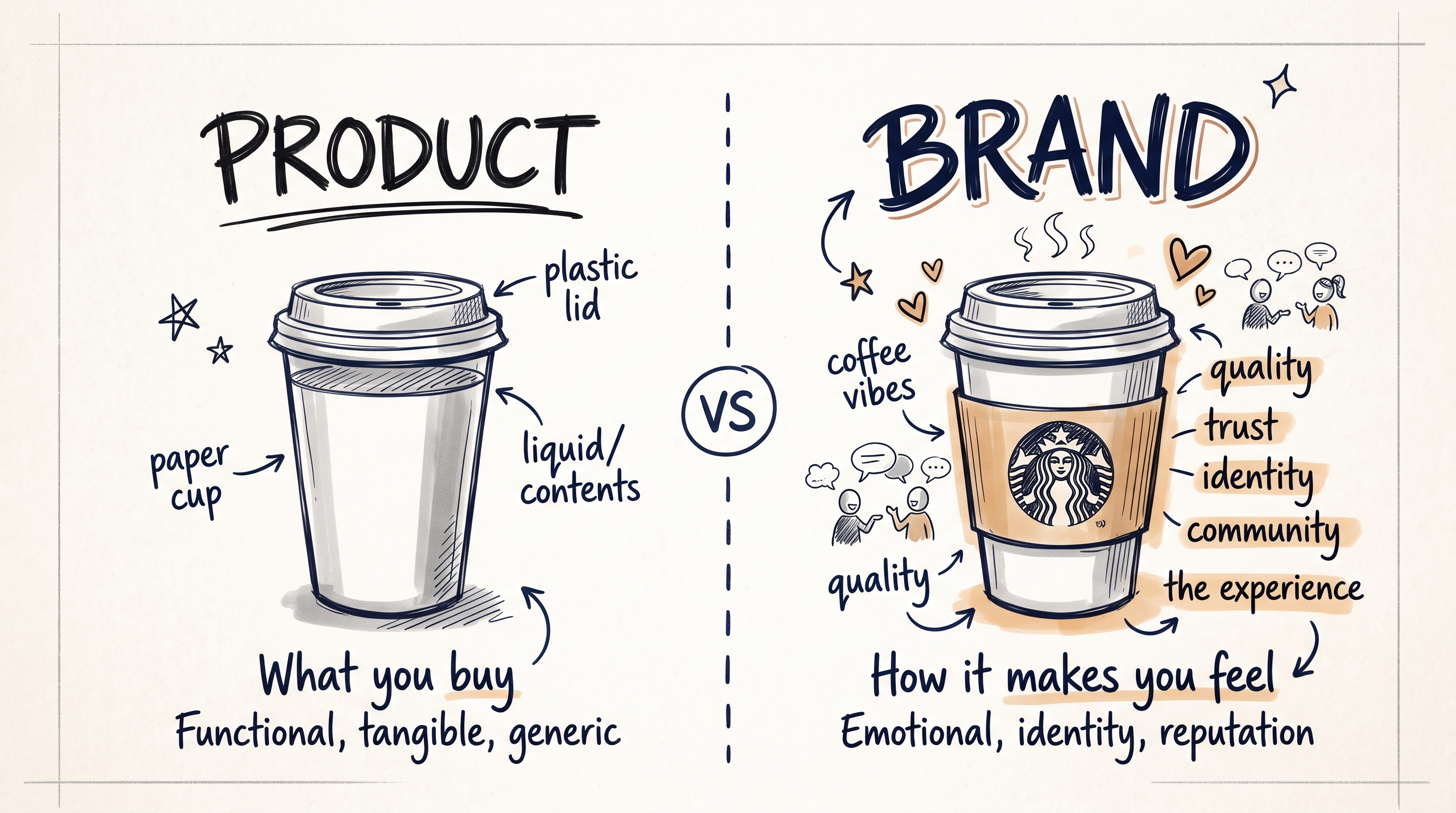
1. Core Distinctions: Defining the Boundary
While casual conversation often conflates the two terms, corporate strategists and marketing leaders treat products and brands as fundamentally distinct operational layers.
What is a Product?
A product is a physical good, digital tool, or discrete service created through manufacturing, coding, or labor to satisfy a tangible customer requirement.
- Functional Utility: It answers the primary question: "Does it work?" Its value is anchored in tangible metrics—processing speed, caloric value, battery capacity, fabric durability, or caffeine content.
- Vulnerability to Commodification: Because products are built on engineering specifications and raw ingredients, competitors can easily reverse-engineer, replicate, or undercut them.
- Transactional Relationship: The relationship between a consumer and a generic product is transactional. When utility drops or a cheaper alternative emerges, the consumer switches without hesitation.
- High Price Elasticity: Products that lack strong brand identity face elastic demand; raising prices quickly erodes market share.
What is a Brand?
A brand is not a physical object, a logo, or a marketing slogan. A brand is a living promise and perceptual ecosystem—the cumulative emotional, social, and psychological meaning attributed to an organization and its offerings.
- Psychological Resonance: It answers the identity question: "Who am I when I use this, and what does it signal to the world?" It satisfies human needs for status, belonging, predictability, and self-expression.
- Defensible Moat: While a competitor can match your product's technical specifications overnight, they cannot replicate decades of cultural goodwill, shared rituals, or emotional trust.
- Relational Loyalty: The consumer forms an emotional and cognitive bond with the brand. Minor product flaws, operational hiccups, or price increases are readily tolerated by loyal brand advocates.
- Pricing Inelasticity: High brand equity empowers organizations to command premium margins, transforming standard goods into high-margin luxury or lifestyle staples.
Structural Comparison Matrix
| Dimension | Product (Commodity Layer) | Brand (Perceptual & Equity Layer) |
|---|---|---|
| Core Definition | Tangible item or functional service produced for sale | Intangible perceptual asset and emotional relationship |
| Primary Question | "What does it do?" / "Does it work?" | "What does it stand for?" / "Who am I when I use it?" |
| Origin & Domain | R&D labs, assembly lines, codebases | Consumer perception, cultural narrative, public reputation |
| Replicability | Readily copied, reverse-engineered, or substituted | Irreplaceable; built on proprietary trust and culture |
| Value Driver | Utility, unit price, availability, convenience | Emotional resonance, status signaling, community, trust |
| Pricing Power | Elastic (price hikes drive customer defection) | Inelastic (price premiums accepted and desired) |
| Customer Relationship | Transactional (use, evaluate, and discard) | Relational (loyalty, advocacy, and identity integration) |
| Competitive Moat | Fragile; eroded by cost leaders and technological shifts | Robust; insulates against commodity price wars |
| Lifespan | Finite; subject to obsolescence and lifecycle decline | Potentially timeless; can extend across product generations |
2. Niche Case Study: The "Product vs. Brand" Conundrum
Why do consumers willingly pay a $5 premium for a Starbucks coffee when any standard caffeinated beverage performs the exact same basic function?
The Anatomy of the Conundrum
At the level of pure product function, a $1.50 cup of gas-station drip coffee and a $6.00 Starbucks Venti Latte are virtually identical. Both deliver:
- A measured dose of caffeine (a central nervous system stimulant)
- A warm (or cold) liquid vehicle
- A bitter alkaloid solution extracted from roasted coffee beans
By any strictly utilitarian metric, the functional gap between the two is negligible. Yet the market sustains a ~300% price premium for the branded beverage. This is not an irrational anomaly — it is the central mechanism of modern consumer capitalism.
The conundrum reveals a fundamental marketing truth: consumers do not buy products; they buy brands. A product satisfies a biological or functional need. A brand satisfies a psychological or social need. The $5 premium is the price of meaning, identity, and environmental comfort — not caffeine.[1]
3. The Architecture of the Premium: Why $5 for Starbucks?
The $5 premium is not an arbitrary surcharge; it represents an integrated stack of tangible commodity inputs and intangible brand equity layers:
- Baseline Commodity Product Layer (~$1.50): The functional caffeine stimulant, liquid vehicle, cup, and thermal heat.
- Quality & Taste Customization Layer (~$0.50): Standardized roasts, alternative dairy options, and proprietary flavor syrups.
- Global Consistency Layer (~$0.50): The operational guarantee that a beverage purchased in Tokyo, London, or Toronto delivers an identical sensory profile.
- Experiential Ritual & Gestalt Layer (~$1.00): Barista interaction, personalized naming rituals, and specialized ordering lexicon ("Venti," "Grande").
- Environmental Equity Layer (~$1.50): The curated "Third Place" offering comfortable seating, ambient jazz, and high-speed Wi-Fi without lingering fees.
- Social Signaling & Identity Layer (~$1.00): The visible green siren insignia serving as a portable badge of cosmopolitan lifestyle participation.
3.1 The "Third Place" — Environmental Equity
Starbucks does not sell coffee; it sells a sanctioned respite — a "third place" between home and work where the consumer is neither host nor employee. The premium pays for:
- Climate-controlled seating with reliable Wi-Fi access
- The absence of transactional pressure (patrons can linger for hours without purchasing a second drink)
- A predictable, standardized aesthetic and sensory environment in any city worldwide
3.2 Identity Signaling — The Veblen Dynamic
Starbucks operates as a mass-affordable Veblen good — a category where paying a premium price signals cultural awareness, disposable income, and modern taste.[1:1] Carrying a paper cup embossed with the green siren logo functions as a portable status badge: it signals participation in a cosmopolitan, self-actualizing lifestyle.
3.3 The Gestalt of the Beverage
As explored in Gestalt Psychology-The Mechanics of the Whole, a Starbucks beverage is a Gestalt — a perceptual whole that is qualitatively different from the sum of its individual components.[2] The consumer is not paying for espresso, steamed milk, and vanilla syrup. They are paying for an emergent experience:
- The specialized nomenclature ("Grande," "Venti," "Quad-Shot")
- The sensory soundscape of steaming wands and acoustic jazz
- The personalized barista interaction and handwritten name on the cup
- The anticipation and first sip from the iconic container
Individually, roasted beans and hot milk are cheap commodities; synthesized through brand ritual, they become an indivisible Gestalt.
3.4 The Bandwagon Effect & Tribal Belonging
Starbucks also operates at the nexus of the Bandwagon Effect.[1:2] Choosing a ubiquitous brand reduces cognitive load and eliminates social risk. The consumer is buying entry into a globally recognized tribe whose consumption rituals are universally validated across international markets.
4. Strategic Business Takeaways: Escaping the Commodity Trap
Understanding the divide between product and brand provides critical guidance for executive decision-makers:
4.1 Points of Parity vs. Points of Difference
- Points of Parity (POP): The minimum baseline features required to compete in a category (e.g., coffee must be hot, hygienic, and caffeinated). Meeting POP merely prevents immediate disqualification.
- Points of Difference (POD): The unique brand perceptions, design aesthetics, and emotional narratives that competitors cannot copy. POD is where sustainable gross margins originate.
4.2 Managing Price Elasticity
When a company competes purely at the product layer, it remains trapped in a race to the bottom. Cost-cutting rivals and macro inflation quickly compress margins. Investing in brand equity shifts the demand curve, lowering price elasticity and granting the firm defensive pricing power.
5. Linguistic Focus: Market-Segment Adjectives & Business Collocations
5.1 Market-Segment Adjectives
| Adjective | Connotation | Typical Collocations |
|---|---|---|
| Iconic | Globally recognized, culturally embedded, timeless | iconic brand, iconic logo, iconic status |
| Aspirational | Desired by consumers seeking upward mobility | aspirational brand, aspirational lifestyle, aspirational pricing |
| Premium | Higher quality, higher price, selective distribution | premium product, premium segment, premium positioning |
| Mass-market | Widely available, accessible pricing, broad appeal | mass-market brand, mass-market retail, mass-market appeal |
| Boutique | Small-scale, highly curated, exclusive | boutique brand, boutique experience, boutique offering |
| Heritage | Long-standing tradition, artisanal authenticity | heritage brand, heritage label, heritage craftsmanship |
| Disruptive | Challenging established industry paradigms | disruptive brand, disruptive pricing, disruptive model |
| Commodity | Undifferentiated, price-driven, interchangeable | commodity product, commodity pricing, commodity trap |
| Lifestyle | Integrated into a broader personal identity system | lifestyle brand, lifestyle marketing, lifestyle integration |
| Niche | Targeted at a specific, tightly defined audience | niche brand, niche market, niche positioning |
5.2 Corporate Business Collocations
| Collocation | Operational Meaning | Contextual Example |
|---|---|---|
| Brand equity | The commercial premium derived from consumer perception rather than physical cost | "Starbucks' formidable brand equity allows it to command healthy margins despite rising dairy costs." |
| Value proposition | The complete bundle of functional, social, and emotional benefits promised to buyers | "The company's value proposition extends far beyond caffeine into personal productivity space." |
| Market positioning | The deliberate mental space a firm seeks to occupy relative to direct competitors | "The enterprise successfully repositioned itself from a fast-food outlet into a lifestyle destination." |
| Price elasticity | The degree to which consumer purchase volume fluctuates in response to price shifts | "High-equity brands enjoy inelastic demand, protecting revenue during inflationary shocks." |
| Brand loyalty | The behavioral tendency of consumers to repeatedly choose a specific label over substitutes | "Deep emotional loyalty insulates established incumbents against low-cost market entrants." |
| Competitive moat | A sustainable strategic advantage that protects enterprise profits from competitor imitation | "Emotional connection and physical convenience form Starbucks' primary competitive moat." |
| Customer lifetime value (CLV) | The aggregate projected net revenue generated throughout the entire customer relationship | "Substantial investments in store ambiance and barista training are justified by extraordinary CLV." |
| Top-of-mind awareness | The immediate brand recalled by a consumer when prompted by a product category | "Consistent retail foot-traffic and ubiquitous packaging maintain top-of-mind awareness globally." |
| Brand extension | Leveraging established brand reputation to launch offerings in adjacent categories | "Starbucks leveraged brand extensions to conquer supermarket ready-to-drink coffee aisles." |
| Point of parity vs. difference | Baseline industry standards versus unique proprietary advantages | "Liquid temperature is a point of parity; the curated 'third place' is an unassailable point of difference." |
6. Synthesis Matrix: Product Functions vs. Brand Perceptions
| Dimension | Product (Commodity Coffee) | Brand (Starbucks Experience) | Premium Justification |
|---|---|---|---|
| Caffeine delivery | ✅ Delivers 150mg stimulant | ✅ Delivers 150mg stimulant | $0 — Functional parity |
| Temperature control | ✅ Hot or iced liquid | ✅ Hot or iced liquid | $0 — Functional parity |
| Taste & Customization | Bitter, standard roast | Consistent, syrup/milk options | $0.50 — Quality & consistency premium |
| Packaging & Aesthetics | Plain unbranded cup | Iconic cup with siren emblem | $0.50 — Aesthetic & signaling premium |
| Physical Environment | Counter, convenience store, car | Curated "Third Place" with Wi-Fi | $1.50 — Environmental premium |
| Ordering Ritual | Pour, pay, depart | Specialized lexicon, barista rapport | $1.00 — Experiential ritual premium |
| Identity Signal | Invisible consumption | Visible status & lifestyle badge | $1.00 — Social signaling premium |
| Consistency Guarantee | Variable across locations | Standardized worldwide experience | $0.50 — Reliability premium |
| Total Value Delivered | ~$1.50 (Commodity Baseline) | ~$6.50 (Integrated Offering) | ~$5.00 Total Brand Premium |
Resonant Notes
The following notes in the vault share direct strategic, psychological, and marketing connections with the product versus brand dynamic:
🔴 Consumer Psychology & Status Signaling
- Snob Effect vs. Veblen Goods vs. Bandwagon Effect — Analyzes how price-inelastic demand, conspicuous consumption, and social proof transform commodity items into status-conferring brand rituals.
- Consumers — Explores consumer decision-making heuristics, cognitive biases, and the psychological mechanisms that drive brand loyalty over utilitarian calculus.
- Gestalt Psychology-The Mechanics of the Whole — Examines how consumer perception integrates sensory inputs, branded nomenclature, and curated environments into an indivisible holistic experience.
🟡 Marketing Strategy & Brand Architecture
- DM - Brand Storytelling — Details how organizations construct enduring narrative frameworks and emotional identity to elevate commodity offerings into high-equity brands.
- The Provenance Paradox — Investigates how geographic origin, cultural heritage, and authentic narratives construct market defensibility that competitors cannot duplicate.
- The Marketing Mix (4 Ps) — Outlines where branding and promotional differentiation interface with core product specifications, distribution channels, and pricing strategies.
- Planned Obsolescence — Evaluates the tension between hardware product lifecycle limits and the permanent continuity of brand trust.
🎴 Interactive Web Practice (Comprehension Check)
Question 1 (Functional Utility vs. Brand Equity): What fundamental distinction separates a commodity product from a brand, and how does this divergence influence consumer price elasticity?
Answer: A product is a utilitarian solution defined by functional attributes (e.g., caffeine delivery, volume, temperature) that answers the question "Does it work?", rendering it highly substitutable and subject to elastic demand where price is the primary differentiator. In contrast, a brand is a constellation of associations, identity signals, and emotional trust answering "Who am I when I use it?". Because brand equity satisfies psychological and social needs (belonging, status, and personal narrative) rather than mere biological utility, consumer demand becomes inelastic, enabling companies to command substantial price premiums.
Question 2 (Value Architecture & The "Third Place"): Why does the case study argue that Starbucks does not merely sell coffee, and what non-functional value drivers justify its ~$5.00 price premium?
Answer: Starbucks monetizes an integrated bundle of environmental, social, and experiential value propositions rather than caffeine alone. Beyond basic functional parity ($0 premium for caffeine and liquid extraction), the ~$5.00 premium is driven by: environmental equity via the "Third Place" (a predictable, climate-controlled respite between home and work with Wi-Fi and no pressure to make further purchases); an experiential ordering ritual (customized nomenclature like "Venti," barista interaction, and name-calling); packaging and symbolic signaling (functioning as a mass-affordable Veblen good and social badge); and guaranteed global consistency.
Question 3 (Gestalt Theory & Strategic Moats): How does Gestalt psychology explain consumer willingness to pay for a branded beverage, and how does this relate to "points of parity" versus "points of difference"?
Answer: In Gestalt psychology, a perceptual whole is "other than the sum of its parts." Consumers purchasing a Starbucks beverage do not evaluate the transaction at the commodity layer (espresso, milk, and syrup), which merely constitute baseline "points of parity" shared with generic coffee. Instead, they buy an emergent Gestalt defined by the conceptual label ("Caramel Macchiato"), sensory ambiance, curated ritual, and brand prestige. These non-functional elements constitute the primary "points of difference," constructing a defensible emotional moat that insulates the brand from commodity price competition.