Punctuated Equilibrium
🗂️ Interactive Notebook: Open Study Companion (Video Summary, Flashcards, Mind Map) ↗
Originally proposed in evolutionary biology to explain long periods of morphological stability punctuated by rapid speciation, punctuated equilibrium serves as a universal mental model for non-linear change across public policy, organizational theory, technology, linguistics, philosophy, and spiritual traditions.
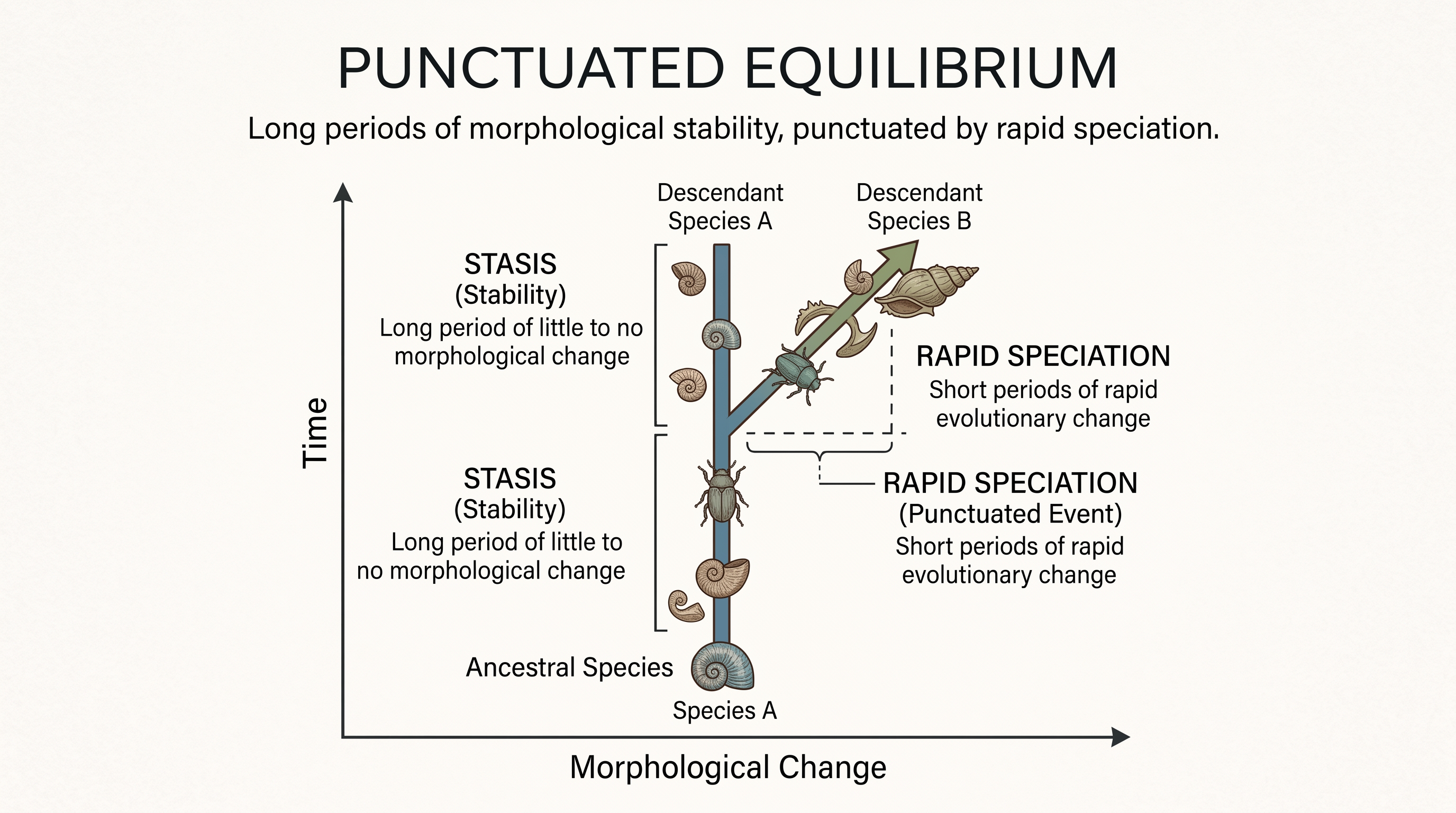
1. Biological Foundations
Proposed by paleontologists Niles Eldredge and Stephen Jay Gould in 1972, the theory of punctuated equilibrium challenged the traditional Darwinian view of evolution as an endlessly slow, continuous crawl.[1]
The Core Mechanics: Stasis vs. Punctuation
-
Stasis (The Long Wait): For hundreds of thousands or millions of years, a species remains relatively unchanged. Natural selection maintains the population around a stable set of traits because the environment is consistent.
-
Punctuation (The Rapid Shift): Environmental catastrophes, geographic isolation, or newly opened ecological niches trigger intense selection. A small population evolves rapidly over geological time (thousands rather than millions of years).
Gradualism vs. Punctuated Equilibrium
| Feature | Phyletic Gradualism | Punctuated Equilibrium |
|---|---|---|
| Pace of Evolution | Slow, steady, and continuous | Long periods of no change, punctuated by rapid bursts |
| Fossil Record "Gaps" | Missing data or incomplete fossilization | Evidence of rapid speciation in small populations |
| Population Dynamics | Uniform change across large populations | Small, isolated groups evolve quickly and replace older populations |
Paleontologists long struggled to find missing intermediate links in rock layers. Gould and Eldredge argued that rapid speciation primarily occurs in small, geographically isolated populations (allopatric speciation). Because these groups are small and adapt quickly, they rarely leave fossil traces. Once the new species expands back into a large population, it appears suddenly in rock layers and remains stable for millions of years.[1:1]
Modern Biological Consensus
Modern evolutionary biology recognizes that both processes occur. Certain lineages (such as specific marine microorganisms) demonstrate classic gradualism, while others (such as mammals rapidly diversifying after the Cretaceous–Paleogene extinction event) display dramatic punctuated patterns.
2. Cross-Disciplinary Applications
Because punctuated equilibrium models how complex systems handle stability and external shocks, it has been widely adapted outside biology.
Public Policy & Political Science
Frank Baumgartner and Bryan Jones introduced the Punctuated Equilibrium Theory (PET) of governance in 1993.[2]
-
Stasis (Incrementalism): Bureaucracy, institutional inertia, and coalition compromises keep year-to-year policies and budgets mostly static, changing by tiny percentages.
-
Punctuation (Policy Shock): Sudden crises or major shifts in public attention (e.g., financial crashes, pandemics, or security breaches) break institutional deadlocks. Policy shifts that normally take decades occur within days or weeks.
Business & Organizational Theory
Management researchers Connie Gersick and Michael Tushman demonstrated that corporate strategy and group dynamics follow punctuated trajectories rather than steady progress.[3]
-
Stasis (Convergence): Organizations optimize a successful business model through incremental refinements, cultural alignment, and process standardization.
-
Punctuation (Strategic Reorientation): Structural market shifts or disruptive technologies make old models obsolete. Companies must undergo rapid strategic reorientation or face failure (e.g., Kodak failing to pivot versus Netflix transitioning from DVDs to streaming to content production).
Technology & Innovation
Technology lifecycles progress through long periods of optimization punctuated by radical platform shifts.
| Phase | Characteristics | Photography Example |
|---|---|---|
| Punctuation | Disruptive breakthrough establishes a new paradigm | Invention of digital camera sensors |
| Stasis | Continuous incremental refinement of the standard | Years of incremental DSLR resolution and battery improvements |
| Punctuation | Secondary structural shock replaces the baseline | Smartphone cameras eliminating the point-and-shoot market |
Linguistics
Linguist R. M. W. Dixon applied the framework to describe language evolution:[4]
-
Stasis: Neighboring cultures living in relative peace experience slow language shift, absorbing minor vocabulary while maintaining core grammatical structures.
-
Punctuation: Invasions, rapid migrations, or historical shocks force populations to mix or assimilate, triggering rapid linguistic mutations (e.g., the transformation of Old English into Middle English following the Norman Conquest of 1066).
Philosophy of Science
Thomas Kuhn's The Structure of Scientific Revolutions (1962) outlined a matching structural pattern in human knowledge development prior to Gould and Eldredge's biological formulation:[5]
-
Normal Science (Stasis): Researchers work within an established paradigm, solving puzzles while assuming core foundational theories are correct.
-
Crisis & Revolution (Punctuation): Unexplained anomalies accumulate until a breaking point forces a rapid paradigm shift (e.g., Newtonian mechanics giving way to Einsteinian relativity).
3. Philosophical & Spiritual Parallels
The structural mechanics of punctuated equilibrium parallel key concepts in Buddhist philosophy regarding human perception, practice, and cosmic evolution.
The Enlightenment Debate: Gradualism vs. Subitism
In 8th-century Chan (Zen) Buddhism, a core philosophical division emerged regarding spiritual awakening:
-
Phyletic Gradualism
Northern School (Gradualism): Championed by Shenxiu, this view framed enlightenment as a continuous process of purifying the mind—likened to polishing a mirror continuously to prevent dust accumulation. -
Punctuated Equilibrium
Southern School (Subitism / Sudden Awakening): Championed by Huineng (the 6th Patriarch), this view posited that while preparation requires time, true realization (Satori or Kensho) occurs in a sudden, non-linear breakthrough.
In practice, years of silent meditation (Zazen) may yield no visible structural change (stasis), until a single sensory trigger or paradoxical riddle (Koan) shatters baseline perception (punctuation).
The Four Stages of Awakening
Theravada Buddhist doctrine frames spiritual progression not as a smooth slope, but as discrete, irreversible structural leaps:
At each punctuation point, specific cognitive fetters (such as identity view or doubt) are permanently severed instantly rather than fading incrementally.
Buddhist Cosmology & History
-
Cosmological Kalpas: Buddhist cosmology divides time into vast aeons (Kalpas). A world system stabilizes and lasts for billions of years (stasis), before dissolving through rapid cosmic destruction and re-emergence under a new Buddha (punctuation).
-
Historical Dharma Spread: Monastic communities maintained localized traditional routines for centuries (stasis), punctuated by major socio-political shocks—such as Emperor Ashoka's conversion in the 3rd century BCE—that forced rapid geographical expansion and adaptive evolution into new traditions like Tibetan Tantra and Zen.
Underpinning both models is the reality of non-linear change (Anicca / Impermanence). Complex systems maintain external equilibrium while internal and external forces quietly accumulate, eventually causing rapid structural reconfiguration once critical thresholds are breached.
4. Punctuated Equilibrium vs. The Tipping Point
While both concepts model non-linear systemic dynamics, they focus on distinct operational dimensions.[6]
Key Differences
-
The Tipping Point focuses on the trigger mechanism—the precise critical threshold where a small push causes an exponential cascade.
-
Punctuated Equilibrium focuses on the full system lifecycle—the alternation between extended equilibrium states and rapid reconfigurations that establish a new baseline.
| Metric | Punctuated Equilibrium | The Tipping Point |
|---|---|---|
| Primary Focus | Lifecycle transitions & structural shifts | Critical mass, contagion, & threshold triggers |
| Key Mechanism | Environmental shocks, isolation, system collapse | Network effects, viral momentum, context |
| Primary Result | Establishment of a new baseline equilibrium | Epidemic spread or rapid adoption wave |
The Frozen Lake Metaphor
-
Stasis (Punctuated Equilibrium): A frozen lake sits unchanged under stable winter conditions for weeks.
-
The Tipping Point: Ambient temperature reaches a critical threshold (33°F / 0.5°C). Critical mass is achieved.
-
Punctuation (Punctuated Equilibrium): Structural integrity collapses, violently melting the ice into liquid water within hours.
-
New Stasis (Punctuated Equilibrium): The lake stabilizes into a liquid state, establishing a new equilibrium baseline until another major shock occurs.
Market Application: Smartphone Industry
-
Tipping Point Perspective: Analyzes how the iPhone reached critical adoption mass through network effects, user interface stickiness, and word-of-mouth marketing past early-adopter thresholds.[6:1]
-
Punctuated Equilibrium Perspective: Analyzes the broader industry lifecycle. Telecommunication hardware remained in feature-phone stasis for decades, experienced rapid punctuation via touchscreen disruption that eliminated legacy market leaders (e.g., BlackBerry, Nokia), and settled into a multi-decade mobile design stasis.
Resonant Notes
The following notes in the vault share direct thematic, sociological, and philosophical connections with Punctuated Equilibrium:
🔴 Systemic Shock, Policy Punctuation & Organizational Rupture
- Canadian Language School Closures — Analyzes the collapse of Canada's private ELT sector through the combined frameworks of public policy punctuation (Baumgartner & Jones) and organizational inertia under sudden regulatory shock.
- The Anatomy of a Project Disaster - RMS Titanic Case Study — Examines institutional overconfidence, operational rigidity, and cascading collapse when static baseline environmental assumptions fail under acute stress.
- Malcolm Gladwell - The Tipping Point — Distinguishes epidemiological threshold triggers and viral tipping points from the comprehensive system-lifecycle alternations modeled by punctuated equilibrium.
🟡 Physics, Evolutionary Theory & Philosophy of Science
- Charles Darwin (1809–1882) — Details classical phyletic gradualism, articulating the foundational Darwinian model of continuous, incremental change that Gould and Eldredge sought to challenge and refine.
- Ludwig Boltzmann (1844-1906) — Boltzmann's phase-space logic and statistical coarse-graining provide the physical foundation for understanding macroscopic stability as an emergent equilibrium arising from microscopic chaos.
- Science vs. Pseudoscience - The Demarcation Problem — Connects Thomas Kuhn's structure of scientific revolutions and paradigm shifts to Karl Popper's demarcation criteria, tracing how periods of normal science stasis fracture into revolutionary punctuation.
🟢 Philosophical, Spiritual & Metaphysical Parallels
- Boltzmannian Coarse-Graining and Nagarjunian Emptiness — Explores deep structural parallels between statistical equilibrium, macro-stasis, and the Buddhist ontology of impermanence (Anicca) and dependent origination (Pratītyasamutpāda).
- The Core Instruction - Turning the Gaze Inward — Examines the sudden awakening (Satori / subitism) model in meditative contemplative practice, where years of silent, baseline discipline culminate in sudden perceptual breakthroughs.
References
Niles Eldredge & Stephen Jay Gould / Punctuated Equilibria: An Alternative to Phyletic Gradualism / archive.org ↩︎ ↩︎
Frank R. Baumgartner & Bryan D. Jones / Agendas and Instability in American Politics / uchicago.edu ↩︎
Connie J. G. Gersick / Revolutionary Change Theories: A Multilevel Exploration of the Punctuated Equilibrium Paradigm / aom.org ↩︎
R. M. W. Dixon / The Rise and Fall of Languages / cambridge.org ↩︎
Thomas S. Kuhn / The Structure of Scientific Revolutions / uchicago.edu ↩︎
Malcolm Gladwell / The Tipping Point: How Little Things Can Make a Big Difference / littlebrown.com ↩︎ ↩︎