Martin Heidegger
🗂️ Interactive Notebook: Open Study Companion (Video Summary, Flashcards, Mind Map) ↗
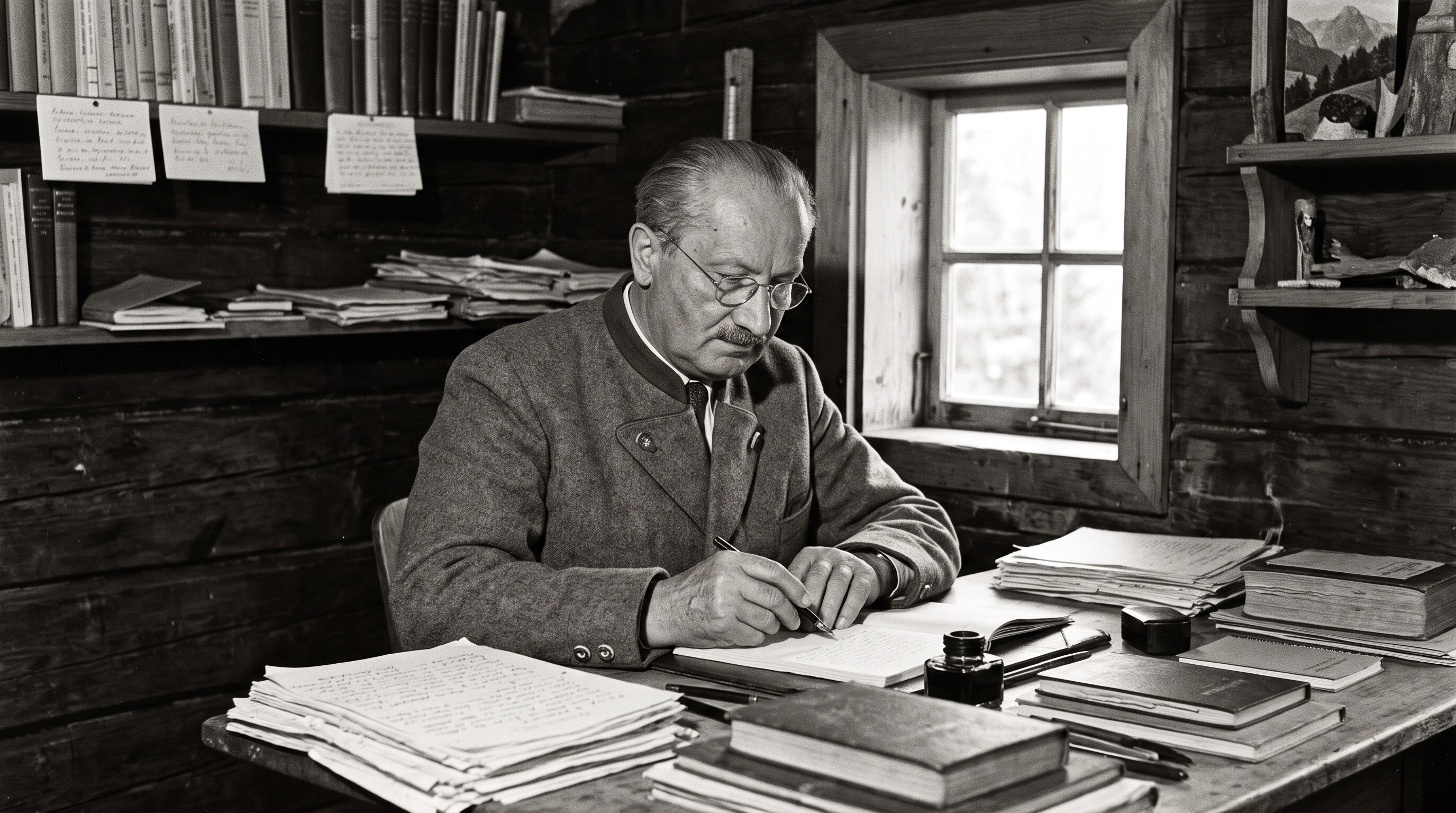
Martin Heidegger (1889—1976) was one of the most influential and fiercely debated philosophers of the 20th century. Best known for his 1927 magnum opus, Being and Time (Sein und Zeit), Heidegger sought to reawaken the fundamental question of what it means to "be." His work dismantled traditional Western metaphysics and laid the foundational groundwork for phenomenology, existentialism, hermeneutics, and deconstructionism.
Early Life and Academic Background
Martin Heidegger was born in 1889 in Messkirch, a conservative, Catholic town in southwestern Germany. He initially studied theology before turning to philosophy at the University of Freiburg. There, he became the protégé of Edmund Husserl, the founder of phenomenology (see Husserl's Internal Time-Consciousness). Heidegger eventually succeeded Husserl in the chair of philosophy at Freiburg in 1928, though he would later sharply diverge from his mentor's philosophical framework.[1]
Core Philosophical Concepts: Being and Time
Traditional Western philosophy, according to Heidegger, had lost sight of the "question of Being" by treating beings (entities, objects, subjects) merely as things to be measured, categorized, or used. In Being and Time, he sought to reconstruct how we understand existence itself.
Dasein (Being-there)
To understand Being, Heidegger argued, one must analyze the only entity capable of asking the question about Being: the human being. He coined the term Dasein (literally "Being-there") to describe human existence. Dasein is not an isolated, rational subject observing an objective world; rather, it is always already engaged and immersed in a context.
Heidegger insisted that humans cannot be separated from their environment. We do not exist as detached minds trying to prove the existence of the external world; our primary mode of existence is practical involvement with our surroundings.
Facticity and Thrownness (Geworfenheit)
Dasein does not choose the conditions of its existence. We are "thrown" into a world, an era, a language, and a culture that we did not select. This condition is what Heidegger calls thrownness. It limits our possibilities but also forms the necessary background for any meaningful action.
Authenticity and Inauthenticity
Because Dasein is thrown into a pre-existing society, it tends to adopt the default opinions, habits, and values of "the They" (das Man—the anonymous crowd or societal norm).
- Inauthenticity: Drifting along with the crowd, doing things simply because "that's what one does."
- Authenticity (Eigentlichkeit): Facing the reality of one's own unique existence, primarily by confronting one's own mortality.
Being-toward-death
For Heidegger, death is not an event at the end of life; it is a structural condition of Dasein. Recognizing that our existence is finite (Being-toward-death) induces Angst (dread or anxiety), which strips away the comforting illusions of the crowd. This anxiety individualizes us, forcing us to take responsibility for our own choices and live authentically.[1:1]
The "Turn" (Die Kehre) and Later Philosophy
In the 1930s, Heidegger's thought underwent a shift often referred to as the "Turn" (Die Kehre). He moved away from the human-centered analysis of Dasein and began focusing on how "Being" reveals itself historically through art, poetry, and language.
"Language is the house of being. In its home man dwells."
— Martin Heidegger, Letter on Humanism
The Critique of Technology
One of his most famous later essays, The Question Concerning Technology, diagnoses the modern crisis. Heidegger argued that modern technology is not merely a collection of tools, but a specific way of revealing the world. Technology views everything—including nature and human beings—as a "standing-reserve" (Bestand), meaning a resource to be optimized, stored, and exploited. This "enframing" (Gestell) blinds humanity to a more poetic, reverent relationship with existence.[2]
The Nazi Controversy
No study of Heidegger is complete without addressing his profound moral and political failings.
In 1933, Heidegger joined the Nazi Party (NSDAP) and was elected Rector of the University of Freiburg. During his tenure, he implemented the Nazification of the university, gave speeches praising Adolf Hitler, and broke ties with Jewish colleagues, including his former mentor Husserl.
He resigned the rectorship in 1934 but remained a party member until the end of the war in 1945. After the war, he underwent a de-Nazification hearing and was banned from teaching until 1951. Heidegger remained notoriously silent on the Holocaust for the rest of his life, never offering a public apology. The posthumous publication of his private notebooks, the Black Notebooks (Schwarze Hefte), in 2014 sparked renewed outrage, as they revealed deeply ingrained, philosophically framed anti-Semitism.[3]
Legacy and Influence
Despite his political associations, Heidegger's intellectual impact is inescapable. He profoundly influenced:
- Existentialism: Jean-Paul Sartre and Simone de Beauvoir adapted his concepts of authenticity and anxiety, though Heidegger personally rejected Sartre's humanistic interpretation.
- Hermeneutics: His student Hans-Georg Gadamer expanded his ideas into a universal theory of interpretation and understanding.
- Political Theory: Hannah Arendt (who was briefly his student and romantic partner) utilized his phenomenological method to analyze totalitarianism and the human condition.
- Postmodernism & Deconstruction: French thinkers like Jacques Derrida and Michel Foucault drew heavily on Heidegger's critique of Western metaphysics and his method of tracing the historical shifts in how truth is understood.
Resonant Notes
The following notes in the vault share direct thematic, sociological, and philosophical connections with Martin Heidegger:
🔴 The Self, Thrownness & Conditioned Existence (Dasein / Geworfenheit)
- Ludwig Wittgenstein — Comparative dialogue on language: the tool metaphor of the Philosophical Investigations versus Heidegger's ontology of language as the "house of being."
- Gestalt and Buddhism-Reality Construction — The self as an illusory Gestalt formed by the five Skandhas, mirroring Heidegger's claim that Dasein is not an isolated substance but a mode of being always already in-the-world.
- Losing Ourselves: Learning to Live without a Self — Jay L. Garfield's distinction between "selves" (permanent entities) and "persons" (relational, narrative beings) parallels Heidegger's rejection of the Cartesian subject.
- The Dividual and the Triṃśikā — Deconstructs the bounded individual into a composite, relational network; the Yogācāra storehouse consciousness operates as a site of relationships, echoing Dasein's entanglement in the world.
- Dissolving vs. Evolving-The Self in Buddhism and Jung — Contrasts the Buddhist deconstruction of the self with Jungian individuation; the Buddhist pole aligns with Heidegger's transition from the inauthentic "they-self" to authentic existence.
- The Architecture of Intention-Cetanā and the Karmic Loop in Vasubandhu's Psychology — Maps how past conditioning (seeds in storehouse consciousness) determines the initial arising of thoughts, while intention serves as the pivot point of freedom — a psychological architecture for thrownness (Geworfenheit).
- The Core Distinction-Epistemologies of Consciousness and Awareness in Nāgārjuna's Madhyamaka and Jungian Analytical Psychology — Diagnoses ordinary consciousness as a limited, dualistic mechanism, paralleling Heidegger's diagnosis of the forgetfulness of Being (Seinsvergessenheit).
🟡 Authenticity, Mortality & Mindfulness (Das Man / Sein-zum-Tode)
- Attention War-Neurobiology vs. Illusion — Connects Iain McGilchrist's divided brain thesis with Buddhist manasikāra (attention); the left hemisphere's model-locked mode provides a neurological substrate for das Man (the "They-self").
- Reflexive Loop-Attention and Intention in McGilchrist and Buddhism — Maps the recursive relationship between attention and intention as a practical framework for breaking out of delusion, paralleling Heidegger's call to authentic resolute disclosure (Entschlossenheit).
- The Generative Eye (McGilchrist and Buddhism) — Explores the self as a fluid functional construction from the aggregates; mistaking it for a permanent reality parallels inauthenticity as fleeing from finite existence.
- Buddhist Themes in Lucky — A cinematic meditation on death, impermanence, and the nature of the self; the film's quiet acceptance of mortality mirrors Heidegger's claim that confronting death (Sein-zum-Tode) individualizes human existence.
- Tibetan Wheel of Life — The Lord of Death holding the wheel of saṃsāra visually symbolizes the inescapable horizon of Being-toward-death.
🟢 Technology, Enframing & Phenomenological Method (Gestell)
- The Digital Mirror and the Lotus — Maps the Noble Eightfold Path onto AI ethics; "Digital Māyā" as a hyper-real, algorithmically enforced illusion directly applies Heidegger's critique of technology to the digital age.
- The Digital Infrastructure of Delusion - A Buddhist Economic and Psychological Analysis of Modern Marketing — Frames the attention economy as an exploitation of the Three Poisons, providing the Buddhist counterpart to Gestell (enframing) as a mode of revealing that blocks all other modes.
- McLuhan's The Medium is the Message & Marshall McLuhan (1911-1980) — McLuhan's insight that media environments restructure sensory ratios parallels Heidegger's thesis that modern technology is not a neutral tool, but an ontological mode of revealing.
- Brian Eno and Buddhism — Brian Eno's rejection of the sovereign creator in favor of generative, relational systems mirrors Heidegger's later emphasis on letting Being reveal itself through art.
- Husserl's Internal Time-Consciousness — Heidegger edited Husserl's 1905 lectures on internal time-consciousness; in Being and Time, he transformed Husserl's tripartite structure (Retention, Primal Impression, Protention) into Dasein's ecstatic temporality of thrownness (Geworfenheit), falling (Verfallen), and projection (Entwurf).
- Louis Sass - Phenomenological Psychopathology and the Self — Sass's Ipseity-Disturbance Model draws directly on Heideggerian Dasein analysis to understand schizophrenia as a disorder of the minimal, pre-reflective self.
- The Failure of the Map-Art, the Uncanny, and the Divided Brain — The left hemisphere's failure to "compute" art parallels Heidegger's critique of calculative thinking; the uncanny feeling when the map fails is the phenomenological experience of Gestell breaking down.
- The Matter With Things Analysis — McGilchrist's synthesis of neuroscience with Heideggerian and Buddhist insights, demonstrating how the divided brain thesis provides the neurobiological architecture for calculative vs. meditative thinking.
- Epistemology of Preference-Avijjā, Māna, and the Emptiness of Aesthetic Taste in Buddhist Philosophy — Deconstructs aesthetic preference as ego-fortification, resonating with Heidegger's insistence that art is a site of truth-disclosure (alētheia), not mere subjective taste.
References
Michael Wheeler / Martin Heidegger / Stanford Encyclopedia of Philosophy ↩︎ ↩︎
Martin Heidegger / The Question Concerning Technology and Other Essays / Harper Perennial ↩︎
Peter E. Gordon / Heidegger in Black / The New York Review of Books ↩︎