Ralph Waldo Emerson
🗂️ Interactive Notebook: Open Study Companion (Video Summary, Flashcards, Mind Map) ↗
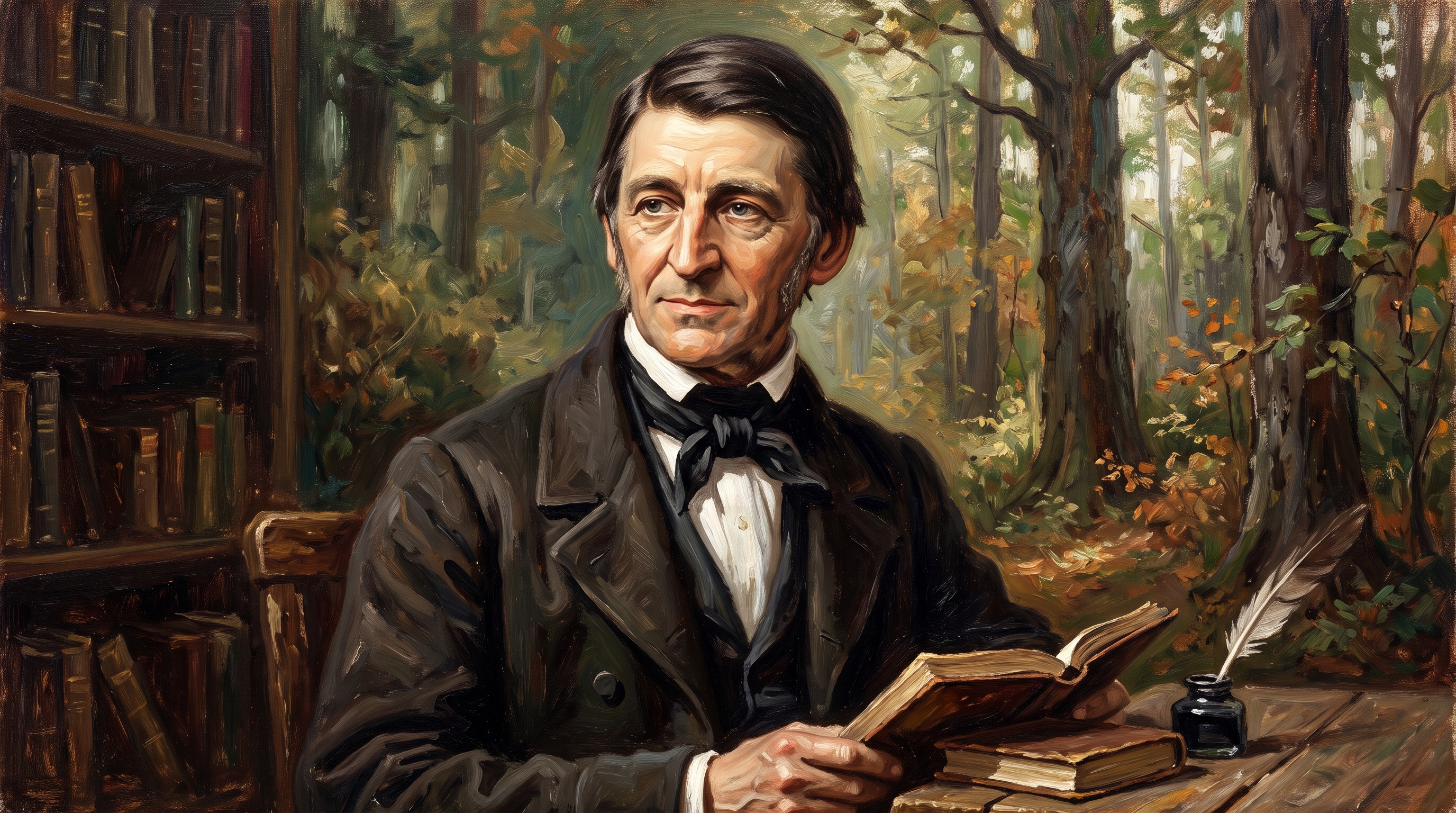
Ralph Waldo Emerson (1803—1882) was an American essayist, lecturer, philosopher, and poet who served as the intellectual leader and primary architect of the mid-19th-century Transcendentalist movement. Renowned for his radical advocacy of moral individualism, intuitive self-reliance, and the metaphysical unity of human consciousness with the natural cosmos, Emerson severed American intellectual culture from European scholastic dependence. His philosophical synthesis—merging German Idealism, British Romanticism, Neoplatonism, and ancient Hindu monism—profoundly influenced modern literature, phenomenology, pragmatism, and existential philosophy.[1]
Biography & Formative Crises
Formative Years and Ancestral Legacy
- Ancestry & Heritage: Born on May 25, 1803, in Boston, Massachusetts, Emerson descended from five generations of Puritan and Unitarian clergy. His father, the Rev. William Emerson, was pastor of Boston's prominent First Church.[1:1]
- Early Bereavement: William Emerson died of stomach cancer in 1811 when Waldo was only seven years old. Raised in genteel poverty by his mother, Ruth Haskins Emerson, his intellectual and spiritual sensibilities were fiercely molded by his eccentric, intellectually voracious aunt, Mary Moody Emerson, who introduced him to Neoplatonism, Hindu mysticism, and rigorous self-discipline.[1:2]
- Harvard Education: Educated at Boston Latin School (1812—1817), Emerson entered Harvard College in 1817 at age fourteen as a President's Freshman (earning board and tuition by running errands for the faculty). Graduating in 1821 in the middle of his class, he spent several years teaching at his brother William's school for young women before entering Harvard Divinity School in 1825.[2]
Ministry, Existential Grief, and the European Epiphany
- The Pulpit of Second Church: Emerson was ordained in 1829 as junior pastor (and shortly thereafter sole pastor) of Boston's Second Church, one of the city's historic pulpits. In September 1829, he married Ellen Louisa Tucker, whose youthful radiance and intense religious temperament deeply inspired him.[2:1]
- The Crucible of Loss (1831): Ellen died of tuberculosis in February 1831 at the age of nineteen. Shattered by grief, Emerson walked daily to her tomb in Roxbury (even opening her coffin over a year later). The devastating tragedy ruptured his remaining faith in formal ecclesiastical structures, cold liturgical dogma, and institutional Unitarian rationalism.[2:2]
- Resignation (1832): In June 1832, Emerson preached his landmark sermon "The Lord's Supper," announcing his refusal to administer the sacrament. Rejecting historical formalism, he argued that Jesus intended a living spiritual communion rather than a perpetual material rite, prompting his resignation from the ministry.[2:3]
- The European Journey & The Jardin des Plantes (1832—1833): Sailing to Europe in December 1832 to restore his health, Emerson visited Rome, Paris, and Britain. In Paris, his visit to the Cabinet of Natural History in the Jardin des Plantes provided a decisive metaphysical epiphany: observing the systematic gradations of botanical and animal forms, he was struck by the vital, occult relationship between human consciousness and natural taxonomy, famously recording in his journal: "I will be a naturalist." In Britain, he sought out intellectual mentors, forging lasting relationships with Samuel Taylor Coleridge, William Wordsworth, and especially Thomas Carlyle, whose lifelong transatlantic friendship anchored Emerson's transition into an independent literary and cultural prophet.[1:3]
Emerson's transition from the Unitarian pulpit to the public lyceum transformed lecturing into a secular liturgy. Returning to Concord, Massachusetts, in 1834, he married Lydia Jackson (whom he renamed Lidian) in 1835 and gathered around him the brilliant circle of the Transcendental Club (including Margaret Fuller, Bronson Alcott, Frederic Henry Hedge, and Henry David Thoreau), establishing Concord as the epicenter of American intellectual nonconformity.[3]
Epistemological and Metaphysical Architecture
Emerson's philosophy does not take the form of an academic, deductively systematic treatise; rather, it operates as an ongoing heuristic dialectic across essays, journals, and public orations. His metaphysical framework rests upon three foundational concepts: the Swedenborgian doctrine of correspondences, the epistemological divide between Intuitive Reason and Mechanical Understanding, and the cosmic monism of the Over-Soul.
1. Intuitive Reason (Vernunft) vs. Mechanical Understanding (Verstand)
Drawing on Samuel Taylor Coleridge's interpretation of Immanuel Kant and German Idealism, Emerson established a radical distinction between two modes of knowing:
- Understanding (Verstand): The lower, logical, sensory faculty. The Understanding operates through Lockean empiricism—measuring, cataloging, commodifying, and dissecting the material world through space and time. It is mechanical, utilitarian, and bounded by external data.
- Reason (Vernunft): The supreme intuitive, imaginative, and spiritual faculty. Reason does not deduce truth from sensory evidence; rather, it perceives truth immediately and holistically. It is the direct inward apprehension of absolute moral and metaphysical reality, transcending empirical demonstration.
For Emerson, genuine spiritual life, creative genius, and authentic individuality occur only when the empirical Understanding is subordinated to the sovereign influx of intuitive Reason.[3:1]
2. The Doctrine of Correspondences & The Hieroglyphic Cosmos
Deeply influenced by the visionary theology of Emanuel Swedenborg, Emerson posited that the physical universe is an outward, tangible materialization of internal spiritual laws. Nature is not an inert mechanical clockwork (as posited by Enlightenment deism), but a living, dynamic language:
- Words are signs of natural facts: Every spoken word and linguistic metaphor traces its etymological lineage back to an observable physical phenomenon.
- Particular natural facts are symbols of particular spiritual facts: Every natural process, creature, and law mirrors an eternal moral or metaphysical principle (e.g., light corresponds to truth; gravity corresponds to moral law).
- Nature is the symbol of spirit: The entire physical cosmos serves as an externalized, visible emblem of the human mind. The observer does not look at nature, but looks through nature into the divine mind.[1:4]
"Standing on the bare ground,—my head bathed by the blithe air, and uplifted into infinite space,—all mean egotism vanishes. I become a transparent eyeball; I am nothing; I see all; the currents of the Universal Being circulate through me; I am part or parcel of God."
— Ralph Waldo Emerson, Nature (1836)
The iconic image of the transparent eyeball encapsulates Emerson's mystical epistemology: egoless perception. By dissolving the petty, calculating social ego (the "mean egotism" of social status, financial anxiety, and personal vanity), sensory perception becomes wholly transparent, permitting the divine current of cosmic being to circulate unimpeded through the contemplative subject.
3. The Over-Soul (Der Allgeist & Vedantic Monism)
Introduced systematically in his 1841 essay "The Over-Soul," Emerson articulated a universalist, panentheistic metaphysics that synthesized German Idealism, Neoplatonic emanation, and the ancient non-dualism of the Hindu Upanishads and Bhagavad Gita (an early American manifestation of the Perennial Philosophy):
- The Universal Substrate: The Over-Soul is the boundless, omnipresent spiritual unity within which every individual human being is contained and interconnected. It is the eternal, divine Ground of Being.
- Inlet and Outlet: The individual human soul is not an isolated, private atom separated from God; rather, it is an "inlet" and an "outlet" through which the universal spirit acts upon the material world.
- The Collapse of Dualisms: Within the Over-Soul, the rigid divisions of classical metaphysics—between subject and object, knower and known, past and future, finite and infinite—are overcome. When an individual achieves profound moral intuition or creative insight, it is not an idiosyncratic personal achievement, but the Over-Soul thinking and speaking through them.[1:5][3:2]
The Philosophy of Action: Nonconformity, "Self-Reliance", and "Circles"
The Anatomy of "Self-Reliance" (1841)
Emerson's most widely read and influential essay, "Self-Reliance," represents his uncompromising defense of individual moral sovereignty against the suffocating pressures of social conformity and historical precedent.
- Aboriginal Selfhood vs. Egotism: Emersonian "self-reliance" is frequently misunderstood as a crude apology for selfish economic individualism or callous libertarian self-interest. In truth, Emerson anchors self-trust in the Over-Soul: to trust one's deepest intuitive conviction is to trust the universal divine law operating within. The "self" to be relied upon is not the shallow, capricious ego, but the aboriginal, transcendent source of life.
- The Tyranny of Conformity: Society everywhere is in a conspiracy against the manhood of every one of its members: "Whoso would be a man must be a nonconformist." Society demands compliance with names, customs, and institutions, substituting collective routine for living moral insight.
- The Rejection of Consistency: Emerson fiercely attacked the obsession with ideological consistency, declaring: "A foolish consistency is the hobgoblin of little minds, adored by little statesmen and philosophers and divines." To cling rigidly to past statements or established dogmas closes the soul to new spiritual influxes. Genuine life is spontaneous, dynamic, and perpetually open to transformation.[1:6]
"Circles" (1841) and the Doctrine of Continuous Genesis
In "Circles," Emerson formulated his most radical philosophy of flux and cognitive expansion:
- The Expanding Horizon: The eye is the first circle; the horizon which it forms is the second; and throughout nature this primary figure is repeated without end. Every ultimate fact is only the first of a new series; every general law is only a particular fact awaiting integration into a wider circle.
- Permanent Instability: Emerson explicitly rejects static finality: "There is no outside, no enclosing wall, no circumference to us." Culture, science, literature, and institutions are merely temporary resting places—encampments of the mind that must inevitably be dismantled when a new, wider circle of consciousness is drawn.
- Continuous Overcoming: Human potential is inexhaustible because the soul participates in divine infinity. The only sin in Emersonian cosmology is cognitive inertia, stagnation, and the refusal to break through the encrusted shell of convention.[2:4]
Tragic Epistemology and the Mature Philosophy of Limitation
While Emerson's early phase (1836—1841) is celebrated for its radiant, ecstatic Transcendental optimism, his middle and later works (1844—1860) developed a nuanced, somber, and sophisticated tragic epistemology.
The Crucible of "Experience" (1844)
In January 1842, Emerson's beloved firstborn son, Waldo, died of scarlet fever at age five. The profound psychic devastation shattered Emerson's confidence in direct, unmediated communion with the Absolute, inspiring his most philosophically complex essay, "Experience":
- The Numbness of Grief: Rather than finding spiritual purification in suffering, Emerson confessed the terrifying realization that grief does not bring us closer to reality: "The only thing grief has taught me, is to know how shallow it is... I grieve that grief can teach me nothing, nor carry me one step into real nature."
- The Seven "Lords of Life": Human existence is mediated and constrained by seven structural conditions of consciousness:
- Illusion: The shifting, deceptive dream-nature of daily experience.
- Temperament: The innate, biological prism through which each mind perceives the world—a colored lens that cannot be removed.
- Succession: The temporal stream of discrete moments that prevents us from grasping the whole at once.
- Surface: The reality that human life is lived along horizontal surfaces rather than plumbed to metaphysical depths.
- Surprise: The spontaneous, uncontrollable arrival of inspiration and events that defies intellectual calculation.
- Reality: The mysterious, recalcitrant ground that resists human mastery.
- Subjectiveness: The insurmountable prison of the self: "It is very unhappy, but too late to be helped, the discovery we have made, that we exist. That discovery is called the Fall of Man."
Fate, Power, and The Conduct of Life (1860)
In his mature masterpiece, The Conduct of Life, Emerson reconciled radical freedom with cosmic determinism:
- The Iron Reality of Fate: Moving beyond early idealism, Emerson acknowledged the crushing weight of natural law, heredity, geography, and historical momentum: "Fate is limitation." The universe is governed by ruthless physical and biological necessities that cannot be wished away.
- Freedom as Conscious Alignment: Liberty is not the absence of physical restraint, but the intellectual mastery of necessity. By understanding the laws of nature and aligning our will with cosmic momentum, human power (Power) harnesses the brute force of Fate itself, converting external obstacles into instruments of purposeful action.[1:7][2:5]
Chronological Matrix of Major Works & Intellectual Evolution
| Work / Address | Year | Genre / Venue | Central Philosophical Theses & Historical Significance |
|---|---|---|---|
| Nature | 1836 | Philosophical Treatise / Manifesto | Published anonymously; established the Swedenborgian doctrine of correspondences, the transparent eyeball epiphany, and the eightfold taxonomy of nature (Commodity, Beauty, Language, Discipline, Idealism, Spirit, Prospects).[3:3] |
| "The American Scholar" | 1837 | Phi Beta Kappa Address (Harvard) | Hailed by Oliver Wendell Holmes as America's "Intellectual Declaration of Independence." Defined the scholar not as a reclusive bookworm, but as "Man Thinking," demanding independent native creativity over passive European imitation.[3:4] |
| "Divinity School Address" | 1838 | Lecture (Harvard Divinity School) | Radical assault on historical, institutional Christianity. Denounced the worship of the historical Jesus in place of cultivating the immanent moral sentiment, provoking a three-decade exile from Harvard.[1:8] |
| Essays: First Series | 1841 | Essay Collection | Contains his defining early statements: "Self-Reliance" (moral nonconformity and self-trust), "The Over-Soul" (cosmic spiritual unity), "Circles" (expanding horizons of consciousness), and "Compensation" (moral equilibrium).[2:6] |
| Essays: Second Series | 1844 | Essay Collection | Marks the pivot to mature tragic epistemology and poetics: "Experience" (the Lords of Life, grief, and epistemic limitation), "The Poet" (the poet as the liberating namer of reality), and "Nominalist and Realist."[2:7] |
| Representative Men | 1850 | Biographical Lectures | Interrogates great historical figures (Plato, Swedenborg, Montaigne, Shakespeare, Napoleon, Goethe) as lenses through which the Over-Soul manifests specific cultural possibilities, directly anticipating Carlyle's hero-worship and Nietzsche's Übermensch.[2:8] |
| English Traits | 1856 | Cultural Critique / Travelogue | A sociopolitical and psychological analysis of English civilization, examining imperial power, industrial capitalism, racial theory, and institutional decay following his 1847—1848 lecturing tour.[1:9] |
| The Conduct of Life | 1860 | Essay Collection | The crowning work of his mature philosophy: synthesizes human agency with deterministic necessity in "Fate," "Power," "Wealth," and "Illusions," establishing a proto-pragmatic framework for living.[2:9] |
Social Agitation, Abolitionism, and the Fugitive Slave Law
From Philosophical Detachment to Militant Resistance
Early in his career, Emerson maintained a skeptical distance from organized reform societies, temperance leagues, and political parties, arguing that political associations diluted personal integrity and treated symptoms rather than the root spiritual sickness of the individual.
However, the escalation of chattel slavery in the United States forced Emerson into the political arena:
- The Annexation of Texas & The Mexican-American War (1846): Emerson condemned American imperial expansion as an aggressive conspiracy by Southern slaveholders, privately predicting that the conquest of Mexican territories would poison the Republic: "The United States will conquer Mexico, but it will be as the man swallows the arsenic, which brings him down in turn. Mexico will poison us."
- The Fugitive Slave Act of 1850: The federal law compelling Northern citizens and marshals to capture and return escaped slaves radicalized Emerson. Deeply disgusted by Massachusetts Senator Daniel Webster's compromise, Emerson declared in his journal: "This filthy enactment was made in the nineteenth century, by people who could read & write. I will not obey it, by God."
- Public Agitation (1851 & 1854 Addresses): Delivering fierce public speeches across Massachusetts, Emerson argued that statutory positive law is subordinate to eternal moral law. When a government enforces radical injustice, civil disobedience becomes an absolute spiritual mandate.
- Support for John Brown (1859): Emerson met John Brown in Concord and became an outspoken defender of his armed raid on Harpers Ferry. After Brown's sentencing, Emerson boldly proclaimed in Boston that Brown's martyrdom would "make the gallows as glorious as the cross," solidifying Emerson's role as a moral warrior for the Union during the Civil War.[1:10][3:5]
Comparative Philosophical Frameworks
Emerson vs. Thoreau: Architectural Idealism vs. Embodied Ecology
While Emerson provided the philosophical vision and metaphysical vocabulary of American Transcendentalism, his closest disciple and friend, Henry David Thoreau, tested and transformed those doctrines in physical practice:
- Epistemology of Nature: For Emerson, nature was primarily an allegorical textbook, an outward hieroglyph whose ultimate utility was to elevate human consciousness to spiritual truths ("Nature is made to conspire with spirit to emancipate us"). For Thoreau, nature possessed an intrinsic, sacred ecological value independent of human utility. Thoreau immersed himself in detailed phenology, botany, and physical sauntering in the wilderness.
- The Physical Stance: Emerson remained an urbanely polished Boston-Concord public lecturer, a man of the library, the study, and the lecture hall. Thoreau built his own cabin on Emerson's woodlot at Walden Pond, reduced his material needs to absolute essentials, and embraced physical labor and manual craft as spiritual disciplines.[3:6]
Emerson and Friedrich Nietzsche: The Genealogy of Self-Overcoming
Few intellectual lineages are as direct and transformative as that connecting Emerson to Friedrich Nietzsche:
- Nietzsche's Lifelong Admiration: Nietzsche discovered Emerson's essays as a schoolboy at Schulpforta in 1862 and kept marked copies of Emerson's works with him throughout his life, famously noting that he found in Emerson a "brother-soul."
- The Rejection of Herd Morality: Emerson's critique of social conformity and his insistence that "every man is a new creation" directly seeded Nietzsche's critique of slave morality, the herd instinct, and cultural decadence.
- Self-Overcoming and the Übermensch: Emerson's doctrine in "Circles"—that every achieved state of being is merely a stepping stone to be superseded by a wider circle—was secularized and radicalized by Nietzsche into the will to power (Wille zur Macht) and the continuous self-overcoming (Selbstüberwindung) of the Übermensch.[1:11]
🎴 Interactive Web Practice (Comprehension Check)
Question 1 (Epistemological Foundations): How does Emerson adapt the Kantian and Coleridgean distinction between "Reason" (Vernunft) and "Understanding" (Verstand) to construct his critique of Lockean empiricism in Nature?
Answer: Emerson appropriated Samuel Taylor Coleridge's interpretation of German Idealism, fundamentally re-engineering the terminology of Immanuel Kant to formulate a spiritual epistemology that rejected John Locke's empirical assertion that the human mind is a blank slate (tabula rasa) receiving truth solely through physical sensory impressions.
In Emerson's framework:
- The Understanding (Verstand): Represents the lower, discursive faculty that engages with the physical world. It measures, quantifies, classifies, and commodifies objects in space and time. While necessary for everyday physical survival and commercial organization, the Understanding is inherently blind to metaphysical essence and spiritual truth.
- Reason (Vernunft): Represents the supreme intuitive and imaginative faculty. Unlike Kant's more restrictive epistemological boundary, Emerson views Reason as the immediate, inward apprehension of divine and moral reality. Reason does not deduce truth through sensory proof or logical syllogisms; rather, it experiences direct spiritual illumination.
Question 2 (The Transcendental Paradox): How does Emerson reconcile the radical, sovereign individualism of "Self-Reliance" with the boundary-dissolving, cosmic monism of "The Over-Soul"?
Answer: At first glance, Emerson's philosophy presents an apparent contradiction: on one hand, "Self-Reliance" demands fierce individual nonconformity and defiance of collective authority; on the other hand, "The Over-Soul" posits that individual egos are transient waves in a universal, boundary-dissolving spiritual ocean.
Emerson reconciles this paradox by redefining the ontological nature of the "self":
- The Aboriginal Self as Inlet: In Emersonian metaphysics, the "self" that one relies upon is emphatically not the shallow, egotistical persona driven by pride, social status, or private greed. Rather, it is the Aboriginal Self—the point of intersection where individual human consciousness opens directly into the universal Over-Soul.
- Self-Reliance as Divine Reliance: When Emerson writes, "Trust thyself: every heart vibrates to that iron string," the trust being exercised is fundamentally trust in the divine current flowing through individual moral intuition. Because the Over-Soul is identical in all human beings, trusting one's purest inward insight aligns the individual with universal cosmic law.
- Conformity as Spiritual Occlusion: Social conformity, institutional dogma, and imitation of past authorities are pernicious precisely because they erect artificial barriers between the individual soul and the universal spirit. Genuine nonconformity is therefore not narcissistic rebellion, but an act of radical spiritual receptivity that allows the Over-Soul to act freely in the material world.
Question 3 (Tragic Epistemology and the Turn in "Experience"): How did the death of his five-year-old son Waldo in 1842 fundamentally alter Emerson's early transcendental optimism, and what are the structural implications of the "Lords of Life"?
Answer: The death of his firstborn son Waldo in 1842 shattered the unclouded, ecstatic idealism of Emerson's early career (1836—1841). In his seminal 1844 essay "Experience," Emerson confronted the horrifying realization that personal tragedy and acute bereavement do not penetrate to the ultimate core of reality, but instead reveal the insurmountable distance and numbness inherent in human perception: "I grieve that grief can teach me nothing, nor carry me one step into real nature."
This profound psychological crisis forced Emerson to formulate a mature tragic epistemology centered on the "Lords of Life"—the inescapable structural constraints that govern embodied human consciousness:
- Temperament and Subjectiveness: Emerson recognized that human perception is permanently colored by physiological temperament and subjective conditioning. We do not perceive the Absolute directly; rather, we see the world through the colored lens of our biological and psychological constitution.
- Surface and Succession: Life is lived horizontally along moving surfaces and fleeting temporal moments rather than in continuous mystical contact with the divine ground. Human beings are caught in a stream of successive states that cannot be arrested or systematically mastered.
- The Pivot to Mature Realism: While Emerson never abandoned his belief in spiritual potential, "Experience" and his later work The Conduct of Life (1860) replaced naive triumphalism with a tough-minded, proto-pragmatic philosophy. Acknowledging the recalcitrant realities of Fate, limitation, and biological contingency, Emerson redefined human power not as effortless transcendence, but as the disciplined, conscious alignment of human will with the unyielding currents of natural law.
Question 4 (Transatlantic Crosscurrents): In what specific ways did Friedrich Nietzsche secularize and adapt Emersonian concepts of nonconformity, "Circles," and representative figures into his philosophy of the Übermensch and the will to power?
Answer: Friedrich Nietzsche read and reread Emerson's essays from his youth into his mature creative period, viewing Emerson as an intellectual kindred spirit who championed sovereign individuality against bourgeois mediocrity.
Nietzsche secularized and transformed Emersonian philosophy across three central dimensions:
- The Critique of Herd Conformity: Emerson's proclamation in "Self-Reliance" that society is in a perpetual conspiracy against the independence of its members directly stimulated Nietzsche's critique of the "herd instinct" (Herdeninstinkt) and the leveling tendencies of modern democratic and Christian culture. Both thinkers viewed collective social norms as an existential trap that paralyzes authentic creative genius.
- Dynamic Genesis and Self-Overcoming: Emerson's doctrine in "Circles"—that every achieved state of culture, science, or personal identity is merely an encampment to be dissolved and superseded by a wider circle of consciousness—was stripped of its theological foundation by Nietzsche and recast as continuous self-overcoming (Selbstüberwindung) driven by the will to power (Wille zur Macht).
- Representative Men to the Übermensch: Emerson's Representative Men (1850) analyzed figures like Plato, Montaigne, and Shakespeare as lenses through which humanity discovers elevated states of consciousness. Nietzsche radicalized this into his doctrine of the higher human being and the Übermensch: figures who do not conform to existing moral codes, but legislate new values through sheer spiritual and creative sovereignty.
Resonant Notes
The following notes in the vault share direct thematic, philosophical, and literary connections with Ralph Waldo Emerson:
🔴 Transcendentalism, Nature & The American Counter-Tradition
- American Transcendentalism — The foundational New England movement Emerson led, articulating the core doctrines of moral intuition, nonconformity, the divinity of nature, and an original relation to the universe.
- Metaphysics of Henry David Thoreau — Emerson's primary counterpart and protégé, who translated Emersonian Transcendentalism and the doctrine of the Over-Soul into an embodied, empirical metaphysics of nature, biological phenology, and the sacred ontology of the "Wild."
- Beyond Representation-Shared Epistemology of Thoreau and Kerouac — Explores how Transcendentalist doctrines of unmediated perception and spectator consciousness evolved into Jack Kerouac's 20th-century spontaneous prose poetics.
- Jack Kerouac (1922-1969) — Kerouac's "Dharma Vagabond" operates as a 20th-century descendant of the Emersonian-Thoreauvian seeker; both sacralize the open landscape, reject institutional bourgeois conformity, and seek direct mystical experience.
- Norman Mailer — Mailer's vernacular American Existentialism—the Hipster's defiant rejection of the "Square" and technocratic conformity—inherits Emersonian self-reliance as an aggressive revolt against institutional regimentation.
- Counter-Culture — Traces the socio-philosophical genealogy linking 19th-century Concord Transcendentalism and communal experiments (such as Brook Farm and Fruitlands) to the 1960s American counter-cultural rebellion against technocratic capitalism.
🟡 The Over-Soul, Mysticism & Perennial Epistemology
- Perennial Philosophy & Aldous Huxley's The Perennial Philosophy — Emerson's Over-Soul serves as a quintessential American expression of the perennial Divine Ground, synthesizing German Idealism, Neoplatonism, and the Hindu Upanishads into a universalist non-dual framework.
- Emanuel Swedenborg — Featured in Emerson's Representative Men; Swedenborg's visionary theology and doctrine of correspondences—where natural facts serve as direct physical emblems of spiritual facts—profoundly shaped Emerson's symbolic understanding of nature.
- Johann Wolfgang von Goethe (1749-1832) & Goethe's Metaphysics of Polarity — Examined in Representative Men as the archetype of the "Writer"; Goethe's organic morphology, dynamic polarity (Polarität), and living conception of nature deeply resonated with Emerson's philosophy of continuous metamorphosis.
- Immanuel Kant-The Transcendental Sublime & The Sublime, Awe, and Epiphany — Provided the critical epistemological vocabulary (the transcendental distinction between intuitive Reason and sensory Understanding) through which Emerson formulated his aesthetics of spiritual elevation and egoless perception.
- Aldous Huxley's Heaven and Hell (1956) & Aldous Huxley's The Doors of Perception (1954) — Huxley's mapping of visionary consciousness and "Mind at Large" directly mirrors Emerson's transparent eyeball metaphor, depicting the dissolution of the ego into a transcendent, unmediated cosmic reality.
- William James & William James and the Landscape of Eastern Thought — Emerson's godson and philosophical heir, James transformed Transcendentalist mystical intuition and the Over-Soul into a rigorous psychological and pluralistic taxonomy of religious experience and radical empiricism.
- Animism — Emerson's view of nature as a living, sacred hieroglyph shimmering with spiritual intelligence mirrors animist relational ontologies that reject Cartesian mechanistic reductionism.
- Jean Klein — Klein's Advaita Vedanta "Direct Approach"—teaching that the seeker is already identical to the ultimate consciousness they seek—resonates with Emerson's conviction that the divine reality is accessed through direct inward intuition rather than institutional mediation.
🟢 Radical Individualism, Self-Overcoming & Existential Authenticity
- Friedrich Nietzsche — Emerson profoundly influenced Nietzsche throughout his creative life; both thinkers championed radical individualism, continuous self-overcoming (Selbstüberwindung), intellectual sovereignty, and the uncompromising rejection of herd conformity.
- Søren Kierkegaard — A contemporary European critic of institutional orthodoxy, Kierkegaard shares Emerson's defense of subjective inwardness, individual passion, and the direct spiritual conscience over collective ecclesiastical dogma.
- Jean-Paul Sartre — Sartre's existentialist thesis that "existence precedes essence" and his condemnation of bad faith (mauvaise foi) align with Emersonian self-reliance and the imperative to forge an authentic life free from societal scripts.
- Fyodor Dostoevsky (1821-1881) — Dostoevsky's Underground Man, who champions irreducible human will against deterministic rationalism and the "Crystal Palace," parallels Emerson's defense of non-conformist individual intuition against mechanistic conformity.
- Ayn Rand's The Fountainhead - An Explanation — Provides an instructive individualist foil: while both Emerson and Rand fiercely condemn social collectivism and second-hand conformity, Emerson grounds individual sovereignty in mystical communion with the divine Over-Soul, whereas Rand anchors it in rational egoism and material production.
- Northrop Frye, From Walls of Wood to Walls of Glass - Northrop Frye’s Geography of Isolation, & English-language Canadian Literature (English CanLit) — Serves as a vital geographical and cultural contrast. While Emerson celebrated nature as a benevolent, divine temple welcoming the sovereign individual, the Canadian literary tradition articulated a "garrison mentality" that viewed wilderness as an indifferent, terrifying force requiring defensive communal solidarity.
- Woody Allen — Allen's neurotic protagonists, paralyzed by existential dread, urban hypochondria, and social alienation, dramatize the inverse of Emersonian self-reliance: the psychological torment of failing to achieve authentic self-trust.