Dunbar's Number - The Rule of 150
🗂️ Interactive Notebook: Open Study Companion (Video Summary, Flashcards, Mind Map) ↗
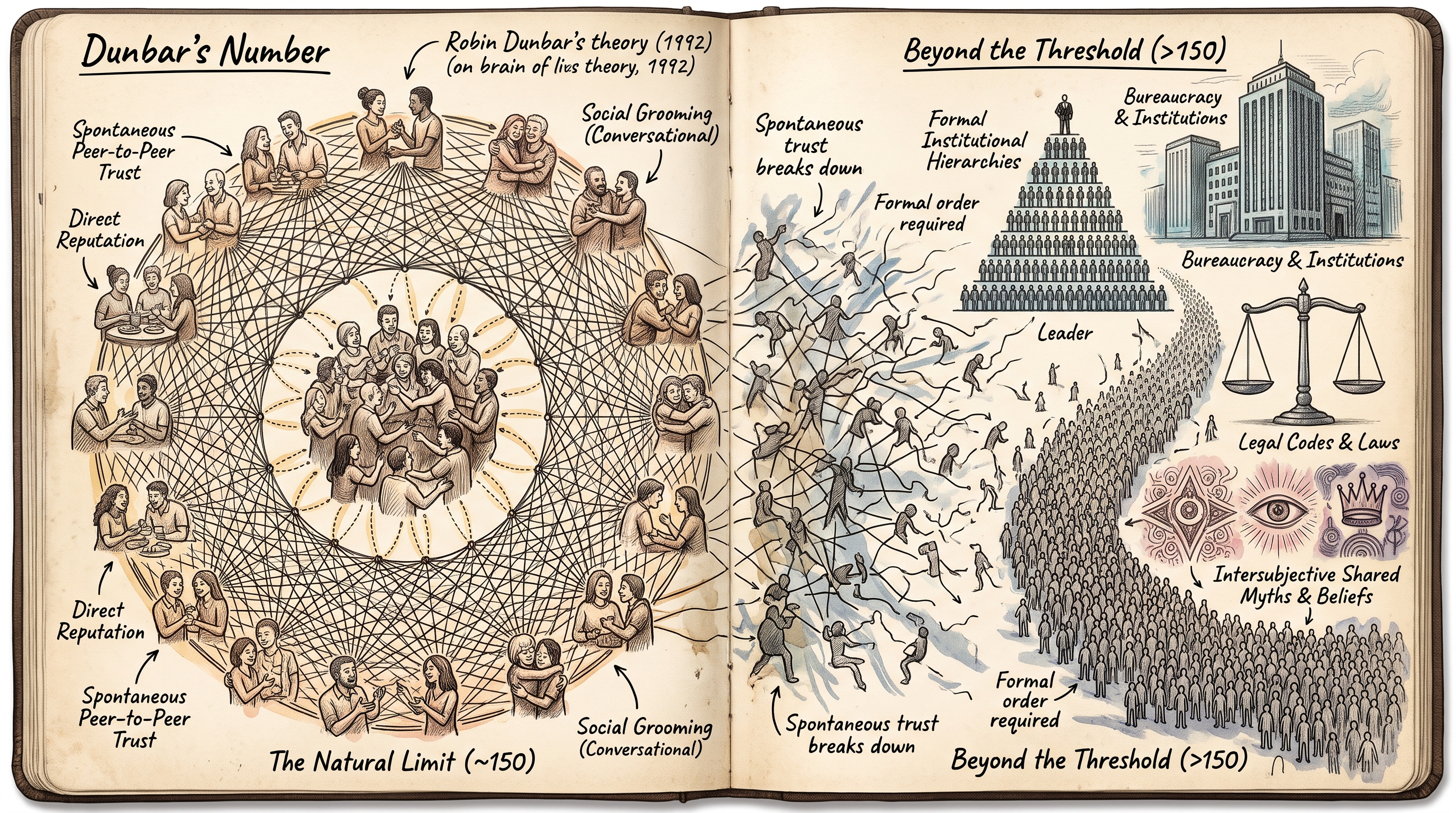
Dunbar's number is a proposed cognitive limit to the number of individuals with whom a human being can maintain stable, reciprocal social relationships—classically cited as 150. First formulated in 1992 by British anthropologist and evolutionary psychologist Robin Dunbar, the theory posits that human social network size is physiologically constrained by the processing capacity of the primate neocortex. Beyond this threshold, spontaneous peer-to-peer trust, social grooming, and direct reputation tracking break down, requiring the substitution of formal institutional hierarchies, legal codes, and intersubjective shared myths to preserve collective order.
1. Evolutionary Origins & The Social Brain Hypothesis
In evolutionary anthropology, the Social Brain Hypothesis—developed by Robin Dunbar following earlier work by Alison Jolly and Nicholas Humphrey—proposes that primates evolved disproportionately large brains not primarily to navigate physical terrain, forage, or manipulate tools, but to navigate the intensely complex computational demands of social living.[1]
Social life requires managing shifting alliances, tracking reciprocal favors, detecting deception, and anticipating the emotional and cognitive states of peers via Theory of Mind.
[ Primate Neocortex Ratio ] ──► [ Social Grooming Capacity ] ──► [ Maximum Cohesive Group Size ]
Dunbar analyzed 38 different genera of non-human primates, plotting their neocortex ratio (the volume of the neocortex relative to the rest of the brain) against their observed mean social group size.[2] He identified a tight, linear regression across species: the larger the neocortex relative to the brainstem and limbic system, the larger the cohesive social troop.
Primate Neocortex Ratio and Social Group Size
The following table presents the comparative evolutionary regression across key primate lineages that formed the foundation for Dunbar's extrapolation:
| Primate Taxon | Common Representative | Relative Neocortex Ratio | Mean Cohesive Group Size | Primary Social Bonding Mechanism |
|---|---|---|---|---|
| Prosimians | Ring-tailed Lemur (Lemur catta) | ~1.2 – 1.5 | 5 – 15 | Physical scent marking & olfactory clustering |
| New World Monkeys | Squirrel Monkey (Saimiri) | ~2.0 – 2.5 | 20 – 35 | Physical grooming & spatial proximity |
| Old World Monkeys | Olive Baboon (Papio anubis) | ~2.8 – 3.2 | 40 – 80 | Dyadic grooming & vocal grunts / contact calls |
| Hominoids (Apes) | Chimpanzee (Pan troglodytes) | ~3.2 – 3.8 | 45 – 65 | Intensive reciprocal grooming (up to 20% of daytime) |
| Hominins (Homo sapiens) | Modern Human | ~4.1 – 4.3 | 147.8 (~150) | Symbolic language, vocal gossip, laughter & shared ritual |
Extrapolating this primate regression line to the volume of the modern human brain yielded a predicted group size of 147.8, which Dunbar conventionally rounded to 150.[3]
To delineate what constitutes a "stable relationship" at this upper limit, Dunbar formulated his celebrated operational criterion:
The number of individuals you would not feel embarrassed about joining uninvited for a casual drink if you happened to bump into them in a bar.[4]
2. The Mathematics of Social Tracking & Cognitive Load
The biological bottleneck behind Dunbar's limit is rooted in combinatorics and working memory limits explored in Cognitive Load Theory. Maintaining group cohesion requires more than just knowing individual identities (
The total number of pairwise relationships (
| Group Size ( | Social Milestone / Tier | Bilateral Ties to Monitor ( | Cognitive & Structural Demands |
|---|---|---|---|
| 5 | Intimate Support Core | 10 | Effortless direct monitoring; total empathic synchronization. |
| 15 | Sympathy Group (Crisis Anchor) | 105 | Trackable via weekly informal conversations and shared time. |
| 50 | Hunter-Gatherer Foraging Band | 1,225 | Near daily contact; relies on subtle micro-coalition awareness. |
| 150 | Dunbar's Limit (Clans & Villages) | 11,175 | Upper threshold of direct social memory without external records. |
| 500 | Mega-Band / Regional Tribe | 124,750 | Exceeds human brain capacity; requires symbolic markers and clans. |
| 1,500 | Tribal Nation / Military Legion | 1,124,250 | Complete cognitive overload; necessitates formal bureaucracy and law. |
At
3. The Fractal Architecture of Sociality (The Rule of Three)
Human social networks do not consist of a flat, homogeneous pool of 150 companions. Instead, Dunbar discovered that human relationships organize into distinct, concentric, nested circles scaling by a constant factor of approximately 3 (the "Rule of Three").[5]
Each layer corresponds to a specific emotional investment, interaction frequency, and cognitive demand:
| Concentric Layer | Emotional Tier | Group Size ( | Cumulative Time / Attention Allocation | Characteristic Interaction & Sociological Function |
|---|---|---|---|---|
| Layer 1 | Support Clique (Intimates) | ~5 | ~40% of all social time | Core emotional pillars, romantic partner, closest kin; immediate crisis sanctuary. |
| Layer 2 | Sympathy Group | ~15 | ~20% of additional social time | Close friends whose untimely passing would cause profound, lasting grief; mutual aid network. |
| Layer 3 | Affinity Group (Camp Band) | ~50 | Regular monthly engagement | Regular gathering group, dinner-party orbit, extended family; cohesive social camp. |
| Layer 4 | Active Clan (Dunbar Limit) | ~150 | Annual / semi-annual contact | The limit of reciprocal obligations; weddings, funerals, communal harvest, seasonal defense. |
| Layer 5 | Acquaintance Orbit | ~500 | Passive observation | People recognized by name, role, and context; weak ties lacking reciprocal obligation. |
| Layer 6 | Recognition Horizon | ~1,500 | Pure visual memory | The maximum number of human faces and identities an average brain can recall visually. |
Movement across these boundaries is dynamic: if a new intimate enters Layer 1, an existing member is almost invariably pushed outward into Layer 2 due to strict cognitive and temporal budget constraints.
4. Real-World Applications Across History, Institutions, and Business
When a community or enterprise remains below 150 members, social order can be sustained organically through peer pressure, spontaneous gossip, shared norms, and direct empathy. Once headcounts cross 150, organizations face a mandatory structural transition: they must either split into autonomous cells or introduce formal bureaucratic procedures, middle management, and written rules.
The table below contrasts how diverse human institutions throughout history have structurally adapted to the 150-person boundary:
| Institutional Domain | Specific Real-World Organization | Typical Headcount | Operational Mechanism & Structural Adaptation |
|---|---|---|---|
| Anthropology | Hunter-Gatherer Overnight Bands | 120 – 150 | Traditional seasonal camps of hunter-gatherers (e.g., the !Kung San, Yanomami) split when bands become unmanageable.[6] |
| Historical Agriculture | Neolithic Farming Villages | 130 – 160 | Archaeological records from the Levant and Europe show early agricultural settlements naturally capped at ~150 before budding.[7] |
| Communal Religion | Old Order Amish Church Districts | ~150 (25–35 families) | When an Amish church district exceeds 30–35 households, it divides into two districts to preserve unwritten mutual accountability.[8] |
| Anabaptist Communes | Hutterite Colonies | 130 – 150 | Colonies deliberately purchase new land and split when reaching 150; beyond this, elders observe that formal policing becomes unavoidable.[9] |
| Military History | Roman Legionary Maniple | 120 – 160 | The core tactical building block of the Republican Roman legion, composed of two centuries, supervised directly by senior centurions.[10] |
| Modern Armed Forces | NATO Infantry Company | 120 – 150 | A basic tactical military formation commanded by a Captain; allows the commander to know every soldier's temperament and physical competence.[10:1] |
| Corporate Architecture | W.L. Gore & Associates (Gore-Tex) | 150 per building | Facilities are capped at 150 employees; when reached, an entirely new factory is built—often sharing the same parking lot.[8:1] |
| Agile Tech Engineering | Spotify "Tribes" | ~100 – 150 | Engineering squads are clustered into "Tribes." To maintain shared context and minimize communication silos, Tribes are capped at 150.[11] |
| Early Remote Tech | 37signals (Basecamp) | Under 100 | Deliberately maintains a lean team to preserve lateral trust and avoid middle-management bloat or bureaucratic ossification. |
| Digital Gaming Communities | World of Warcraft Guilds & DAOs | 120 – 150 | Online clans and decentralized autonomous organizations without formal officer hierarchies consistently fracture when active rosters surpass 150.[12] |
Detailed Case Studies
1. W.L. Gore & Associates: The Factory Parking Lot Rule
The most prominent corporate operationalization of Dunbar's number was pioneered by Wilbert L. "Bill" Gore, founder of W.L. Gore & Associates (makers of Gore-Tex). Gore observed that whenever a manufacturing plant grew beyond roughly 150 people:
- Spontaneous cooperation deteriorated into bureaucratic formality;
- Employees no longer recognized colleagues passing in the hallway;
- Absenteeism increased and workers demanded rigid policy manuals and union rules to resolve conflicts.[8:2]
To counteract this, Gore instituted a strict structural policy: plants were limited to 150 workstations and 150 parking spaces. Once the parking lot filled up, the company purchased land and built an independent, autonomous factory—sometimes directly adjacent in the same industrial park. By preserving plants under the 150-person threshold, Gore-Tex operated without formal titles, organizational charts, or middle managers, relying entirely on self-organizing peer commitments.[8:3]
2. The Hutterite Ethnosociological Split
The Hutterian Brethren, an Anabaptist communal religious movement originating in the 16th century, have systematically implemented Dunbar's rule for centuries without knowledge of primate neuroscience. Hutterite colonies live as a communal agricultural unit where all property is held in common:
- When a colony approaches 130 to 150 individuals, the leadership initiates a deliberate daughter-colony split (daughtering).
- Half the colony moves to a newly acquired farm property, splitting the community by lottery into two balanced cohorts.[9:1]
- Ethnographic studies confirm that under 150, peer pressure and community religious sentiment suffice to motivate labor and curb anti-social behavior; exceeding 150 leads to internal factions, social alienation, and the demand for punitive legal apparatuses.[9:2]
3. Spotify's Squad & Tribe Engineering Framework
During its rapid global expansion in the early 2010s, music streaming service Spotify created an influential organizational architecture designed to balance engineering agility with corporate scale:
- The base unit was the Squad (6 to 12 engineers, mimicking Dunbar's Layer 1/2 intimate support clique).
- Squads working in related functional areas were bundled into a Tribe.
- Spotify explicitly capped Tribes at a maximum of 150 people.[11:1]
- Lead engineers noted that within a 150-person Tribe, engineers retained cross-functional visibility, shared technical architecture organically, and felt a shared collective purpose without heavy layers of project managers and steering committees.[11:2]
4. Reciprocity Constraints in Digital Social Networks
When platforms like Facebook, Twitter (now X), and LinkedIn emerged, digital visionaries claimed that networked computing would dissolve physical and biological constraints on social interaction, enabling individuals to maintain thousands of active friendships.
Empirical network analysis has thoroughly refuted this utopian premise:
- Twitter Network Analysis (2011): A study conducted by Bruno Gonçalves, Nicola Perra, and Alessandro Vespignani analyzed millions of Twitter conversations across 380 million tweets. They discovered that while users followed thousands of accounts, the number of individuals with whom a user actively exchanged bidirectional messages consistently capped between 100 and 200 accounts.[13]
- The "Path" Social Network Experiment: Launched in 2010 by Dave Morin, the mobile social network Path was explicitly designed around Dunbar's cognitive threshold. Recognizing that Facebook feeds were degrading into superficial broadcasts, Path initially instituted a hard cap of 50 friends, later raised to 150. By eliminating the incentive for follower accumulation, the platform fostered high-trust, authentic personal sharing, validating that meaningful interaction requires bounded social intimacy.[14]
- Virtual Worlds & MMORPG Guilds: In large-scale online games like World of Warcraft and EVE Online, sociologist Nick Yee and virtual-world researchers discovered that player guilds that attempt to govern themselves through flat, egalitarian consensus routinely splinter once active membership crosses 150. Above this threshold, guilds inevitably dissolve due to factional drama unless they adopt rigid hierarchical officer ranks, formal attendance systems (DKP), and written disciplinary policies.[12:1]
5. Methodological Critiques and Scientific Deconstruction
Despite its vast popular appeal—largely driven by Malcolm Gladwell's popularization in The Tipping Point—Dunbar's number has encountered substantial scientific criticism from modern evolutionary biologists and statistical researchers.
The Stockholm University Deconstruction (Lindenfors, Wartel, & Lind, 2021)
In May 2021, Swedish researchers Patrik Lindenfors, Andreas Wartel, and Johan Lind published an empirical critique in Biology Letters titled "Dunbar's number deconstructed", replicating Dunbar's methodology using updated datasets and modern phylogenetic comparative methods.[15]
| Diagnostic Dimension | Robin Dunbar's Original Formulation (1992) | Stockholm University Deconstruction (2021) |
|---|---|---|
| Statistical Regression Method | Ordinary Least Squares (OLS) regression on uncorrected species means. | Phylogenetic Generalized Least Squares (PGLS) correcting for evolutionary relatedness.[15:1] |
| Primate Dataset Size | 38 primate genera. | Expanded contemporary databases incorporating dozens of additional primate species.[15:2] |
| Predicted Human Group Size | A precise mean of 148 (rounded to 150). | No stable number; 95% confidence intervals spanned from 2 to 520 individuals.[16] |
| Primate Brain Function Assumption | The neocortex processes social networks identically across all primate families. | Primate cognitive strategies vary drastically; ape sociality is driven heavily by diet, foraging ecology, and predation pressures, not merely neocortex volume.[17] |
| Role of Human Culture | Biological constraints in the brain hardware establish a firm ceiling. | Cultural mechanisms, language, institutional tools, and written records easily overwrite biological cognitive limitations.[18] |
The researchers concluded that a single cognitive number cannot be reliably derived from primate brain proportions:
"The cognitive limit on human group size cannot be derived with any precision using analyses of comparative primate brain data." — Patrik Lindenfors et al.[15:3]
The Ecological and Functionalist Counter-Argument
Anthropologists have also pointed out that human group sizes vary dramatically based on subsistence strategy:
- Pastoralists and nomadic desert foragers often operate in fluid, fission-fusion groups ranging anywhere from 20 to 50 individuals;
- Sedentary maritime and riverine communities easily form denser settlements;
- Modern technological interventions (calendars, contact lists, CRM databases, Slack channels) distribute relational cognitive load across external technological artifacts—a phenomenon aligning with Cognitive Load Theory and distributed cognition.
6. Sociological Implications: Georg Simmel and the Urban Stranger
When human beings are thrust into metropolitan environments where they encounter thousands of strangers daily, biological social capacity is utterly overwhelmed. This psychological rupture was anticipated by German sociologist Georg Simmel (1858-1918) in his landmark 1903 treatise The Metropolis and Mental Life.
Simmel observed that the urban resident, confronted with an unceasing barrage of sensory stimuli and anonymous faces far exceeding their cognitive bandwidth, must develop an emotional protective shield: the blasé attitude (die Blasiertheit).[19]
Rather than engaging with every passerby through authentic personal recognition, the urban dweller adopts an attitude of indifference, emotional distance, and cold calculation.
[ Cognitive Capacity Exceeded (>150) ] ──► [ Simmelian Sensory Saturation ] ──► [ The Blasé Attitude & Social Estrangement ]
As expanded in Simmel and the Attention Economy — Abstraction, Alienation, and Cognitive Capture, when community scale expands beyond Dunbar's boundary, human sociality shifts from:
- Gemeinschaft (Organic Community): Grounded in face-to-face intimacy, shared moral consensus, and mutual reputation tracking; to
- Gesellschaft (Mechanical Society): Grounded in contractual agreements, abstract currency, legal codes, and impersonal institutional monitoring.
To bridge this gap, humans rely on shared fictions—imagined communities, national identities, corporate brands, and legal entities—to coordinate action among millions of anonymous individuals who can never know one another personally.
🎴 Interactive Web Practice (Comprehension Check)
Question 1 (The Social Brain Hypothesis & Neocortex Regression): How did Robin Dunbar arrive at the specific figure of approximately 150 for human social groups, and what is the core premise of the Social Brain Hypothesis?
Answer: The Social Brain Hypothesis posits that large primate brains evolved primarily to manage the computational complexity of navigating intricate social relationships, alliances, and deception within troops, rather than for physical foraging or tool fabrication. By analyzing 38 primate genera, Robin Dunbar demonstrated a direct linear correlation between the relative volume of a primate species' neocortex (the neocortex ratio) and its average cohesive social group size. When Dunbar plugged the neocortex ratio of modern Homo sapiens into this regression model, it predicted a mean group size of approximately 147.8 individuals (conventionally rounded to 150). This represents the biological boundary where an individual can maintain stable, reciprocal, and trust-based social bonds without relying on formal institutional hierarchies.
Question 2 (Organizational Scaling & Institutional Fission): Why do institutions like W.L. Gore & Associates and Hutterite colonies enforce a structural cap of 150 members, and what sociometric shift occurs when a group exceeds this threshold?
Answer: Below 150 members, social order, productivity, and cooperation can be sustained through informal peer accountability, direct interpersonal familiarity, and spontaneous social pressure. At this scale, everyone knows who everyone else is, their strengths, weaknesses, and reliability, rendering extensive middle-management hierarchies and rigid rulebooks unnecessary. When headcounts surpass 150, the number of potential bilateral relationships expands into the tens of thousands ($r = \frac{n(n-1)}{2}$), overwhelming individual cognitive tracking capacity. As a result, anonymity creeps in, peer pressure loses its regulatory power, and factions emerge. To prevent this social decay, W.L. Gore builds new factories (capping facilities at 150 workstations and parking spots), and Hutterite colonies deliberately divide their settlements into daughter communities to preserve organic cohesion without relying on bureaucratic coercion.
Question 3 (Scientific Deconstruction & Statistical Limitations): On what methodological grounds did the 2021 Stockholm University study (Lindenfors et al.) challenge the validity of Dunbar's Number?
Answer: Lindenfors, Wartel, and Lind deconstructed Dunbar's Number in Biology Letters by demonstrating that the original 1992 calculation relied on vulnerable statistical assumptions. Using updated primate brain datasets and modern Phylogenetic Generalized Least Squares (PGLS) methods that account for evolutionary relatedness, they found that the 95% confidence interval for human group size was extraordinarily wide and practically unusable—spanning anywhere from 2 to 520 individuals. Furthermore, they criticized the assumption that primate brains process social data identically across families, highlighting that primate sociality is shaped heavily by ecology, diet, and predator avoidance. Finally, they argued that human social structures are uniquely flexible and driven by cultural technologies, language, and institutions, which easily expand or reshape human social organization beyond any supposed biological hardwiring.
Resonant Notes
The following notes in the vault share direct thematic, sociological, and literary connections with Dunbar's Number and Social Scaling:
🔴 Cognitive Evolution, Theory of Mind & Primate Grooming
- Theory of Mind - The Cognitive Architecture of Social Intelligence — The cognitive bedrock of the Social Brain Hypothesis. Navigating higher-order intentionality (tracking who believes what about whom) consumes immense neocortical resources, establishing the computational bottleneck that caps direct human group size at ~150.
- Cognitive Load Theory & Cognitive Schemas — The cognitive architecture explaining why bilateral tracking collapses beyond 150 individuals. As the number of social dyads exceeds working memory limits, human cognition requires heuristic categorization and institutional shortcuts to prevent cognitive overload.
- Identity Protective Cognition — Examines how group membership and cognitive loyalty shape human information processing; in groups larger than the tribal baseline, individuals resort to identity-protective biases to preserve standing within their chosen faction.
- Charles Darwin (1809–1882) — Evolutionary natural selection provides the physical framework for the Social Brain Hypothesis, tracking how brain size and energy-intensive neural tissue evolved in response to hominin cooperative survival pressures.
🟡 Urban Density, Social Alienation & Simmelian Sociology
- Georg Simmel (1858-1918) & The Metropolis and Mental Life — Simmel's classic diagnosis of the urban blasé attitude provides the sociological outcome of vastly exceeding Dunbar's number. When individuals encounter millions of strangers, the brain erects an emotional defense mechanism of detachment and indifferent calculation to avoid psychic exhaustion.
- Simmel and the Attention Economy — Abstraction, Alienation, and Cognitive Capture — Explores how modern communications infrastructure and market abstraction exploit human attention, replacing the rich, multi-sensory grooming of the 150-person clan with superficial digital micro-interactions.
- Georg Simmel's concept of The Stranger — Analyzes the specific relational category that emerges when human social density outgrows intimate clans; the Stranger is neither complete insider nor total outsider, but a structural fixture of groups operating beyond biological trust limits.
- The Philosophy of Money (Philosophie des Geldes) — Simmel illustrates how money functions as the ultimate abstract coordination technology, allowing millions of anonymous actors to cooperate economically without requiring the direct, emotional trust characteristic of small hunter-gatherer bands.
- The flâneur — The solitary, observant urban wanderer who drifts through the anonymous metropolitan crowd, embodying the total dissolution of intimate communal bonds in mass society.
🟢 Organizational Scaling, Bureaucratic Capture & Shared Myths
- Yuval Noah Harari — Harari's central thesis in Sapiens directly builds on Dunbar's number: human beings bypassed the biological 150-person threshold during the Cognitive Revolution by inventing intersubjective shared fictions (religions, corporations, nations, legal systems), allowing millions of strangers to cooperate toward common goals.
- Malcolm Gladwell - The Tipping Point — Gladwell features the Rule of 150 as a core mechanism within "The Power of Context," detailing how W.L. Gore & Associates operationalized Dunbar's limit to preserve peer pressure and eliminate corporate bureaucracy.
- William H. Whyte's The Organization Man & William H. Whyte's Social Ethics — Whyte analyzes the bureaucratic conformity and institutional apparatus that inevitably arises when corporate enterprises expand far beyond organic tribal limits, forcing employees to surrender individual autonomy to managerial hierarchies.
- David Émile Durkheim (1858–1917) & Durkheimian Sociology — Durkheim's distinction between mechanical solidarity (pre-modern, small-scale cohesion based on shared sameness) and organic solidarity (modern, large-scale cohesion based on division of labor and institutional interdependence) mirrors the transition across Dunbar's boundary.
- Dividual — The post-structuralist concept of the human being fragmented into algorithmic data points and corporate profiles, illustrating the fate of individual identity in hyper-scaled, digitized societies.
- Consumer Behavior and the Architecture of Influence — Investigates how marketers leverage the human psychological longing for tribal belonging (Layer 1–3 intimacy) to engineer brand loyalty in mass consumer markets.
Backlinks
- Yuval Noah Harari — Harari identifies Dunbar's Number as the biological barrier that Homo sapiens conquered through intersubjective myth-making and collective storytelling during the Cognitive Revolution.
- Malcolm Gladwell - The Tipping Point — Cites the Rule of 150 as the critical architectural threshold for organizational agility, employee engagement, and corporate cultural stickiness in W.L. Gore & Associates.
- Theory of Mind - The Cognitive Architecture of Social Intelligence — Outlines the neural mechanisms of recursive mentalizing that constrain primate neocortical processing, providing the neurobiological foundation for Dunbar's limit.
- The Metropolis and Mental Life — Investigates the cognitive and sociological coping mechanisms developed by metropolitan inhabitants when population density overwhelms biological social capacity.
- Simmel and the Attention Economy — Abstraction, Alienation, and Cognitive Capture — Traces how expanding network scales degrade organic relational trust into commodified, abstract digital attention.
- Case Study-Managing Workplace Relationships and Love Contracts — Examines how corporate human resource departments deploy formal contractual instruments to regulate intimate interpersonal boundaries in large organizations where organic community norms no longer suffice.
References
R.I.M. Dunbar / Neocortex size as a constraint on group size in primates / Journal of Human Evolution, 1992 ↩︎
Robin Dunbar / Grooming, Gossip, and the Evolution of Language / Harvard University Press, 1996 ↩︎
R.I.M. Dunbar / The Social Brain Hypothesis / Evolutionary Anthropology, 1998 ↩︎
Robin Dunbar / How Many Friends Does One Person Need? Dunbar's Number and Other Evolutionary Quirks / Faber & Faber, 2010 ↩︎
R.I.M. Dunbar et al. / The structure of online social networks mirrors that in the offline world / Social Networks, 2015 ↩︎
Russell D. Greaves, Karen L. Kramer / Hunter-gatherer settlement sizes and mobility / Journal of Anthropological Archaeology, 2014 ↩︎
Ofer Bar-Yosef / The Natufian Culture in the Levant, Threshold to the Origins of Agriculture / Evolutionary Anthropology, 1998 ↩︎
Malcolm Gladwell / The Tipping Point: How Little Things Can Make a Big Difference / Little, Brown and Company, 2000 ↩︎ ↩︎ ↩︎ ↩︎
John A. Hostetler / Hutterite Society / The Johns Hopkins University Press, 1974 ↩︎ ↩︎ ↩︎
Defense Media Network / Dunbar's Number and the Military / defensemedianetwork.com ↩︎ ↩︎
Henrik Kniberg, Anders Ivarsson / Scaling Agile @ Spotify with Tribes, Squads, Chapters & Guilds / Spotify Whitepaper, 2012 ↩︎ ↩︎ ↩︎
Nick Yee / The Proteus Paradox: How Online Games and Virtual Worlds Change Us—And How They Don't / Yale University Press, 2014 ↩︎ ↩︎
Bruno Gonçalves, Nicola Perra, Alessandro Vespignani / Modeling Users' Activity on Twitter Networks: Validation of Dunbar's Number / PLOS ONE, 2011 ↩︎
TechCrunch / Path Raises Limit to 150 Friends / techcrunch.com ↩︎
Patrik Lindenfors, Andreas Wartel, Johan Lind / 'Dunbar's number' deconstructed / Biology Letters, Royal Society, 2021 ↩︎ ↩︎ ↩︎ ↩︎
Patrik Lindenfors, Andreas Wartel, Johan Lind / 'Dunbar's number' deconstructed / ScienceDaily, 2021 ↩︎
Robert W. Sussman / The Myth of Man the Hunter: Man the Hunted / Westview Press, 2006 ↩︎
Kim Sterelny / The Evolved Apprentice: How Evolution Made Humans Unique / MIT Press, 2012 ↩︎
Georg Simmel / Die Großstädte und das Geistesleben (The Metropolis and Mental Life) / Dresden: Petermann, 1903 ↩︎