Entropy: Thermodynamics, Information, and Systems
🗂️ Interactive Notebook: Open Study Companion (Video Summary, Flashcards, Mind Map) ↗
Entropy is one of the most foundational, transformative concepts in modern intellectual history, bridging classical physics, statistical mechanics, cybernetics, neurobiology, and postmodern cultural theory. While popularly trivialized as a synonym for "disorder," "chaos," or "messiness," entropy is fundamentally a rigorous measure of energy dispersal, microscopic probability, and informational uncertainty. In physical systems, the Second Law of Thermodynamics dictates that concentrated energy spontaneously disperses into wider thermal equilibria, establishing the macroscopic arrow of time. In statistical mechanics, Ludwig Boltzmann demonstrated that systems evolve toward macroscopic states corresponding to the greatest multiplicity of microscopic arrangements, an insight deepened by Carlo Rovelli into the relational realization that thermodynamic irreversibility emerges from observer coarse-graining. In information theory, Claude Shannon reconceptualized entropy as the measure of unexpected novelty and communication surprise. Transposed into cognitive science and the humanities, entropy illuminates the brain's struggle against metabolic degradation through predictive inference, the neurodynamics of altered consciousness, and the postmodern saturation of media, institutional decay, and late-capitalist waste.
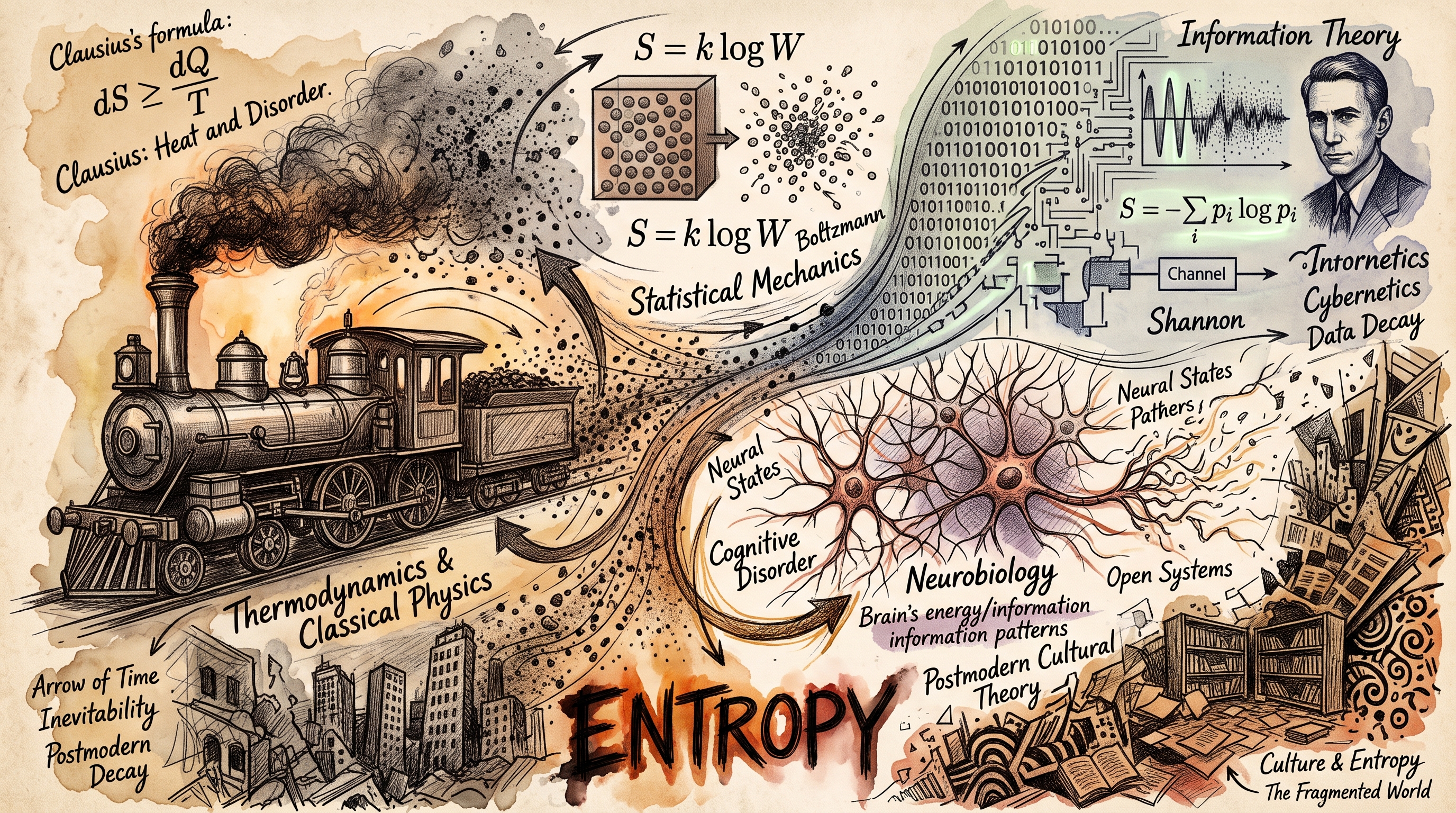
1. Classical Thermodynamics: Energy Dispersal and the Arrow of Time
Classical thermodynamics emerged during the nineteenth-century Industrial Revolution, driven by the engineering imperative to optimize the mechanical efficiency of steam engines. Formulated by Rudolf Clausius, William Thomson (Lord Kelvin), and Nicolas Léonard Sadi Carnot, the science of heat revealed an intrinsic asymmetry in natural processes.
Beyond the Fallacy of "Disorder"
For over a century, educational pedagogy casually framed entropy as an index of "messiness" or "untidiness," comparing it to an unkempt bedroom or a scattered pile of papers. Contemporary physical chemists and epistemologists have demonstrated that this anthropocentric metaphor obscures the underlying physics:[1]
- The Bedroom Fallacy: A messy bedroom does not become disordered because of a thermodynamic law; human rooms require continuous human intentionality to conform to personal cultural preferences. Nature possesses no aesthetic preference for neat stacks of laundry over laundry scattered on the floor. Both configurations are simply arrangements of matter.
- Energy Dispersal: Rigorously conceived, entropy measures the spontaneous tendency of concentrated energy to spread out, dilute, and disperse into surrounding cooler spaces whenever it is not physically constrained. High entropy represents dilute, evenly distributed energy; low entropy represents concentrated, localized energetic potential capable of doing directed work.
- The Asymmetry of Work: While mechanical, electrical, or chemical energy can be converted completely into heat (such as car brakes grinding a moving vehicle to a halt), thermal energy can never be gathered completely back into organized mechanical propulsion without expending additional energy elsewhere.
- The Arrow of Time: Microscopic particle interactions in classical Newtonian mechanics are strictly time-reversible; a film of two billiard balls colliding appears physically plausible whether played forward or in reverse. Macroscopic thermodynamics introduces the unidirectional "arrow of time": spontaneous macroscopic processes—heat conduction, gas expansion, chemical dissipation—never run backwards in isolation.[2]
The Ink Drop and the Hot Coffee Analogy
To grasp thermodynamic irreversibility without equations, consider two everyday physical phenomena:
- The Ink Drop in Water: When a single droplet of dark blue ink falls into a glass of still, clear water, the pigment molecules are initially packed tightly together inside a tiny perimeter (a state of highly concentrated energy and position). Over time, unguided molecular agitation carries the ink outward, dispersing the pigment evenly until the entire liquid becomes a uniform, faint azure hue. The ink never spontaneously un-mixes or re-coalesces into a solitary droplet at the surface. Energy and matter have dispersed into equilibrium.
- The Cooling Cup of Coffee: A freshly brewed mug of boiling coffee placed on an office desk contains dense thermal energy stored in rapid molecular vibrations. The stark temperature gap between the hot coffee and the surrounding ambient room represents high thermodynamic potential—usable energy capable of driving a miniature heat engine. Spontaneously, through ceaseless molecular collisions, that concentrated heat leaks across the ceramic barrier into the air, desk, and surrounding walls until the entire room reaches a uniform room temperature.
- The Irreversible Tax: The dispersed thermal vibrations will never spontaneously muster themselves from the walls and ambient air back into the ceramic mug to bring the liquid back to a boil. Although total energy is perfectly preserved by the First Law of Thermodynamics, its capacity to perform directed work has been permanently degraded. Entropy measures the degree of that irreversible dispersal.[1:1]
2. Statistical Mechanics: Boltzmann, Microstates, and Coarse-Graining
The transition from macroscopic bulk thermodynamics to modern statistical physics was engineered by Austrian physicist Ludwig Boltzmann, alongside James Clerk Maxwell and J. Willard Gibbs. Boltzmann connected the bulk properties of matter (pressure, volume, temperature) to the chaotic, unguided collisions of microscopic atoms and molecules.
Macrostates and Microstates
To operationalize statistical mechanics, Boltzmann established a conceptual distinction between two perspectives on any system:
- Macrostate (The Big Picture): The overarching, bulk description of a system perceived through coarse human senses or laboratory gauges (such as the overall temperature of a room, the total pressure of a gas tank, or the general appearance of a deck of cards).
- Microstate (The Atomic Reality): The exact, instantaneous configuration of every microscopic constituent in the system—the specific position, trajectory, momentum, and quantum state of every individual particle at any split second.
The Lego Castle and the Statistical Inevitability of Entropy
Rather than viewing entropy as an active mechanical force pushing things toward ruin, Boltzmann revealed that entropy is simply an overwhelming game of probability. Consider a complex castle built out of colored Lego bricks:
- The Fragile Low-Entropy Macrostate: There is essentially only one specific arrangement (or a very tiny handful of microscopic configurations) where every brick sits in its exact structural place to form towers, walls, drawbridges, and parapets. Because the number of compatible microstates is exceedingly small, the Lego castle possesses exceptionally low entropy.
- The Vast High-Entropy Macrostate: If you place the castle in a large plastic bin and shake it vigorously, the bricks disassemble and rattle against one another. There are quadrillions of distinct arrangements that all register to the human eye as an undifferentiated, chaotic jumble of loose bricks at the bottom of the bin.
- Statistical Inevitability: Shaking the bin does not possess a malevolent desire to destroy the castle. Rather, because configurations that look like a jumble outnumber configurations that look like an intact castle by trillions to one, random agitation will inevitably produce the jumble. A system moves from low entropy to high entropy simply because high-entropy states have vastly more ways of existing.[3]
The Shuffled Card Deck Analogy
The same combinatorial truth governs a standard deck of fifty-two playing cards:
- The Pristine Deck (Low Entropy): When a brand-new deck is unsealed, it is arranged in strict order: Hearts ace through king, followed by Diamonds, Clubs, and Spades. There is only one unique sequence that satisfies this exact specification.
- The Shuffled Deck (High Entropy): After several thorough riffle shuffles, the cards are thoroughly mixed. There are over eighty unvigintillion (an eight followed by sixty-seven zeroes) possible card orders. Almost every single one of those arrangements represents an uncoordinated, generic mixture.
- No Invisible Hand: If an expert dealer shuffles the deck and deals five cards, the hand is overwhelmingly likely to be an unremarkable collection of mismatched suits rather than a Royal Flush. The dealer is not being thwarted by an antagonistic force; the phase space of mismatched hands simply dwarfs the tiny handful of royal hands.
Coarse-Graining and Relational Thermal Time
In contemporary theoretical physics, Boltzmann's framework has been synthesized with quantum gravity and relational ontology, as explored in Boltzmannian Coarse-Graining and Nagarjunian Emptiness and the work of Carlo Rovelli.
- Microscopic Reversibility: At the fundamental quantum level, physical laws are completely symmetrical. An exact, omniscient microscopic description of all particles in the universe contains no friction, no heat dissipation, and no intrinsic arrow of time.
- The Pointillist Painting Analogy (Coarse-Graining): Stand two inches away from a Pointillist canvas by Georges Seurat, and your eye perceives only isolated dots of red, blue, and yellow pigment. Step back ten feet, and your visual apparatus naturally blurs—or "coarse-grains"—those discrete dots into a woman holding a parasol in a park. Macroscopic biological observers cannot track trillions of quantum variables; we interact with the world through blurred sensory and cognitive summaries.
- Relational Thermal Time: In The Order of Time, Carlo Rovelli demonstrates that entropy is not an absolute, objective property of physical matter in isolation; it is a relational property arising at the intersection between a coarse-grained observer and an interactive system. The unidirectional flow of time is an emergent statistical illusion generated by our blurred perspective. As Rovelli aphorizes: "Time is ignorance." If an observer possessed infinite informational resolution and could track every single subatomic particle simultaneously, entropy and the arrow of time would cease to exist.[4]
- The Boltzmann Brain Paradox: If the universe drifts toward equilibrium over infinite eons, random statistical fluctuations will eventually, over unimaginably vast timescales, temporarily assemble complex structures out of background static. Boltzmann calculated that a stray fluctuation is far more likely to produce a single isolated conscious brain floating in the void—complete with synthetic memories of an entire lifetime—than an entire physical cosmos of billions of coordinated galaxies. This thought experiment serves as an epistemic challenge to cosmological theories that take our observed low-entropy Big Bang as ordinary.[5]
3. Information Theory: Shannon Entropy and Communication Cybernetics
In his groundbreaking 1948 paper "A Mathematical Theory of Communication," Bell Labs mathematician Claude E. Shannon adapted Boltzmann's statistical framework to quantify signals, data, and noise in telecommunications.[6]
Information as the Resolution of Uncertainty
In colloquial speech, "information" implies meaningful insight, semantic truth, or philosophical wisdom. In Information Theory, however, semantic meaning is irrelevant. Entropy measures the quantitative degree of uncertainty, surprise, or unpredictability in a message source.
- The Morning Sunrise vs. The Solar Flare: If a news broadcast announces, "The sun rose in the east this morning," the transmission carries virtually zero information entropy. The event was already expected with absolute certainty; the message resolves zero doubt and delivers zero surprise. Conversely, if an alert announces, "A massive coronal mass ejection has instantly knocked out the Western electrical grid," the message delivers immense informational entropy because the event was completely improbable and carries maximum surprise.
- The Two-Headed Coin vs. The Fair Coin: Imagine betting on repeated coin tosses. If the coin is weighted with heads on both sides, the outcome of every flip is completely predictable before it lands. Watching it flip provides zero surprise, which corresponds to the absolute minimum of information entropy (zero bits). If the coin is slightly biased (landing heads ninety percent of the time), uncertainty is low because you can reasonably predict heads. But if the coin is perfectly fair (fifty percent heads, fifty percent tails), uncertainty is maximized. Every single toss provides a full unit of surprise, representing maximal informational entropy (one bit).
Redundancy, Noise, and Channel Capacity
Shannon's formulation established foundational principles for cybernetics, computing, and media ecology:
- Signal vs. Static: As explored in Signal vs Static - Breaking Down Communication Noise, every communication pathway—from copper wires to conversational speech—is bombarded by background static. If a message is compressed down to its purest, most unpredictable essence (maximum information entropy), even a single corrupted letter or sound will ruin the entire message.
- Redundancy as a Safety Buffer: To guarantee that an idea survives noisy transmission, communicators intentionally introduce repetition and predictable patterns (lowering information entropy). Phrases like "I repeat" or spelling names phonetically ("Alpha, Bravo, Charlie") deliberately sacrifice brevity to create an error-resistant shield against channel noise.
- Landauer's Principle and the Blackboard Eraser: In 1961, physicist Rolf Landauer proved that information entropy is inseparable from physical thermodynamics. Writing data into a memory register can theoretically occur with negligible energy, but erasing a bit of information unavoidably dissipates a microscopic quantity of physical heat into the surroundings. Just as vigorously scrubbing a chalk sketch off a slate blackboard requires physical friction that warms the stone, erasing computational memory expels heat into the room. Computation is physically tethered to the thermodynamic Second Law.[7]
4. Cognitive Science & Neurodynamics: The Entropic Brain and Predictive Processing
Over recent decades, neuroscientists and philosophers of mind have demonstrated that human perception, subjective experience, and cognitive stability are governed by the dynamic management of entropy.
The Entropic Brain Hypothesis
Formulated by neuropharmacologist Robin Carhart-Harris, the Entropic Brain Hypothesis posits that the richness and flexibility of conscious states correlate directly with cortical entropy—the degree of informational diversity, unpredictability, and cross-talk occurring across brain networks:[8]
- The Deep Ruts of Low Entropy (Rigid / Sub-Critical): When cortical entropy drops too low, brain activity becomes excessively constrained, repetitive, and locked in rigid feedback loops. Clinically, this manifests as obsessive-compulsive disorders, severe depressive rumination, rigid addictions, and catatonia. The mind travels down the exact same worn mental grooves, unable to escape its own predictable internal scripts.
- Normal Waking Consciousness (The Balanced Middle): Everyday healthy functioning balances order and flexibility. The brain maintains sufficient predictive stability to navigate social rules and physical hazards while retaining enough adaptive plasticity to learn from novel surprises.
- The Fresh Snow of High Entropy (Fluid / Super-Critical): When cortical constraints are loosened—such as through psychedelic compounds (psilocybin, LSD), REM dreaming, or early spiritual epiphanies—cortical entropy surges. Brain networks that normally operate in strict isolation begin communicating across wide distances. The rigid mental ruts are covered by a fresh snowfall of neural fluidity, leading to ego dissolution, synesthetic perceptions, and hyper-associative creativity.
The Default Mode Network (DMN) as an Entropy Dam
The primary biological engine responsible for keeping cortical entropy suppressed in ordinary adult life is the Default Mode Network (DMN), anchored in the medial prefrontal and posterior cingulate cortices.
- The Reducing Valve Analogy: This neural architecture acts as the biological realization of Henri Bergson's philosophical model in Bergson’s Eliminative Model of Perception and Memory and Aldous Huxley's formulation in Aldous Huxley's The Doors of Perception (1954). The physical brain does not manufacture consciousness from scratch; instead, it acts as a restrictive reducing valve or dam, holding back an overwhelming ocean of sensory and cosmic data to prevent the organism from being paralyzed by sheer informational overload.
- Opening the Floodgates: When the Default Mode Network is quieted—whether through deep meditative absorption, sensory deprivation, or psychedelic compounds—the dam opens. Suppressed sensory currents flood conscious awareness, temporarily releasing the mind into high-entropy perception.
Predictive Processing and the Free Energy Principle
Formulated by neuroscientist Karl Friston, the Free Energy Principle describes every living organism as a localized defiance of the Second Law of Thermodynamics.[9]
- Active Inference Against Decay: An organism that passively allowed its internal states to equilibrate with the ambient environment would quickly die, dissolve, and decompose. To stay alive, an organism must maintain a continuous barrier against entropy, preserving a predictable internal environment.
- The Internal Weather Simulator: As detailed in the Bayesian Brain Hypothesis and Glitches in The Bayesian Brain, the human brain operates as a hierarchical prediction machine. Rather than passively waiting for sensory inputs to arrive, it continuously broadcasts top-down models of what it expects to encounter, calculating the discrepancy (prediction error) between expectations and reality. By constantly updating its internal forecasts, the brain minimizes surprise and keeps metabolic entropy bounded.
- The Desktop Interface Analogy: In alignment with Donald Hoffman's The Interface Theory of Perception (ITP), human perception did not evolve to reveal objective physical reality in its full thermodynamic complexity. Instead, evolution equipped organisms with a species-specific desktop interface. Just as a blue folder icon on a computer screen conceals millions of microscopic transistors and fluctuating electrical voltages behind an intuitive graphic, our senses coarse-grain thermodynamic reality into actionable icons (edges, colors, tastes) optimized solely for biological survival.
5. Sociological, Media, and Literary Manifestations of Entropy
Beyond natural science, entropy has served as a central diagnostic metaphor for twentieth- and twenty-first-century cultural critics, novelists, and social theorists examining institutional paralysis, telecommunications saturation, and civilizational debris.
Deleuze: From Thermodynamic Machines to Cybernetic Control
In Postscript on the Societies of Control, French philosopher Gilles Deleuze traced the historical evolution of institutional power:
- Disciplinary Societies (18th–19th Century): Structured around enclosed physical institutions (factories, prisons, military barracks, schools) and powered by thermodynamic machines (steam boilers, combustion engines, heavy mechanical levers). The systemic danger threatening disciplinary capitalism was thermodynamic entropy—friction, mechanical wear, fuel exhaustion, boiler explosions, and physical worker strikes.
- Societies of Control (Late 20th–21st Century): Structured around open, continuous digital modulations, algorithmic tracking, credit scores, and remote connectivity. Powered by cybernetic machines (microprocessors, fiber-optic networks, data streams). The systemic danger threatening control capitalism is informational entropy—cybernetic noise, data leaks, software crashes, signal jamming, hacking, and algorithmic hallucinations.[10]
Postmodern Literature: DeLillo and the Archaeology of Waste
In Don DeLillo Major Themes Analysis, novelist Don DeLillo elevates thermodynamic and informational entropy to a primary cultural force across works like White Noise, Mao II, and Underworld:
- Informational Saturation ("Blur and Glut"): In Mao II, DeLillo diagnoses the psychological exhaustion of modern urban life bombarded by continuous cable broadcasts, flashing advertisements, and breaking news banners. Rather than elevating public intelligence, this unceasing flood creates inertia-hysteria, accelerating cognitive entropy and dissolving historical coherence into an endless stream of interchangeable media fragments.[11]
- The Electronic Hum of White Noise: In White Noise, Jack Gladney's domestic life is enveloped by a steady background radiation of consumer media—supermarket barcode scanners, radio static, late-night television infomercials. This white noise acts as a synthetic buffer, an auditory screen erected by modern suburbanites to drown out the somatic terror of death.
- The Landfill as Capitalism's Basement: In Underworld, waste management executive Nick Shay functions as an archaeologist of late capitalism. Towering landfills like Fresh Kills and buried toxic waste represent the repressed thermodynamic truth of consumer society. While marketing campaigns project an illusion of weightless digital convenience, the physical byproducts of consumption accumulate inexorably as indestructible, toxic monuments to material entropy.[12]
Mailer and Frye: Rebellions Against Stasis
- The Existential War Against Plastic: In his cultural essays, Norman Mailer framed human existence as a cosmic rebellion against the sterile forces of stasis, bureaucracy, and spiritual entropy. Mailer attacked mid-century corporate culture as a "plastic totalitarianism" that methodically irons out existential risk, biological vitality, and moral courage in pursuit of safe, predictable mediocrity.
- Archetypal Winter in Northrop Frye's - Anatomy of Criticism: Literary theorist Northrop Frye mapped Western literary structures onto natural seasonal cycles. The Winter mythos of Satire and Irony depicts the entropic phase of culture, where heroic vitality collapses into cynicism, legalistic entrapment, and institutional paralysis, mirroring the inexorable descent of dynamic forms into stasis.
Urban Alienation and the Angel of History
- The Protective Shell of Modernity: In Georg Simmel's classic sociological analysis, The Metropolis and Mental Life (and the modern synthesis Simmel and the Attention Economy — Abstraction, Alienation, and Cognitive Capture), the intense sensory barrage of the modern metropolis threatens the nervous system with psychic collapse. To survive the deluge of high-entropy stimuli, the urban resident constructs a protective blasé attitude—an emotional damping filter designed to hold sensory overload at bay.
- The Accumulating Storm of Debris: In Walter Benjamin’s Theses on the Philosophy of History, Walter Benjamin interprets Paul Klee's painting Angelus Novus as the Angel of History. Where human observers perceive an orderly chain of historical progress, the Angel sees a solitary catastrophe piling wreckage upon wreckage at his feet. A violent storm blowing from Paradise propels the Angel backwards into an uncertain future. Benjamin's vision offers the supreme historical allegory for entropy: civilization's march as the irreversible accumulation of cultural and material debris.[13]
6. Comprehensive Multidisciplinary Synthesis
Comparative Dimensions of Entropy Across Disciplines
-
Classical Thermodynamics (Steam, Heat, and Physical Work)
- Primary Thinkers: Rudolf Clausius, Lord Kelvin, Nicolas Léonard Sadi Carnot.
- Core Conceptual Definition: The quantitative measure of irreversible heat dispersal and the permanent loss of usable mechanical work.
- Governing Mechanism: Thermal energy spontaneously spreads from concentrated, hot zones into diffuse, cool environments until equilibrium is reached.
- Systemic Consequence: Establishes the irreversible macroscopic arrow of time, dictating the eventual cosmic heat death of all energetic structures.
-
Statistical Mechanics (Atoms, Probability, and Multiplicity)
- Primary Thinkers: Ludwig Boltzmann, J. Willard Gibbs, Carlo Rovelli.
- Core Conceptual Definition: The logarithmic count of microscopic configurations that correspond to a single, observable macroscopic state.
- Governing Mechanism: Systems naturally wander into macrostates supported by an astronomical number of microstates rather than those supported by a tiny few.
- Systemic Consequence: Dissolves rigid mechanical certainty; stability emerges as a statistical likelihood, while irreversibility is shown to be a relational consequence of observer coarse-graining.
-
Information Theory (Signals, Surprises, and Data)
- Primary Thinkers: Claude Shannon, Rolf Landauer.
- Core Conceptual Definition: The measure of average uncertainty, unpredictability, or surprise inherent in an incoming signal.
- Governing Mechanism: Highly expected signals deliver minimal informational surprise, whereas rare and unpredictable signals deliver maximum informational surprise.
- Systemic Consequence: Establishes the mathematical limits of data compression and network bandwidth, while Landauer's Principle proves that erasing information expels thermodynamic heat.
-
Cognitive Neuroscience (Cortical Fluidity and Predictive Brains)
- Primary Thinkers: Robin Carhart-Harris, Karl Friston.
- Core Conceptual Definition: The diversity, variability, and informational flexibility of neural signal repertoires across cortical networks.
- Governing Mechanism: The Default Mode Network constrains cortical entropy to maintain predictive stability, while active inference minimizes variational free energy to prevent metabolic decay.
- Systemic Consequence: Low cortical entropy generates rigid, rumination-heavy pathologies; high cortical entropy enables creative fluidity and psychedelic ego dissolution.
-
Postmodern Sociology and Culture (Media Saturation and Waste)
- Primary Thinkers: Gilles Deleuze, Don DeLillo, Jean Baudrillard.
- Core Conceptual Definition: The erosion of social cohesion, authentic narrative meaning, and physical material integrity beneath industrial and digital proliferation.
- Governing Mechanism: An unceasing deluge of commercial broadcasts, media static, and disposable consumer goods floods the public sphere.
- Systemic Consequence: Produces cognitive inertia-hysteria, institutional alienation, and the permanent accumulation of toxic, indestructible industrial debris.
Spectrum of States: Low Entropy vs. High Entropy Across Domains
-
Physical Matter and Heat
- Low Entropy (Concentrated Potential): Boiling water trapped inside a sealed chamber; fuel held in a chemical container; pressurized gas in a canister.
- High Entropy (Dispersed Equilibrium): Lukewarm water matching the ambient room temperature; diffuse air spreading evenly across an open hall; dissipated exhaust heat.
-
Combinatorial Probability
- Low Entropy (Rare Structural Order): A freshly unboxed deck of cards sorted by suit and numerical rank; a crystalline gemstone with atoms arranged in a flawless lattice.
- High Entropy (Ubiquitous Mixture): A thoroughly randomized, shuffled deck of cards; an amorphous cloud of gas particles bouncing in all directions.
-
Digital Communication
- Low Entropy (Predictable Redundancy): Highly repetitive, scripted automated announcements; predictable strings of text; a two-headed coin always landing on heads.
- High Entropy (Uncertain Novelty): Encrypted digital data streams; unformatted white noise; a fair coin toss delivering complete unpredictability.
-
Neurobiology and Consciousness
- Low Entropy (Rigid Stability): Obsessive-compulsive ritual loops; chronic depressive ruminations; hyper-dominant Default Mode Network control.
- High Entropy (Fluid Plasticity): Synesthetic psychedelic states; vivid REM dream sequences; temporary ego dissolution and cross-network neural communication.
-
Socio-Cultural Systems
- Low Entropy (Coherent Structure): Centralized institutions with shared canonical myths; tightly organized physical disciplinary facilities.
- High Entropy (Fragmented Static): Algorithmic social media feeds generating endless noise; sprawling suburban landfills overflowing with discarded commodities; postmodern cultural pastiche.
🎴 Interactive Web Practice (Comprehension Check)
Question 1 (Thermodynamics and Statistical Mechanics): Why is it scientifically misleading to define entropy purely as "disorder" or "untidiness," and how did Ludwig Boltzmann explain the Second Law of Thermodynamics as a statistical probability rather than a mechanical command?
Answer: Defining entropy as "disorder" or "messiness" introduces subjective, human-centered value judgments that confuse personal preferences with fundamental physics. Nature does not possess an aesthetic preference for a tidy bedroom or an organized bookshelf over clothes on a floor or scattered pages. In physics, entropy rigorously measures energy dispersal—the spontaneous tendency of concentrated energy to spread out and become diluted across space, rendering it unavailable for directed mechanical work.
Ludwig Boltzmann demystified the Second Law by demonstrating that it is an inescapable combinatorial reality:
- Macrostates vs. Microstates: A macrostate represents the bulk, observable condition of a system (such as uniform air temperature in a room or an unsorted deck of cards). A microstate is the precise microscopic arrangement of every single particle or card at an exact moment.
- Combinatorial Asymmetry: Boltzmann showed that entropy corresponds to the number of microscopic arrangements compatible with an observed macrostate. There is only a tiny handful of arrangements that assemble an intact Lego castle or keep heat localized inside a ceramic mug. Conversely, there are an astronomical number of microscopic arrangements that look like an amorphous pile of bricks or heat evenly dispersed across a room.
- Statistical Inevitability: Systems do not move toward equilibrium because an antagonistic physical force pushes them; they drift into high-entropy macrostates simply because those configurations are overwhelmingly the most probable. The Second Law is a statistical certainty born of astronomical numbers.
Question 2 (Relational Physics and Observer Coarse-Graining): How does Carlo Rovelli's Thermal Time Hypothesis connect statistical entropy to observer coarse-graining, and why does this lead to the conclusion that "time is ignorance"?
Answer: In modern fundamental physics (such as Loop Quantum Gravity and relativistic mechanics), the universal time parameter completely drops out of the fundamental equations describing reality. At the microscopic quantum scale, interactions are completely time-symmetric: particles collide and interact reversibly, with no intrinsic friction, no heat, and no unidirectional arrow of time.
Carlo Rovelli's Thermal Time Hypothesis demonstrates that temporal flow and entropy increase emerge exclusively from the perspective of a macroscopic observer:
- Microscopic Blindness: Macroscopic observers (such as humans or measuring sensors) cannot track trillions of quantum degrees of freedom. We perceive nature through coarse-grained, blurred macroscopic averages (such as overall temperature and pressure), like viewing a Pointillist painting from a distance.
- Entropy as a Relational Property: Because our interaction ignores fine microscopic details, countless distinct microscopic configurations look completely identical to us. Entropy measures the volume of these indistinguishable microstates relative to our limited observational resolution. Therefore, entropy is not an isolated attribute of physical matter, but a relational consequence of our interaction with it.
- "Time is Ignorance": The apparent unidirectional flow of time—from a low-entropy past to a high-entropy future—exists solely because our coarse-grained perspective blurs out microscopic information. If an observer possessed infinite informational resolution and could track every microscopic variable simultaneously, there would be no heat, no entropy increase, and no arrow of time. Temporal flow is an emergent byproduct of incomplete knowledge.
Question 3 (Information Theory and Cybernetics): In what way did Claude Shannon adapt statistical entropy to communication systems, and how does information entropy differ fundamentally from colloquial "information"?
Answer: In everyday speech, "information" implies meaningful knowledge, semantic truth, or practical utility. In Claude Shannon's mathematical communication framework, however, semantic meaning is entirely irrelevant. Information entropy is defined strictly as a measure of uncertainty, surprise, or unpredictability in a signal source:
- Surprise Value: If an event is completely predetermined (such as a two-headed coin always landing on heads), witnessing the outcome delivers zero new surprise, which corresponds to zero information entropy. If an outcome is completely balanced and unpredictable (such as a fair coin toss), the outcome delivers maximum surprise, representing high information entropy (one full bit).
- Redundancy and Channel Static: In telecommunications, maximum informational entropy represents maximal data compression. However, because real-world channels are bombarded by physical static, messages must incorporate deliberate redundancy (intentionally lowering information entropy) to ensure that the original signal can survive transmission noise.
- Landauer's Eraser: Rolf Landauer subsequently proved that information is physical. Erasing a single bit of information in a computing system unavoidably generates a tiny quantity of physical heat in the surroundings, establishing an indissoluble physical bridge between Shannon's communicative surprise and Boltzmann's thermodynamic heat dissipation.
Question 4 (Cognitive Neuroscience and Cultural Theory): How do Robin Carhart-Harris's Entropic Brain Hypothesis and Don DeLillo's postmodern sociological critique illustrate the human struggle to manage entropy?
Answer: Both frameworks examine how psychological and social systems maintain cohesion by erecting barriers against the overwhelming flux of entropic noise, and what happens when those barriers break down:
- The Entropic Brain Hypothesis (Neuroscience): Carhart-Harris demonstrates that normal waking consciousness is maintained by the Default Mode Network (DMN), which acts as an entropy-constraining filter (resonating with Bergson's "reducing valve"). It suppresses cortical entropy to keep thoughts predictable, focused, and survival-oriented. If cortical entropy drops too low, the mind becomes trapped in rigid, repetitive ruts (depression, OCD). If cortical entropy rises significantly (via psychedelics or deep meditation), habitual constraints collapse, unleashing high-entropy states characterized by ego dissolution, rich sensory synthesis, and hyper-associative fluidity.
- Postmodern Cultural Entropy (DeLillo): DeLillo transposes this dynamic into consumer capitalism and media ecology. In novels like White Noise and Mao II, modern citizens are inundated by an unceasing commercial and televisual broadcast ("blur and glut"). Rather than producing wisdom, this hyper-informational noise accelerates cultural entropy, generating "inertia-hysteria." Meanwhile, as shown in Underworld, consumer society attempts to repress its physical entropy by discarding garbage into landfills like Fresh Kills. In both instances, late capitalism constructs synthetic screens (brand mantras, commodity packaging) to shield human consciousness from somatic decay and death, yet the indestructible thermodynamic byproducts continually accumulate.
Resonant Notes
The following notes in the vault share direct thematic, physical, cognitive, and sociological connections with Entropy:
🔴 Thermodynamics, Statistical Mechanics & Relational Time
- Ludwig Boltzmann (1844-1906) — Primary biographical and theoretical profile detailing Boltzmann's revolutionary statistical formulation of entropy, linking macroscopic thermodynamic behavior to microscopic probability multiplicity and introducing the concept of the Boltzmann Brain.
- Boltzmannian Coarse-Graining and Nagarjunian Emptiness — Establishes the conceptual convergence between Boltzmann's statistical entropy and Nāgārjuna's Buddhist doctrine of emptiness (śūnyatā), demonstrating that macroscopic irreversibility is an emergent relational designation.
- Carlo Rovelli — Formulates the Thermal Time Hypothesis in Loop Quantum Gravity and relational mechanics, demonstrating that fundamental quantum reality is timeless and that the arrow of time is a relational byproduct of observer coarse-graining.
- Time as Change — Deconstructs absolute Newtonian time in favor of relational temporality through Aristotle, Leibniz, and modern physics, synthesizing the thermodynamic arrow of entropy with Husserlian internal time-consciousness.
- Two Kinds of Nothingness-Astrophysics and Buddhist Philosophy — Analyzes the boundary between physical vacuum states, cosmological non-equilibrium conditions, and ontological emptiness.
- Heraclitus (c. 500 BCE) — Pre-Socratic philosopher of universal flux (panta rhei), whose cosmic fire and doctrine of continuous transformation anticipate the thermodynamic reality of ceaseless energetic dissipation.
🟡 Cybernetics, Information Theory & Neurodynamics
- Signal vs Static - Breaking Down Communication Noise — Details Claude Shannon's communication model, analyzing how information entropy, channel capacity, and deliberate redundancy prevent message corruption by physical and operational noise.
- Nature of Information — Explores the ontological status of information, analyzing the convergence of Shannon's informational entropy with Landauer's thermodynamic erasure threshold.
- Bergson’s Eliminative Model of Perception and Memory — Formulates Henri Bergson's thesis that the physical brain operates as an eliminative reducing valve, filtering out cosmic and sensory entropy to serve utilitarian motor action.
- Aldous Huxley's The Doors of Perception (1954) — Adopts Bergson's reducing valve to explain how mescaline and psychedelics temporarily disable the brain's sensory filters, producing high-entropy, transcendent conscious states.
- Default Mode Network (DMN) — Analyzes the central neurobiological network responsible for ego maintenance, narrative rumination, and temporal projection, serving as the biological engine that suppresses cortical entropy.
- Bayesian Brain Hypothesis & Glitches in The Bayesian Brain — Models the brain as a hierarchical predictive processing engine that preserves homeostatic viability by minimizing variational free energy (informational entropy).
- The Interface Theory of Perception (ITP) — Donald Hoffman's evolutionary proof that sensory faculties function as species-specific desktop interfaces that coarse-grain thermodynamic reality into survival-oriented icons rather than revealing objective truth.
🟢 Literature, Media Ecology & Social Systems
- Don DeLillo Major Themes Analysis — Examines DeLillo's fictional dissection of late capitalism, where thermodynamic entropy accumulates as indestructible municipal and nuclear waste (Underworld), while informational entropy dissolves human agency into media static ("blur and glut" in Mao II and White Noise).
- Postscript on the Societies of Control — Gilles Deleuze's diagnosis of the structural mutation from disciplinary enclosures governed by thermodynamic machines to open societies of control modulated by cybernetic computers and digital tracking.
- Norman Mailer — Anatomizes Mailer's Manichean worldview, which frames human existence as a visceral existential rebellion against the soul-deadening forces of technocratic stasis, bureaucratic standardization, and spiritual entropy.
- Northrop Frye's - Anatomy of Criticism — Connects literary genre cycles to mythic archetypes; Frye's Winter mythos of Satire and Irony mirrors the entropic disintegration of heroic human agency beneath bureaucratic and institutional inertia.
- Simmel and the Attention Economy — Abstraction, Alienation, and Cognitive Capture & The Metropolis and Mental Life — Georg Simmel's sociology of urban sensory overload, illustrating how the modern city bombards human consciousness with high-entropy stimuli, forcing the adoption of a protective blasé attitude.
- Walter Benjamin’s Theses on the Philosophy of History & Walter Benjamin (1892–1940) — Presents the Angel of History gazing upon historical progress as a catastrophic storm of accumulating wreckage, providing an allegorical mirror to the thermodynamic law of irreversible entropy.
- Pulse (Kairo) — Existential Dread and Digital Alienation — Kiyoshi Kurosawa's cinematic masterpiece exploring the collapse of human connection and spiritual entropy as society is absorbed into the ghostly, entropic static of the early internet.
Backlinks
- Ludwig Boltzmann (1844-1906) — Boltzmann's statistical insight defines entropy in terms of microscopic phase-space configurations, establishing the cornerstone of statistical mechanics.
- Don DeLillo Major Themes Analysis — DeLillo portrays municipal garbage, toxic chemical spills, and nuclear stockpiles as the repressed physical entropy of late capitalism, paralleled by media white noise.
- Northrop Frye's - Anatomy of Criticism — Frye's archetypal progression into the Winter mythos of Satire and Irony reflects the narrative equivalent of thermodynamic decline and systemic exhaustion.
- Time as Change — The thermodynamic arrow of time is grounded in the irreversible energetic mixing of entropy, which the human brain translates into psychological temporal flow.
- Signal vs Static - Breaking Down Communication Noise — Shannon's information entropy measures unpredictable variation and channel noise in digital transmission systems.
- Bergson’s Eliminative Model of Perception and Memory — High cortical entropy reflects the unconstrained opening of Bergson's reducing valve during altered states of consciousness.
- Norman Mailer — Mailer's Manichean cosmology posits human vitality in existential warfare against the creeping entropy of technocratic and corporate stasis.
- Postscript on the Societies of Control — Thermodynamic machines of disciplinary enclosures confront physical entropic friction, while control societies confront cybernetic noise and data corruption.
- Boltzmannian Coarse-Graining and Nagarjunian Emptiness — Coarse-graining operates as the epistemic mechanism by which macroscopic entropy and temporal asymmetry emerge from time-reversible microscopic dynamics.
- Carlo Rovelli — Rovelli's Thermal Time Hypothesis establishes that entropy and the arrow of time are relational designations generated by the macroscopic blurring of finite observers.
- Bayesian Brain Hypothesis — Living cognitive agents maintain non-equilibrium steady states by minimizing variational free energy against environmental entropic degradation.
References
Frank L. Lambert / Entropy Is Simple, Qualitatively: The Dispersal of Energy / entropysite.com ↩︎ ↩︎
Rudolf Clausius / The Mechanical Theory of Heat: With Its Applications to the Steam-Engine and to the Physical Properties of Bodies / John van Voorst, 1867. ↩︎
Ludwig Boltzmann / Lectures on Gas Theory (Vorlesungen über Gastheorie) / Translated by Stephen G. Brush, Dover Publications, 1995. ↩︎
Carlo Rovelli / The Order of Time / Translated by Erica Segre and Simon Carnell, Riverhead Books / Penguin Random House, 2018. ↩︎
Sean M. Carroll / From Eternity to Here: The Quest for the Ultimate Theory of Time / Dutton / Penguin Group, 2010. ↩︎
Claude E. Shannon / A Mathematical Theory of Communication / The Bell System Technical Journal, Vol. 27, pp. 379–423, 623–656, 1948. ↩︎
Rolf Landauer / Irreversibility and Heat Generation in the Computing Process / IBM Journal of Research and Development, Vol. 5, No. 3, pp. 183–191, 1961. ↩︎
Robin L. Carhart-Harris et al. / The Entropic Brain: A Theory of Conscious States Informed by Neuroimaging with Psychedelics / Frontiers in Human Neuroscience, Vol. 8, Art. 20, 2014. ↩︎
Karl Friston / The Free-Energy Principle: A Unified Brain Theory? / Nature Reviews Neuroscience, Vol. 11, pp. 127–138, 2010. ↩︎
Gilles Deleuze / Postscript on the Societies of Control / October, Vol. 59, pp. 3–7, MIT Press, 1992. ↩︎
Don DeLillo / Mao II / Viking Press, 1991. ↩︎
Don DeLillo / Underworld / Scribner, 1997. ↩︎
Walter Benjamin / Theses on the Philosophy of History (Über den Begriff der Geschichte) / In Illuminations, edited by Hannah Arendt, Schocken Books, 1968. ↩︎