Dividual
🗂️ Interactive Notebook: Open Study Companion (Video Summary, Flashcards, Mind Map) ↗
The concept of the "dividual" challenges the classical Western notion of the "individual" (an indivisible, autonomous, and self-contained subject). Across anthropology, philosophy, and sociology, a "dividual" is understood as a person or entity that is inherently divisible, composite, and fragmented. Anthropologists use it to describe relational, partible identity in non-Western gift and kinship systems, while post-structuralist philosophers use it to describe how late capitalism, algorithmic governance, and surveillance systems fracture human beings into quantifiable, continuously modulated data points.
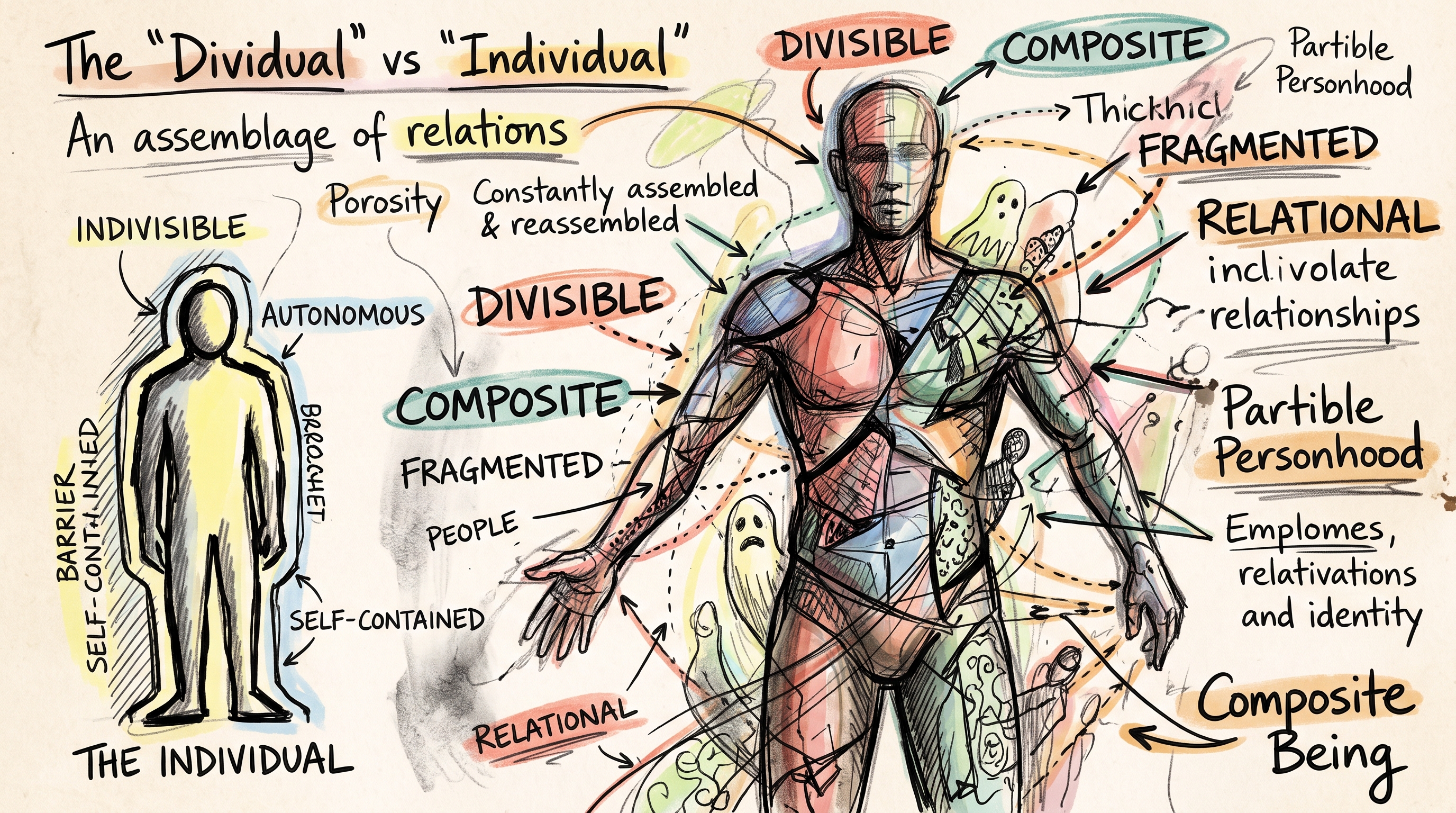
Introduction to the Dividual
The term "dividual" derives from the Latin dividuus, meaning divisible, separable, or distributed. While Western Enlightenment thought—from René Descartes and John Locke to classical liberalism—conceptualizes the human subject as an "individual" (literally from Latin in-dividuus, "not divisible": a bounded, atomic agent endowed with natural rights and interior autonomy), the framework of the dividual posits that human beings are fundamentally composite, relational, and partitioned.[1]
This conceptual paradigm comprises two primary, distinct intellectual genealogies:
- The Anthropological (Relational) Dividual: Pioneers in structural and cultural anthropology demonstrate that many non-Western societies understand personhood not as an insulated monad, but as a dynamic nexus of social relations, transacted substances, and obligations.
- The Sociological / Philosophical (Algorithmic / Control) Dividual: Critical theorists and post-structuralist philosophers demonstrate how contemporary digital capitalism disassembles the human subject into packetized behavioral streams, credit vectors, and algorithmic feedback loops.
Rather than representing a mere theoretical abstraction, the dividual provides a rigorous analytical framework for understanding both traditional kinship practices and cutting-edge digital economies.
Paradigms of Personhood
| Dimension / Attribute | Enlightenment Individual | The Dividual Subject |
|---|---|---|
| Etymology | Latin: In-dividuus ("not divisible") | Latin: Dividuus ("divisible, separable") |
| Ontological Structure | Bounded, sovereign atom | Composite, porous, distributed |
| Essence & Agency | Fixed interior essence | Relational substance exchange |
| Institutional Form | Enclosed in disciplinary molds | Modulated by dynamic networks |
| Systemic Identifier | Signature & identity number | Passwords, samples, & data |
Anthropological Perspectives: The Relational and Partible Self
In cultural anthropology, the concept of the dividual arose to correct the ethnocentric imposition of Western psychological individualism onto societies organized around gift economies, ancestral substances, and relational obligations.
1. Melanesian Dividuality and Partible Personhood (Marilyn Strathern)
The foundational anthropological formulation of the term was developed by Marilyn Strathern in her seminal 1988 ethnography, The Gender of the Gift.[2] Studying indigenous societies in the Papua New Guinea Highlands (notably the Mount Hagen area), Strathern demonstrated that Melanesians do not perceive persons as isolated, bounded individuals who enter into contracts from the outside. Instead, persons are conceived as the plural and composite site of the relationships that produced them.[2:1]
- Partibility: A person's body and identity are divisible. Portions of a person (labor, food, prestige, ceremonial valuables) can be detached and transferred to another person, effectively distributing their personhood across space and time.
- Relational Emergence: An individual does not possess gender or social standing as an innate, static essence. Rather, a person is made manifest as male or female, donor or receiver, through specific acts of ceremonial exchange.
Real-World Example: The Hagen Moka and Massim Kula Ring
In the Mount Hagen moka ceremonial exchange system, a big man does not amass private wealth to consume as an autonomous capitalist accumulator. Instead, pigs, pearl shells, and cassowary plumes are circulated through intricate gift chains. When a leader gives away hundreds of pigs in a moka, he is not merely giving property; he is detaching a part of his relational network—the sweat, maternal land, and allied support that bred the livestock—and lodging it within the body of the recipient clan.
Similarly, in the Massim archipelago's kula ring, ceremonial shell necklaces (soulava) and armbands (mwali) travel endlessly in opposite circular orbits across open ocean voyages. A necklace carries the embedded histories, spirits, and prestige of previous owners. To wear a prominent kula shell is to inhabit a dividual identity constituted by the accumulated biographical traces of every elder who has ever transacted it.
2. South Asian Dividuality and Biomoral Substance (McKim Marriott)
Pioneering the term in ethnology prior to Strathern, anthropologist McKim Marriott examined personhood in rural Hindu society in South Asia.[3] Marriott argued that Western dualisms—such as the division between physical matter and moral mind—do not apply to classical Indian transactional thought. Instead, Hindu personhood is biomoral: physical bodily substances and moral qualities are indivisible and constantly transacted between persons.[3:1]
- Substance-Codes: Physical bodily substances (blood, semen, sweat, breastmilk) and spiritual-moral qualities (karma, purity, auspiciousness) constitute a single unified medium known as "substance-code."
- Porous, Open Systems: A person is an open conduit through which substances flow. One's caste status, spiritual health, and moral integrity are continuously modulated by what one gives, receives, touches, or ingests.
Real-World Example: Gastro-Politics and Dietary Exchange
In traditional village transactions, the food one ingests is not treated as inert fuel, but as a transmissible vehicle of the cook's moral and bodily substance. A strict distinction is maintained between:
- Kachha Food: Food cooked with water (such as rice or dal), which is exceptionally porous and acts as a potent conductor of the cook's spiritual and biological impurities. It is exchanged only between members of the same lineage or caste equals.
- Pukka Food: Food fried in ghee (clarified butter), which is sealed by fat and heat, rendering it less permeable and capable of safely crossing caste lines.
In this context, the human actor is a dividual who must continuously regulate culinary, sexual, and ceremonial transactions to protect their karmic composition. Personhood is an ongoing thermodynamic and moral balancing act, not an unalterable Cartesian soul.
3. Animism and Interspecies Relationality
As explored in Animism, hunter-gatherer and indigenous cosmologies (from the Amazon basin to circumpolar Siberia) extend dividuality beyond human communities to animals, plants, rivers, and spirits.
Real-World Example: Amazonian Hunting Rituals
Among indigenous Amazonian hunters (documented by anthropologists such as Eduardo Viveiros de Castro and Philippe Descola), a hunter does not view game animals as external natural objects to be extracted. Successful hunting requires spiritual negotiation, kinship adoption, or ceremonial transformation. The hunter borrows the perceptive clothing or spirit of the prey, entering into a temporary dividual pact with animal masters. Over-hunting or disrespectful butchering is believed to contaminate the hunter's bodily soul, causing retribution or sickness because human and non-human essences are relationally commingled.
Philosophical & Sociological Perspectives: The Societies of Control
While anthropology approaches the dividual as an organic, relational mode of social belonging, continental philosophy and post-structuralism diagnose the dividual as a modern apparatus of political control, behavioral exploitation, and somatic dismemberment.
The Architectural Mutation of Power
| Feature | Disciplinary Society | Society of Control |
|---|---|---|
| Primary Theorist | Michel Foucault | Gilles Deleuze |
| Spatial Model | Enclosed molds | Open, undulating networks |
| Institutional Archetype | School, Prison, Mill, Hospital | The Corporation, Web, Platform |
| Governing Target | The Individual & Mass | The "Dividual" & Data |
| Operative Medium | Signature & Number | Passwords & Access Codes |
| Systemic Dynamic | Discontinuous molds (periodic starting over) | Continuous modulation (perpetual flux) |
1. The Deleuzian Dividual: From Discipline to Control
In his seminal 1990 text Postscript on the Societies of Control, French philosopher Gilles Deleuze declared that Western societies were undergoing a seismic transition away from Michel Foucault's disciplinary societies.[4]
- Disciplinary Regimes (18th–Mid-20th Century): Governed through enclosures (the family, the school, the barracks, the factory, the hospital, the prison). The subject was molded sequentially into a discrete individual within closed walls. Power operated through a double pairing: the signature (designating the unique individual) and the administrative register/number (designating their place in the collective mass).[4:1]
- Societies of Control (Late 20th Century–Present): Replaced enclosures with open-air, continuous cybernetic networks. Power operates not through solid molds, but through continuous modulation—like a self-deforming sieve whose mesh shifts constantly from moment to moment.[4:2]
In control societies, the polarity of the individual and the mass disappears:
"Individuals have become 'dividuals' and masses, samples, data, markets, or 'banks'." — Gilles Deleuze, Postscript on the Societies of Control[4:3]
The citizen is no longer disciplined into a cohesive biological worker; they are liquidated into a packet of floating attributes, behavioral telemetry, risk probabilities, and access codes.
2. Machinic Capitalism and the Molecular Subject (Gerald Raunig)
Expanding Deleuze's formulation, philosopher Gerald Raunig published Dividuum: Machinic Capitalism and Molecular Revolution (2016).[1:1] Raunig argues that contemporary digital capitalism does not extract labor from cohesive human bodies. Instead, it operates at the molecular and algorithmic scale.
Machinic algorithms plug directly into our pre-individual cognitive reflexes, micro-attentions, and somatic impulses. The worker is no longer an enclosed wage-laborer selling eight hours of manual effort, but a distributed cognitive terminal participating in human-machine assemblages.
Real-World Manifestations in the Digital Age
The philosophical diagnosis of the dividual has evolved from speculative theory into the foundational architecture of the modern global economy. Contemporary individuals do not interact with institutions as unified subjects; they are fractured into specialized data arrays managed by corporate algorithms and state apparatuses.
The Digital Dividual in Action
| Domain | Focus / Mechanism | Manifestations & Data Points |
|---|---|---|
| Surveillance Capitalism | Behavioral surplus extraction & predictive bidding | • Click-data & scroll speed • Gaze-time tracking • Real-time ad-auctions (RTB) • Behavioral surplus |
| Financial & Predictive Systems | Algorithmic risk profiling & dynamic scoring | • Alternative FICO score generation • FinTech micro-loans • Dynamic insurance risk • Behavioral proxy evaluation |
| Gig & App Labor | Automated workforce management & algorithmic control | • Real-time dispatch queues • Warehouse pick-rates (TOT) • Algorithmic penalties • Automated deactivations |
| Biometrics & Border Regimes | Cybernetic identity verification & pattern recognition | • Iris & retina scans • Predictive gait tracking • Facial coordinate vectors • DNA hashes & e-passports |
1. Surveillance Capitalism and Real-Time Ad Bidding (RTB)
As documented in Shoshana Zuboff-The Age of Surveillance Capitalism, digital monopolies (such as Alphabet and Meta) do not track or monetize human persons; they extract behavioral surplus.[5] When a user navigates the web, they are dismembered into a cloud of telemetry:
- Millisecond scroll velocity and pause durations.
- Front-facing camera gaze vectors.
- Device battery percentage, IP geolocations, and typing rhythms.
Real-World Example: Real-Time Bidding (RTB) Auctions
In programmatic advertising auctions (Real-Time Bidding across DSPs and SSPs), digital ad exchanges conduct billions of automated micro-auctions every millisecond. The entity being bought and sold is not "John Smith." The asset is an anonymized dividual token:
[Male, 28-34, High Debt-Stress Index, 2:15 AM Session, Low Battery (4%), High Vulnerability to Impulse Buys].
The ad server modulates the user's feed with a targeted high-interest credit card promotion before John's conscious deliberative mind has registered his own fatigue. The dividual precedes and supersedes the conscious individual.
2. The Financialization of Subjectivity & Predictive Risk Scoring
In financial capitalism, a person's lived moral character, communal reputation, or verbal word is replaced by mathematical dividuation.
Real-World Example: FinTech Micro-Lending in Emerging Markets
In markets such as Kenya, Nigeria, and India, digital micro-lending apps (such as Tala and Branch) bypass traditional collateral requirements. When a borrower downloads the app, the software demands access to smartphone permissions:
- Frequency of outgoing calls vs. incoming calls.
- Punctuality of battery charging habits.
- The consistency of daily geographic GPS coordinates.
- Contact list hygiene and text-message parsing.
Machine-learning credit models process these fragmented behavioral traces to generate an instantaneous, floating credit line. If a user consistently lets their phone battery drain to 0% or makes erratic late-night phone calls, the algorithm interprets this dividuated behavioral data as a marker of financial irresponsibility and raises interest rates or denies capital. The physical person is judged solely through the proxy of their algorithmic shadow.
3. Platform Labor, the Gig Economy, and Algorithmic Modulation
In traditional industrial capitalism, as analyzed in Karl Marx - Economic and Philosophic Manuscripts of 1844, the worker's labor was alienated within the physical enclosure of the factory under the gaze of a human foreman. In the platform economy, the worker is governed through open-air dividual modulation.
Real-World Example: Uber Drivers and Amazon Fulfillment Centers
- Ride-Hail Dispatch: An Uber or Lyft driver does not have a manager or a fixed work schedule. Instead, they are continuously modulated through an algorithmic interface: surge pricing heatmaps, acceptance rate percentages, cancellation penalties, and customer star ratings. If a driver exhibits suboptimal acceleration curves or pauses too long between trips, the algorithm deprioritizes their dispatch queue or initiates an automated algorithmic deactivation. The worker is treated as a modular vector of rolling velocity and labor-time.
- Amazon Warehouse "Rate" Systems: Amazon warehouse pickers carry hand-held barcode scanners that calculate the exact seconds allotted to retrieve an item from a bin. The scanner tracks "Time Off Task" (TOT) down to the second. The worker's body is fractured into isolated ergonomic coordinates: hand-reach speed, walking stride, and scanning intervals.
4. Biometric Surveillance, Border Regimes, and Smart Cities
Modern state borders and policing infrastructures no longer rely primarily on paper passports or sovereign inquisitions. They deploy cybernetic access control based on Deleuzian passwords and biometric verification.
Real-World Example: Automated Border E-Gates and Urban Facial Recognition
- Airport E-Gates: At international airport checkpoints (such as the UK ePassport gates or US Global Entry/CLEAR), travelers do not present their biographical narrative to an immigration officer. The e-gate scans their passport chip, maps facial nodal coordinates (distance between pupils, bridge of nose, curvature of cheekbones), and calculates a mathematical match vector. The traveler passes or fails based on biometric dividuation.
- Predictive Policing & Gait Analysis: In contemporary surveillance cities (such as London, New York, or Chinese municipal networks), high-definition CCTV feeds equipped with gait analysis and infrared thermography assess crowds. Pedestrians are identified not by legal name, but by biometric heat signatures, stride rhythm, and trajectory vectors flagged for behavioral anomalies.
5. The Quantified Self and Dynamic Insurance Underwriting
The commercialization of personal biometric wearables (Apple Watch, Oura Ring, Whoop, continuous glucose monitors) encourages citizens to voluntarily participate in their own dividuation.
Real-World Example: Telematics and Health-Linked Insurance Policies
Automobile insurance companies (such as Progressive's Snapshot or Root Insurance) provide drivers with OBD-II ports or mobile apps that record real-world driving habits: hard braking instances, rapid cornering, highway speed bursts, and late-night driving. Drivers are granted monthly discounts or hit with immediate premium surcharges based on these telemetric samples.
Similarly, health insurance providers (such as John Hancock's Vitality program) subsidize smartwatches in exchange for real-time biological streams: daily step counts, resting heart rates, and sleep stage distributions. Health is no longer an indivisible state of biological flourishing, but an actuarial balance sheet modulated through real-time physiological telemetry.
6. Affective Modulation and The Attention Economy
As demonstrated in Simmel and the Attention Economy — Abstraction, Alienation, and Cognitive Capture and The Attention Economy, digital platforms do not compete for intellectual consensus; they compete for neural dwell-time.
Real-World Example: The TikTok Recommendation Algorithm
ByteDance's recommendation system for TikTok operates on an unprecedented level of affective micro-targeting. Unlike legacy social networks that relied on explicit social graphs (who you "friend" or follow), TikTok's engine observes sub-conscious behavior:
- Millisecond pauses as a video loops.
- Re-watches of a specific 2-second clip segment.
- Speed of swipe-away.
- Audio volume adjustments.
The algorithm does not ask what the "individual" consciously likes or values. It maps the dividual's subliminal, somatic arousal patterns, immediately generating an individualized stream that bypasses deliberative executive function, locking the user into compulsive loops of instant gratification.
Comparative Matrix: The Individual vs. The Dividual
The following table summarizes the structural distinctions between the classical Enlightenment individual and the relational/algorithmic dividual:
| Analytic Dimension | The Enlightenment Individual | The Anthropological Dividual | The Post-Structural / Control Dividual |
|---|---|---|---|
| Etymology | Latin in-dividuus ("not divisible") | Latin dividuus ("separable, divisible") | Latin dividuus ("fragmented, sampled") |
| Ontological Status | Autonomous, bounded, sovereign atom | Porous, composite, relational knot | Dissolved, datafied behavioral stream |
| Locus of Agency | Internal will, reason, moral conscience | Kinship networks, ceremonial gift debts | Algorithmic vectors, automated feedback loops |
| Spatial Architecture | Enclosed spaces (home, school, factory) | Communal territory, exchange circuits | Open networks, digital platforms, clouds |
| Operational Mechanism | Fixed molds, institutional discipline | Substance exchange, biomoral transfer | Continuous modulation, dynamic scoring |
| Identifier | Signature, birth certificate, civil name | Gift history, maternal lineage, kinship ties | Passwords, tokens, biometric hashes, cookies |
| Economic Expression | Wage labor, private property, contracts | Gift economies (kula, moka), dowry | Surveillance capitalism, platform gig labor |
| Primary Risk | Disciplinary oppression, incarceration | Severance from kin, spiritual pollution | Behavioral modulation, algorithmic precarity |
| Key Theorists | John Locke, René Descartes, Immanuel Kant | Marilyn Strathern, McKim Marriott | Gilles Deleuze, Shoshana Zuboff, Gerald Raunig |
Resonant Notes
The following notes in the vault share direct thematic, sociological, and philosophical connections with the concept of the Dividual:
🔴 Post-Structuralism, Control Societies & Algorithmic Surveillance
- Postscript on the Societies of Control — Gilles Deleuze's foundational 1990 essay detailing the historical collapse of disciplinary enclosures and the birth of continuous cybernetic modulation, providing the primary philosophical origin of the "dividual" and network-based power.
- Michel Foucault — Establishes the genealogy of disciplinary power, panoptic enclosures, and biopolitical normalization, providing the historical baseline against which the society of control and the dividual mutate.
- Shoshana Zuboff-The Age of Surveillance Capitalism — Demonstrates how commercial digital monopolies harvest behavioral surplus to manufacture predictive behavioral products, converting human lived experience into algorithmic dividual data points.
- Simmel and the Attention Economy — Abstraction, Alienation, and Cognitive Capture — Links the quantitative abstractions of monetary exchange to digital platform architecture, analyzing how continuous algorithmic modulation extracts human cognitive attention.
- The Attention Economy — Outlines the corporate infrastructure of monetization, push notifications, and cognitive capture that segments the human sensorium into billable engagement intervals.
- Capitalism and Schizophrenia — Deleuze and Guattari's broader magnum opus (Anti-Oedipus and A Thousand Plateaus), articulating the concepts of the body without organs, desiring-machines, and the deterritorialization of the bourgeois subject.
- Control — Investigates the broader philosophical and systems-theoretic mechanics of cybernetic governance, steering, and systemic feedback mechanisms.
- Don DeLillo Major Themes Analysis — DeLillo's literary examination of consumer white noise, media-saturated hyperreality, and the liquidation of sovereign human identity inside technocratic corporate environments.
🟡 Cognitive Science, Philosophy of Mind & The Non-Unitary Self
- The Dividual and the Triṃśikā — Bridges continental theory with Indian phenomenology, demonstrating how the Deleuzian surveillance dividual functions as a technological externalization of Yogācāra Buddhism's saṃsāric cognitive fragmentation (ālaya-vijñāna, vāsanā, and kliṣṭa-manas).
- Vasubandhu's-Triṃśikā-vijñaptimātratā — Vasubandhu's 4th-century treatise deconstructing the permanent soul (ātman) into an eightfold stream of interdependent consciousnesses, demonstrating that the human subject has always been structurally dividual.
- David Hume's Bundle Theory (1739) — Hume's classic empiricist deconstruction of personal identity, arguing that introspection reveals no permanent "self," but only a fleeting bundle of ever-shifting perceptions and sensations.
- Derek Parfit's Reductionism (1984) — Parfit's psychological reductionism in Reasons and Persons, proving that personal identity over time is a matter of degree and physical/psychological connectedness, not an indivisible, Cartesian ego.
- Gilbert Ryle's-The Concept of Mind & Ghost in the Machine — Ryle's critique of the Cartesian dogma of the sovereign, interior mind, exposing the category mistake that imagines an autonomous ghost directing biological machinery.
- Deconstruction of the Central Controller — Cognitive science and neurocomputational critiques proving that the conscious brain lacks a centralized executive hub or "homunculus," operating instead as a decentralized coalition of modular heuristics.
- Jacques Lacan — Lacanian psychoanalysis examining how the ego is an alienated, imaginary construct manufactured through the Mirror Stage, mirroring the curated avatars and fragmented profiles of the digital dividual.
- Milinda Pañha & The Ship of Theseus and the Chariot of King Milinda — Classical dialogues demonstrating the non-inherent, composite nature of personhood through the chariot metaphor, showing that identity is a convenient designator for a shifting assembly of constituent parts.
🟢 Anthropological Relationality, Media Ecology & Alienation
- Animism — Explores non-Western ontological frameworks where agency and personhood are extended relationally to non-human beings, directly utilizing the anthropological dividual (Strathern, Marriott) as an epistemic counter-model to Western individualism.
- The Philosophy of Money (Philosophie des Geldes) & Georg Simmel (1858-1918) — Simmel's analysis of how monetary economies dissolve relational and qualitative human bonds into purely abstract, quantitative, and calculable equivalences, anticipating the datafication of the self.
- Karl Marx - Economic and Philosophic Manuscripts of 1844 — Marx's early formulation of estranged labor (Entfremdung), analyzing how capitalist production detaches the worker's somatic species-being (Gattungswesen) from their product, body, and community.
- Marshall McLuhan (1911-1980) & McLuhan's The Medium is the Message — Medium theory demonstrating that electronic media externalize the human nervous system into an interconnected global network, altering perceptual ratios and dissolving the private, bounded print-era individual.
- Defining a Simulacrum — Jean Baudrillard's hyperreal theory where signs, simulations, and algorithmic models entirely precede and generate the real, reflecting how digital profiles supersede lived human subjectivity.
- Pulse (Kairo) — Existential Dread and Digital Alienation — Kiyoshi Kurosawa's cinematic critique of how digital connectivity atomizes and dissolves human consciousness into spectral digital static, providing an artistic manifestation of late-modern dividuation.
Backlinks
- Postscript on the Societies of Control — The primary post-structuralist source for the Deleuzian genealogy of the dividual. Deleuze introduces the concept to define the transition from disciplinary enclosures to open cybernetic modulation, providing the socio-technological framework expanded in this note.
- The Dividual and the Triṃśikā — Directly synthesizes the Deleuzian dividual analyzed here with Vasubandhu's Yogācāra Buddhist psychology, demonstrating how surveillance capitalism algorithmically exploits the latent, saṃsāric fragmentation of the human mind.
- Animism — Employs the anthropological dividual (Strathern, Marriott) to explain how indigenous animist worldviews construct identity through reciprocal exchange with ecological systems, establishing an ontological alternative to Euro-American individualism.
- Shoshana Zuboff-The Age of Surveillance Capitalism — Provides the empirical and economic machinery behind the digital dividual, detailing how private tech cartels extract behavioral surplus to feed predictive algorithmic markets.
- Simmel and the Attention Economy — Abstraction, Alienation, and Cognitive Capture — Synthesizes Simmel's monetary abstraction with Deleuzian modulation, illustrating how attention-merchants slice the human sensorium into commodified behavioral samples.
- Deconstruction of the Central Controller — Supplies the neuroscientific and philosophical counterpart to the dividual, demonstrating that the sovereign Cartesian individual is an illusion deconstructed both by contemporary cognitive science and post-structuralist sociology.
References
Gerald Raunig / Dividuum: Machinic Capitalism and Molecular Revolution / Semiotext(e) / MIT Press, 2016. ↩︎ ↩︎
Marilyn Strathern / The Gender of the Gift: Problems with Women and Problems with Society in Melanesia / University of California Press, 1988. ↩︎ ↩︎
McKim Marriott / Hindu Transactions: Diversity Without Dualism / in Transaction and Meaning: Directions in the Anthropology of Exchange and Symbolic Behavior, ed. Bruce Kapferer / Institute for the Study of Human Issues, 1976, pp. 109–142. ↩︎ ↩︎
Gilles Deleuze / Postscript on the Societies of Control / October, Vol. 59, Winter 1992, pp. 3–7. ↩︎ ↩︎ ↩︎ ↩︎
Shoshana Zuboff / The Age of Surveillance Capitalism: The Fight for a Human Future at the New Frontier of Power / PublicAffairs, 2019. ↩︎